Department of Safety Engineering, Seoul National University of Science and Technology, 232 Gongneung-ro, Nowon-gu, Seoul 01811, Korea.
Int J Environ Res Public Health. 2021 May 23;18(11):5573. doi: 10.3390/ijerph18115573.
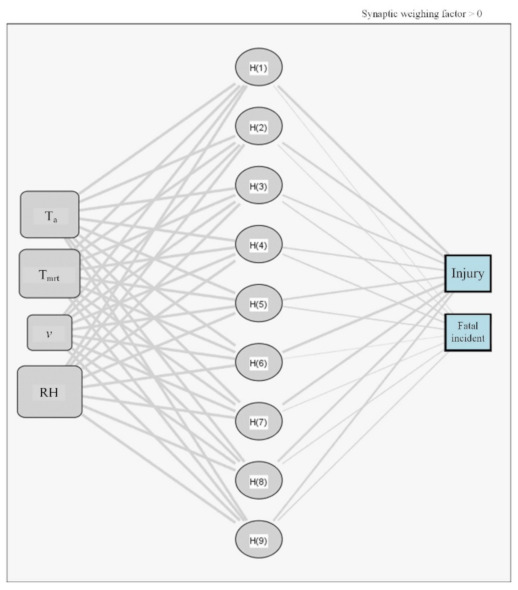
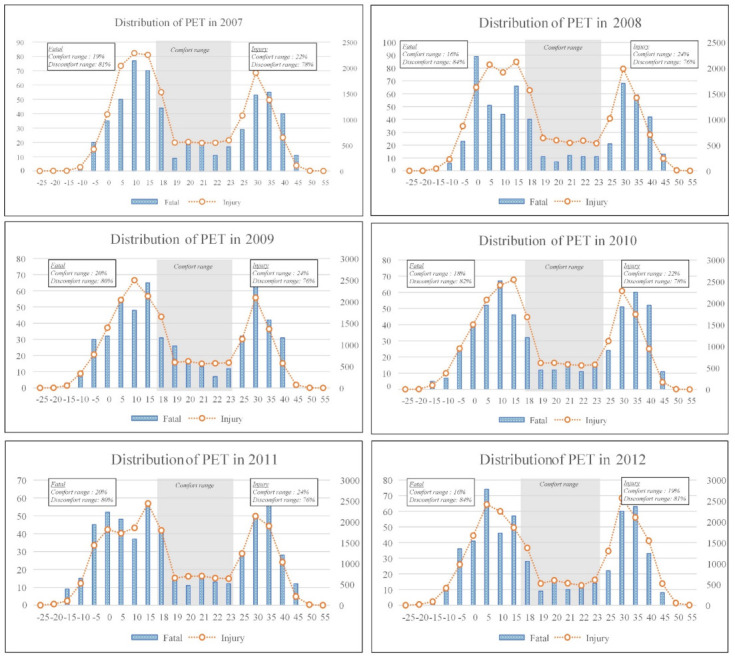
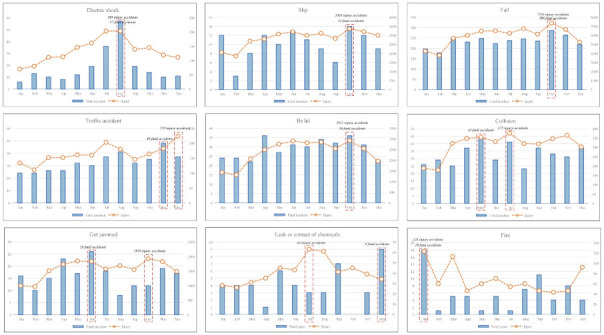
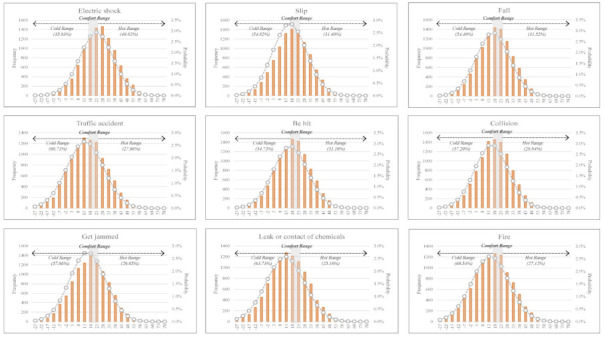
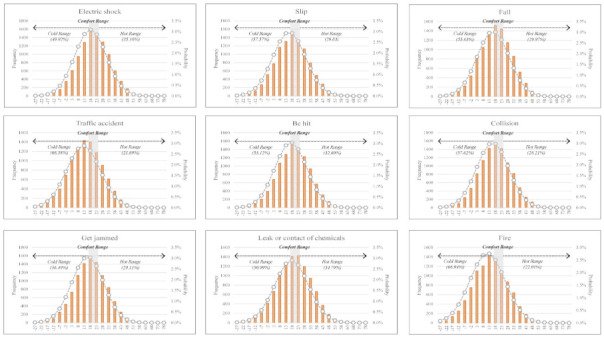
Fatal injury and accidents in the construction industry occur under the influence of outdoor weather conditions such as temperature, humidity and wind speed in all four seasons. Previous research in this area has focused on hot and cold weather conditions: hot weather causes heat rash, heat cramps and heat fainting, while cold weather causes fatigue, lumbago, and cold finger sensations. However, other weather conditions are also associated with, and cause, fatal injury and accidents. Accordingly, this study analyzes injury and fatal accidents in the construction industry based on the physiological equivalent temperature (PET) as it pertains to thermal comfort using an uncertainty analysis. Furthermore, using a neural network, relative importance is analyzed considering injury and fatal accidents. This study is conducted in five steps: (i) Establishment of the database, (ii) Classification of accident types and weather conditions, (iii) Calculation of thermal comfort, (iv) Analysis of injury and fatal accidents based on thermal comfort, and (v) Calculation of the relative importance of thermal comfort during injury and fatal accidents. Via the research process, 5317 fatal incidents and 207,802 injuries are analyzed according to 18 accident types in all seasons. It was found that 'falls', were the most frequent fatal incident and injury (2804 fatal incidents and 71,017 injuries), with most of these occurring during the autumn season. The probabilities of injury and fatal accidents in the 'fall' category are 86.01% and 85.60%, respectively, in the outside comfort ranges. The contribution of this study can provide data for a database on safety management considering weather conditions.
在建筑行业中,致命伤害和事故的发生受到户外天气条件的影响,包括四季的温度、湿度和风速。该领域之前的研究主要集中在炎热和寒冷天气条件上:炎热天气会导致热疹、热痉挛和热晕厥,而寒冷天气会导致疲劳、腰痛和手指发冷。然而,其他天气条件也与致命伤害和事故有关,并导致这些事故的发生。因此,本研究基于生理等效温度(PET),通过不确定性分析,针对热舒适度,对建筑行业中的伤害和致命事故进行了分析。此外,还使用神经网络分析了考虑伤害和致命事故时的相对重要性。本研究分五步进行:(i)数据库的建立;(ii)事故类型和天气条件的分类;(iii)热舒适度的计算;(iv)基于热舒适度对伤害和致命事故的分析;(v)计算伤害和致命事故中热舒适度的相对重要性。通过研究过程,根据所有季节的 18 种事故类型,分析了 5317 起致命事件和 207802 起伤害事件。结果表明,“坠落”是最常见的致命和伤害事件(2804 起致命事件和 71017 起伤害事件),其中大部分发生在秋季。“坠落”类别的伤害和致命事故的概率分别为 86.01%和 85.60%,在外部舒适范围内。本研究的贡献可以为考虑天气条件的安全管理数据库提供数据。