Thomas Claire E, Luu Hung N, Wang Renwei, Xie Guoxiang, Adams-Haduch Jennifer, Jin Aizhen, Koh Woon-Puay, Jia Wei, Behari Jaideep, Yuan Jian-Min
Department of Epidemiology, Graduate School of Public Health, University of Pittsburgh, Pittsburgh, PA 15261, USA.
UPMC Hillman Cancer Center, University of Pittsburgh, Pittsburgh, PA 15232, USA.
Cancers (Basel). 2021 May 28;13(11):2648. doi: 10.3390/cancers13112648.
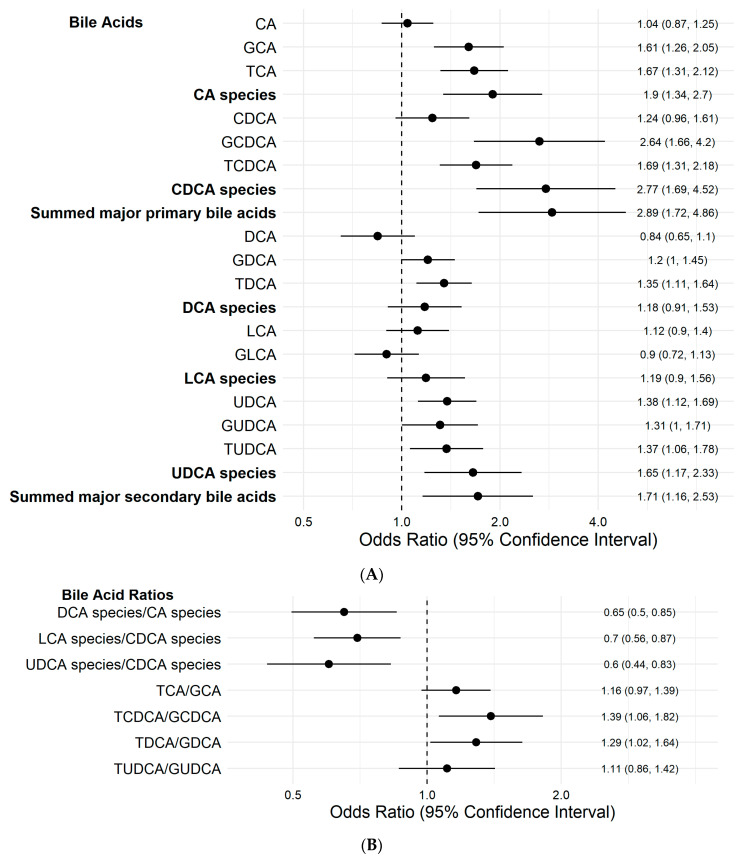
Hepatocellular carcinoma (HCC) is a commonly diagnosed malignancy with poor prognosis. Rising incidence of HCC may be due to rising prevalence of metabolic dysfunction-associated fatty liver disease, where altered bile acid metabolism may be implicated in HCC development. Thirty-five bile acids were quantified using ultra-performance liquid chromatography triple-quadrupole mass spectrometry assays in pre-diagnostic serum of 100 HCC cases and 100 matched controls from the Singapore Chinese Health Study. Conditional logistic regression was used to assess associations for bile acid levels with risk of HCC. Conjugated primary bile acids were significantly elevated whereas the ratios of secondary bile acids over primary bile acids were significantly lower in HCC cases than controls. The respective odds ratios and 95% confidence intervals of HCC were 6.09 (1.75-21.21) for highest vs. lowest tertile of cholic acid species and 30.11 (5.88-154.31) for chenodeoxycholic acid species. Doubling ratio of taurine-over glycine-conjugated chenodeoxycholic acid was associated significantly with 40% increased risk of HCC whereas doubling ratio of secondary over primary bile acid species was associated with 30-40% reduced risk of HCC. In conclusion, elevated primary bile acids and taurine over glycine-conjugated ratios were strongly associated with HCC risk whereas the ratios of secondary bile acids over primary bile acids were inversely associated with HCC risk.
肝细胞癌(HCC)是一种常见的诊断出的恶性肿瘤,预后较差。HCC发病率上升可能归因于代谢功能障碍相关脂肪性肝病患病率的上升,其中胆汁酸代谢改变可能与HCC的发生有关。在新加坡华人健康研究中,对100例HCC病例和100例匹配对照的诊断前血清,使用超高效液相色谱三重四极杆质谱分析法对35种胆汁酸进行了定量。采用条件逻辑回归分析胆汁酸水平与HCC风险的关联。与对照相比,HCC病例中结合型初级胆汁酸显著升高,而次级胆汁酸与初级胆汁酸的比值显著降低。胆酸种类最高三分位数与最低三分位数相比,HCC的相应比值比和95%置信区间为6.09(1.75 - 21.21),鹅去氧胆酸种类为30.11(5.88 - 154.31)。牛磺酸结合型与甘氨酸结合型鹅去氧胆酸的翻倍比值与HCC风险显著增加40%相关,而次级胆汁酸与初级胆汁酸种类的翻倍比值与HCC风险降低30 - 40%相关。总之,初级胆汁酸升高以及牛磺酸与甘氨酸结合的比值与HCC风险密切相关,而次级胆汁酸与初级胆汁酸的比值与HCC风险呈负相关。