Belleudi Valeria, Rosa Alessandro C, Poggi Francesca R, Armuzzi Alessandro, Nicastri Emanuele, Goletti Delia, Diamanti Andrea Picchianti, Davoli Marina, Agabiti Nera, Addis Antonio
Department of Epidemiology, Lazio Regional Health Service, 00147 Rome, Italy.
IBD Unit, Fondazione Policlinico Universitario A. Gemelli IRCCS, Università Cattolica, 00168 Roma, Italy.
J Clin Med. 2021 May 28;10(11):2388. doi: 10.3390/jcm10112388.
Since the beginning of the Coronavirus Disease-19 (COVID-19) pandemic, Severe Acute Respiratory Syndrome-CoV-2 (SARS-CoV-2) infection has been a serious challenge for immune-compromised patients with immune-mediated inflammatory diseases (IMIDs).
Our aim was to investigate the impact of COVID-19 in terms of risks of infection, hospitalization and mortality in a cohort of patients with rheumatoid arthritis (RA), psoriasis (PSO) or inflammatory bowel disease (IBD). Furthermore, we studied the impact of SARS-CoV-2 infection on the prescribed drug regimen in these patients.
Through the record linkage between health information systems, a cohort of patients, ≥18 years old, assisted in the Lazio region and who had suffered from immune-mediated inflammatory diseases (RA, PSO, IBD) between 2007 and 2019, was identified. The risk of infection, hospitalization or mortality for COVID-19, was assessed by logistic regression models, and reported in an Odds Ratio (ORs; CI 95%), adjusting for sex, age and the Charlson Comorbidity Index. We also estimated these risks separately by IMID and in the subgroup of prevalent biologic drug users. We investigated deferral of biological treatments in the study population by comparing the prevalence of weekly use of biologicals (2019-2020) before and during the pandemic periods.
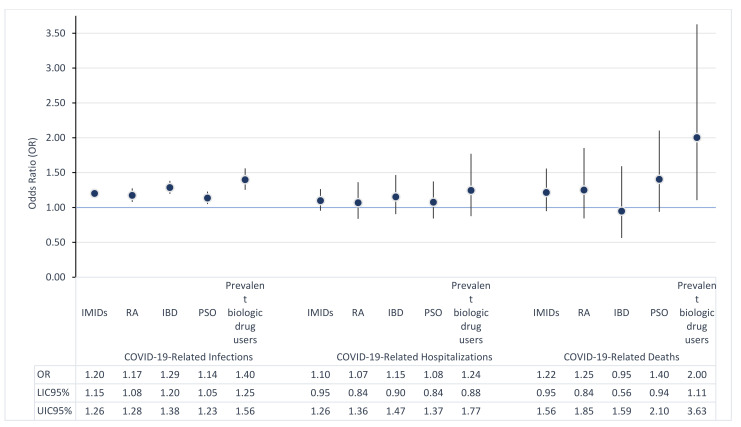
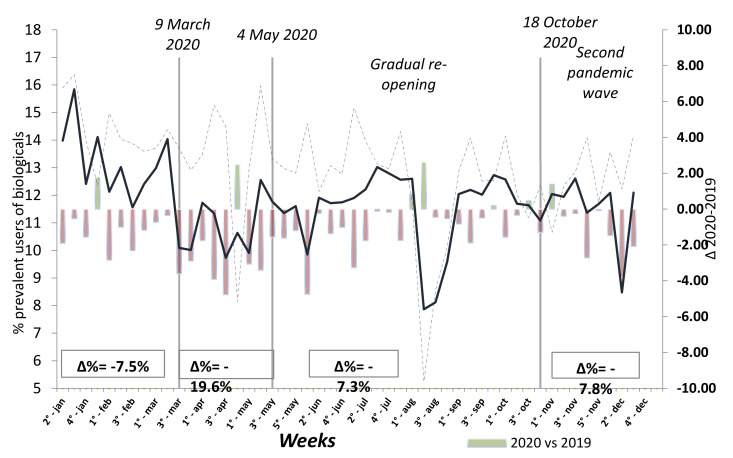
Within the 65,230 patients with IMIDs, the cumulative incidence for COVID-19 was 303/10,000 ab. In this cohort of patients, we observed a significantly higher risk of SARS-CoV-2 infection than the general population: OR = 1.17 (95% CI 1.12-1.22). The risk was higher even considering separately each disease and in the subgroup of prevalent biologic drug users. This last subgroup of patients showed a higher risk of death related to COVID-19 (OR 1.89; 95% CI 1.04-3.33) than the general population. However, no differences in terms of risks of hospitalization or death related to COVID-19 were recorded in patients with the IMIDs. Comparing the 2019-2020 prevalence of weekly biological drug treatments in prevalent biologic drug users, we found a decrease (-19.6%) during the lockdown, probably due to pandemic restrictions.
Patients with IMIDs seem to have a higher risk of SARS-CoV2 infection. However, other than for patients with prevalent biologic drug treatment, no significant differences in terms of hospitalization and mortality were reported compared to the general populations; further investigation is warranted on account of unmeasured confounding. In addition, during the lockdown period, the COVID-19 emergency highlighted a lower use of biologic drugs; this phenomenon requires strict pharmacological monitoring as it could be a proxy of forthcoming long-term clinical progression.
自冠状病毒病2019(COVID-19)大流行开始以来,严重急性呼吸综合征冠状病毒2(SARS-CoV-2)感染一直是免疫介导的炎症性疾病(IMID)免疫功能低下患者面临的严峻挑战。
我们的目的是调查COVID-19对类风湿性关节炎(RA)、银屑病(PSO)或炎症性肠病(IBD)患者队列在感染风险、住院风险和死亡风险方面的影响。此外,我们研究了SARS-CoV-2感染对这些患者规定药物治疗方案的影响。
通过健康信息系统之间的记录链接,确定了一组年龄≥18岁、在拉齐奥地区接受治疗且在2007年至2019年期间患有免疫介导的炎症性疾病(RA、PSO、IBD)的患者。通过逻辑回归模型评估COVID-19的感染、住院或死亡风险,并以比值比(OR;95%置信区间)报告,对性别年龄和查尔森合并症指数进行调整。我们还分别按IMID以及在生物制剂使用者亚组中估计这些风险。通过比较大流行期间和之前(2019 - 2020年)生物制剂每周使用的患病率,我们调查了研究人群中生物治疗的延迟情况。
在65230例IMID患者中,COVID-19的累积发病率为303/10000人年。在这组患者中,我们观察到SARS-CoV-2感染风险显著高于一般人群:OR = 1.17(95%置信区间1.12 - 1.22)。即使分别考虑每种疾病以及在生物制剂使用者亚组中,该风险也更高。这最后一组患者显示与COVID-19相关的死亡风险(OR 1.89;95%置信区间1.04 - 3.33)高于一般人群。然而,在患有IMID的患者中,未记录到与COVID-19相关的住院或死亡风险方面的差异。比较生物制剂使用者中2019 - 2020年每周生物药物治疗的患病率,我们发现在封锁期间有所下降(-19.6%),这可能是由于大流行限制所致。
IMID患者似乎有更高的SARS-CoV-2感染风险。然而,除了生物制剂使用者外,与一般人群相比,在住院和死亡率方面未报告有显著差异;鉴于存在未测量的混杂因素,有必要进一步调查。此外,在封锁期间,COVID-19紧急情况凸显了生物药物使用减少;这一现象需要严格的药物监测,因为它可能预示即将出现的长期临床进展。