School of Microelectronics, Shandong University, Jinan 250100, China.
Sensors (Basel). 2021 May 27;21(11):3721. doi: 10.3390/s21113721.
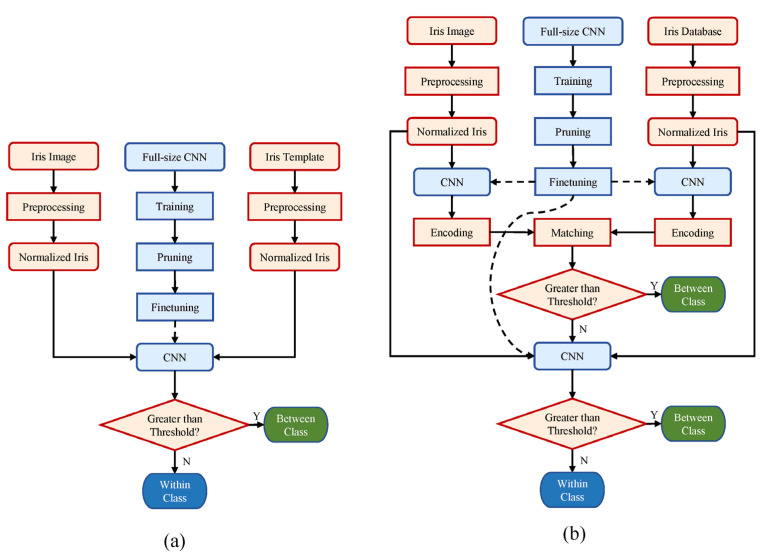
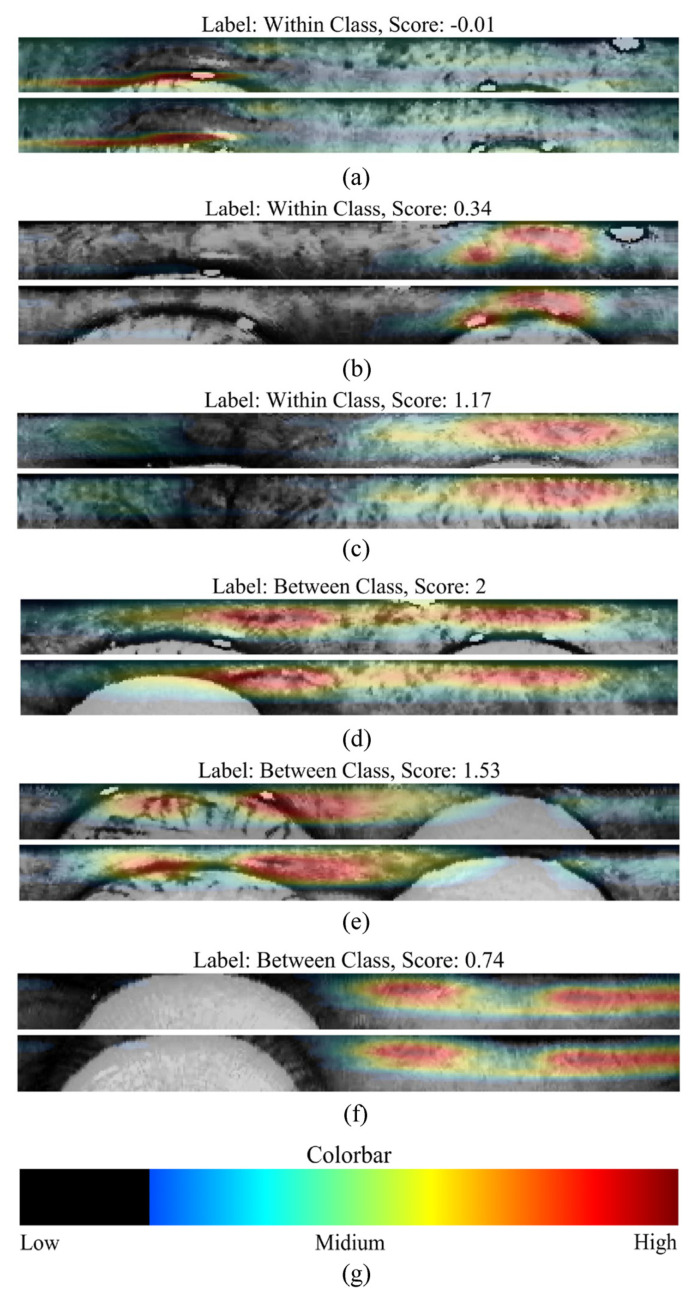
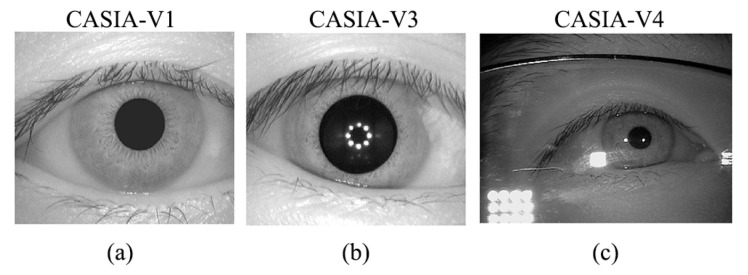
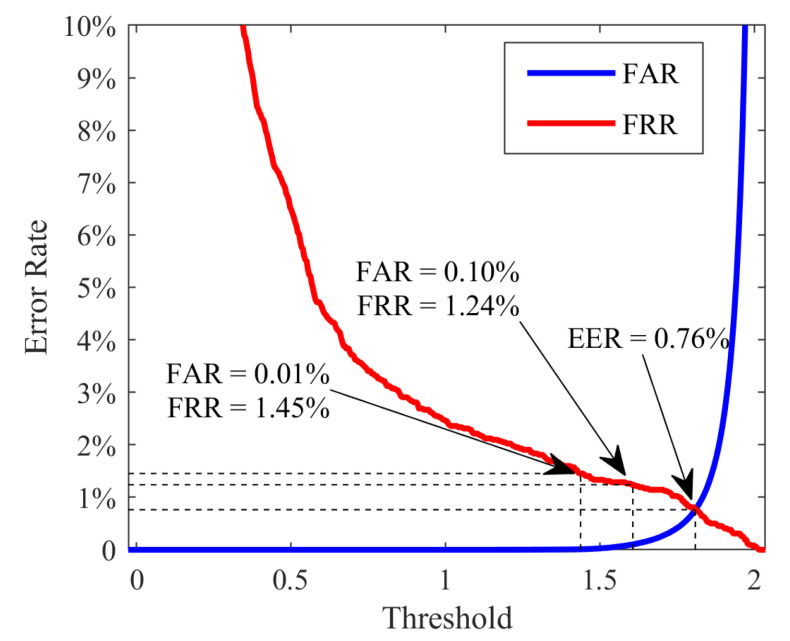
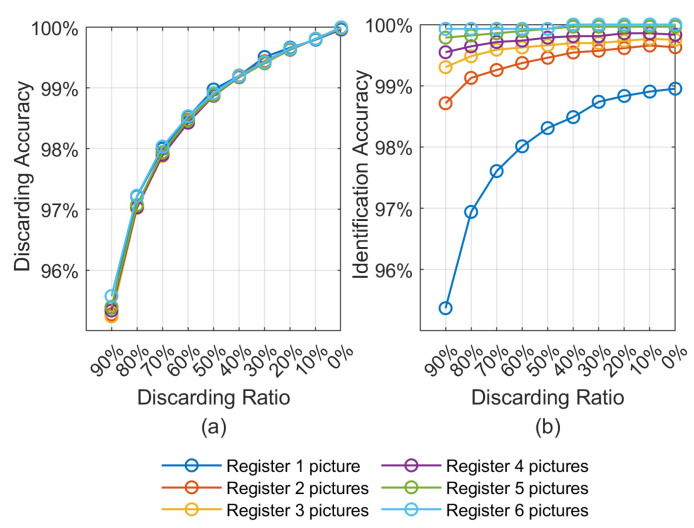
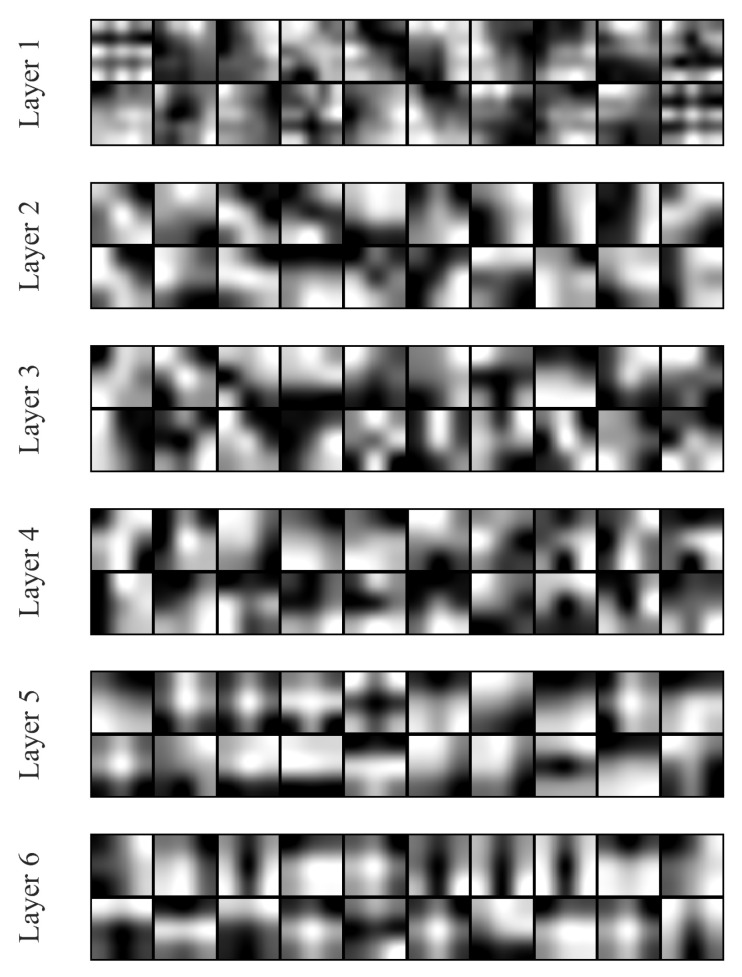
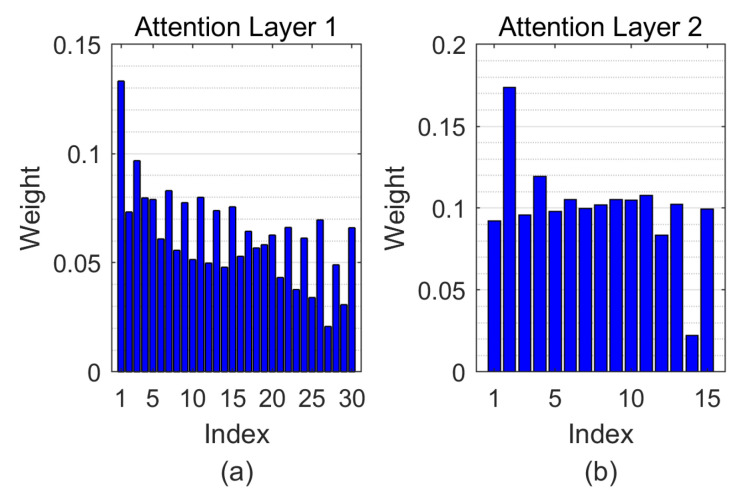
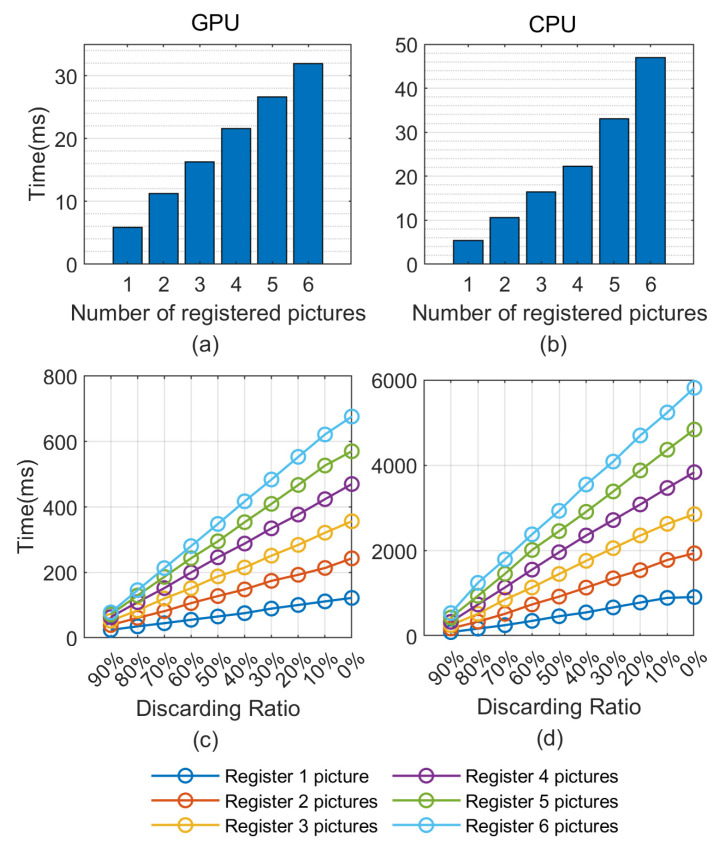
Recently, deep learning approaches, especially convolutional neural networks (CNNs), have attracted extensive attention in iris recognition. Though CNN-based approaches realize automatic feature extraction and achieve outstanding performance, they usually require more training samples and higher computational complexity than the classic methods. This work focuses on training a novel condensed 2-channel (2-ch) CNN with few training samples for efficient and accurate iris identification and verification. A multi-branch CNN with three well-designed online augmentation schemes and radial attention layers is first proposed as a high-performance basic iris classifier. Then, both branch pruning and channel pruning are achieved by analyzing the weight distribution of the model. Finally, fast finetuning is optionally applied, which can significantly improve the performance of the pruned CNN while alleviating the computational burden. In addition, we further investigate the encoding ability of 2-ch CNN and propose an efficient iris recognition scheme suitable for large database application scenarios. Moreover, the gradient-based analysis results indicate that the proposed algorithm is robust to various image contaminations. We comprehensively evaluated our algorithm on three publicly available iris databases for which the results proved satisfactory for real-time iris recognition.
最近,深度学习方法,特别是卷积神经网络(CNN),在虹膜识别中引起了广泛关注。虽然基于 CNN 的方法实现了自动特征提取,并取得了出色的性能,但它们通常比经典方法需要更多的训练样本和更高的计算复杂度。本工作专注于使用少量训练样本训练一种新颖的压缩 2 通道(2-ch)CNN,以实现高效准确的虹膜识别和验证。首先提出了一种具有三个精心设计的在线增强方案和径向注意力层的多分支 CNN,作为高性能的基本虹膜分类器。然后,通过分析模型的权重分布,实现了分支剪枝和通道剪枝。最后,可以选择进行快速微调,这可以在减轻计算负担的同时显著提高剪枝 CNN 的性能。此外,我们进一步研究了 2-ch CNN 的编码能力,并提出了一种适用于大型数据库应用场景的高效虹膜识别方案。此外,基于梯度的分析结果表明,所提出的算法对各种图像污染具有鲁棒性。我们在三个公开的虹膜数据库上全面评估了我们的算法,结果证明其适用于实时虹膜识别。