Translational Research in Gastrointestinal Disorders, Gut Peptide Research Lab, University of Leuven, Gasthuisberg, 3000 Leuven, Belgium.
Nutrients. 2021 May 27;13(6):1839. doi: 10.3390/nu13061839.
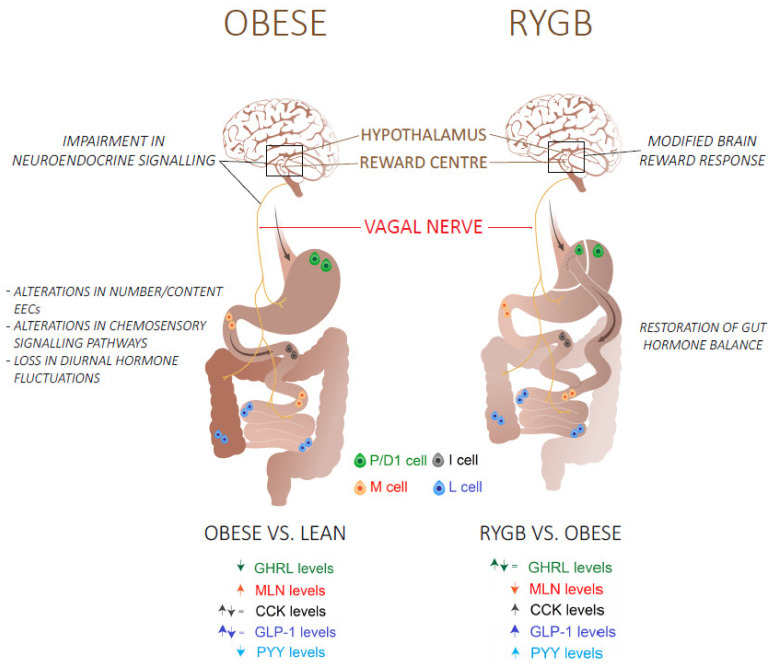
The global burden of obesity and the challenges of prevention prompted researchers to investigate the mechanisms that control food intake. Food ingestion triggers several physiological responses in the digestive system, including the release of gastrointestinal hormones from enteroendocrine cells that are involved in appetite signalling. Disturbed regulation of gut hormone release may affect energy homeostasis and contribute to obesity. In this review, we summarize the changes that occur in the gut hormone balance during the pre- and postprandial state in obesity and the alterations in the diurnal dynamics of their plasma levels. We further discuss how obesity may affect nutrient sensors on enteroendocrine cells that sense the luminal content and provoke alterations in their secretory profile. Gastric bypass surgery elicits one of the most favorable metabolic outcomes in obese patients. We summarize the effect of different strategies to induce weight loss on gut enteroendocrine function. Although the mechanisms underlying obesity are not fully understood, restoring the gut hormone balance in obesity by targeting nutrient sensors or by combination therapy with gut peptide mimetics represents a novel strategy to ameliorate obesity.
肥胖的全球负担和预防的挑战促使研究人员研究控制食物摄入的机制。食物摄入会引发消化系统中的几种生理反应,包括参与食欲信号传递的肠内分泌细胞释放胃肠激素。肠道激素释放的调节紊乱可能会影响能量平衡并导致肥胖。在这篇综述中,我们总结了肥胖症患者在餐前和餐后状态下肠道激素平衡的变化,以及其血浆水平昼夜动态的变化。我们进一步讨论了肥胖症如何影响感应腔内容物并引起其分泌谱改变的肠内分泌细胞上的营养传感器。胃旁路手术在肥胖患者中产生了最有利的代谢结果之一。我们总结了不同减肥策略对肠道内分泌功能的影响。尽管肥胖的机制尚未完全阐明,但通过靶向营养传感器或与肠道肽类似物联合治疗来恢复肥胖症中的肠道激素平衡,代表了改善肥胖症的一种新策略。