Department of Physical Education, Kyung Hee University (Global Campus), 1732 Deokyoungdaero, Giheung-gu, Yongin-si 17014, Gyeonggi-do, Korea.
Department of Physical Education, Seoul National University, 1 Gwanakro, Gwanak-gu, Seoul 08826, Korea.
Int J Environ Res Public Health. 2021 May 29;18(11):5863. doi: 10.3390/ijerph18115863.
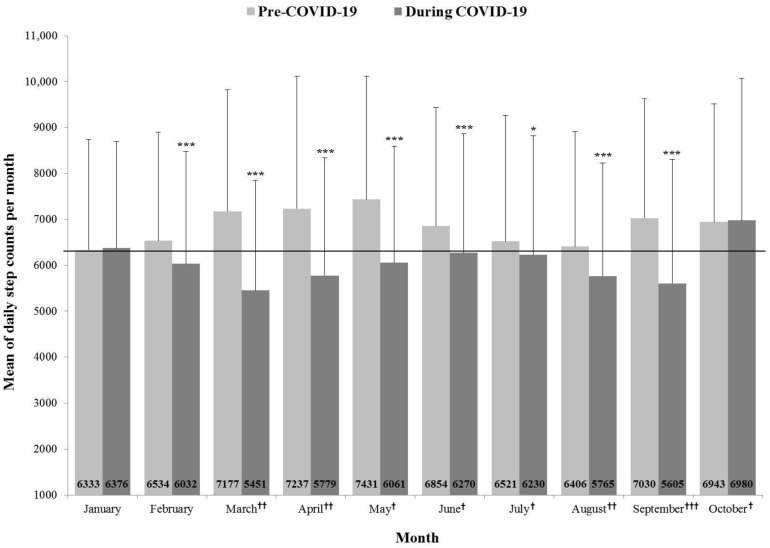
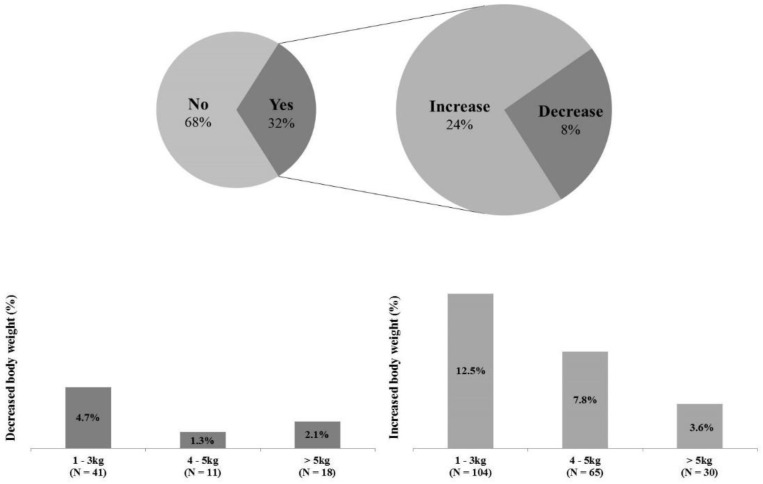
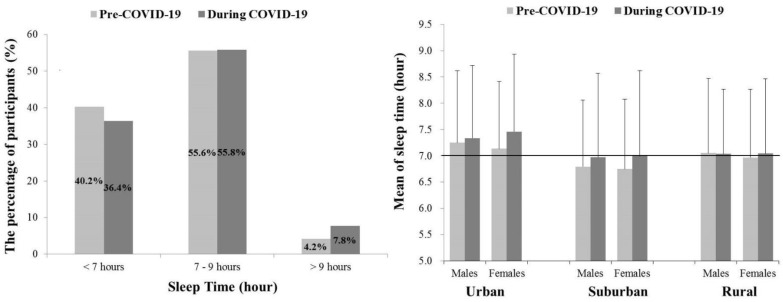
The purpose of the current study is to investigate the changes in physical activity (PA), sleep time (ST), and body weight (BW) Pre- and during COVID-19 in South Korea, and specifically, PA data were obtained during COVID-19 at three-time points based on the multilevel social distancing policies. All data were surveyed by questionnaires online and offline, and participants were required to fill in the monthly average of daily step counts were recorded an application on participants' smartphone devices from Pre-COVID-19 (2019 year) and during COVID-19 (2020 year). Participants were 834 adults (males: 54.4%, female: 45.6%) and all statistical analyses were summarized by SPSS 25.0 program. The monthly average of daily step counts was 6747.09 during Pre-COVID-19, but the PA during COVID-19 was 5812.11 daily step counts per month. Also, there were significant pairwise differences between average PA Pre-COVID-19 and each level of social distancing ( < 0.001). After COVID-19, the participants who slept less than 7 hours decreased by 3.6%, while those who slept more than 9 hours increased by that much. As a result of BW, 269 participants responded their BW changed during COVID-19, and 199 of them reported they gained BW during COVID-19 (74.0%). Although self-reported questionnaires may have led to an under-or over-estimation of ST and BW, the present study found that the environment in which the COVID-19 is prevalent had adverse relationships on PA, ST, and BW. Therefore, it is important to identify strategies to motivate individuals for remaining physically active and getting adequate sleep while maintaining social distancing due to the presence of the COVID-19 global pandemic.
本研究旨在探讨 COVID-19 前后韩国人身体活动(PA)、睡眠时间(ST)和体重(BW)的变化,特别是根据多层次社会隔离政策,在 COVID-19 期间分三个时间点获取 PA 数据。所有数据均通过在线和线下问卷进行调查,参与者需填写 Pre-COVID-19(2019 年)和 COVID-19 期间(2020 年)每日平均步数记录在参与者智能手机设备上的应用程序。参与者为 834 名成年人(男性:54.4%,女性:45.6%),所有统计分析均采用 SPSS 25.0 程序汇总。Pre-COVID-19 期间每日平均步数为 6747.09 步,但 COVID-19 期间的 PA 为每月 5812.11 步。此外,Pre-COVID-19 期间的平均 PA 与每个社会隔离水平之间存在显著的两两差异(<0.001)。COVID-19 后,睡眠时间少于 7 小时的参与者减少了 3.6%,而睡眠时间超过 9 小时的参与者增加了 3.6%。在 BW 方面,有 269 名参与者报告其 BW 在 COVID-19 期间发生变化,其中 199 名参与者报告在 COVID-19 期间体重增加(74.0%)。尽管自我报告的问卷可能导致 ST 和 BW 的低估或高估,但本研究发现,COVID-19 流行的环境对 PA、ST 和 BW 产生了不利影响。因此,由于 COVID-19 大流行的存在,识别保持社交距离的同时激励个人保持身体活跃和获得充足睡眠的策略非常重要。