Tsegaye Bahiru, Jaiswal Swarna, Jaiswal Amit K
Department of Food Process Engineering, College of Engineering and Technology, Wolkite University, Wolkite 07, Ethiopia.
School of Food Science and Environmental Health, College of Sciences and Health, Technological University Dublin-City Campus, Central Quad, Grangegorman, D07 ADY7 Dublin, Ireland.
Foods. 2021 May 24;10(6):1174. doi: 10.3390/foods10061174.
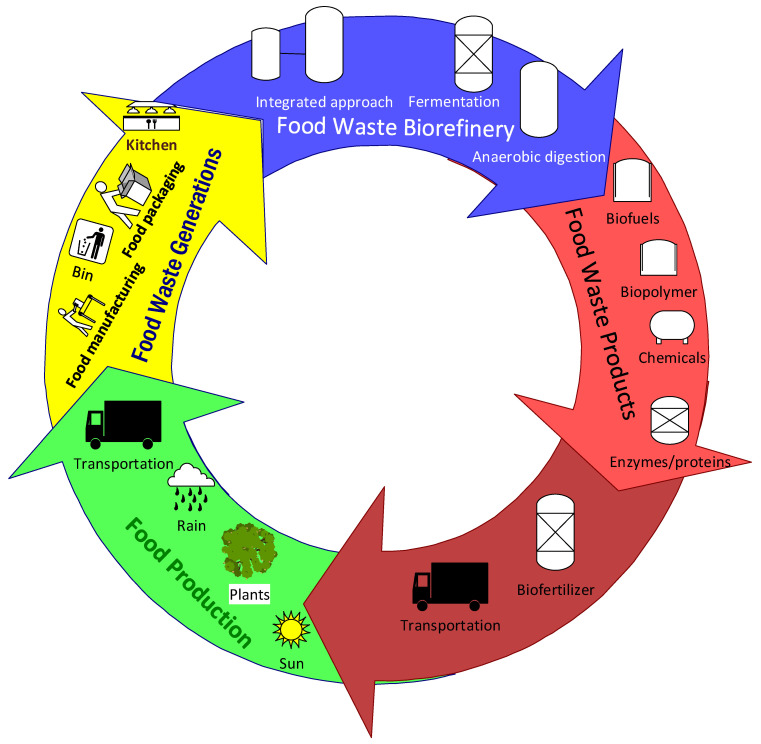
Food waste biorefineries for the production of biofuels, platform chemicals and other bio-based materials can significantly reduce a huge environmental burden and provide sustainable resources for the production of chemicals and materials. This will significantly contribute to the transition of the linear based economy to a more circular economy. A variety of chemicals, biofuels and materials can be produced from food waste by the integrated biorefinery approach. This enhances the bioeconomy and helps toward the design of more green, ecofriendly, and sustainable methods of material productions that contribute to sustainable development goals. The waste biorefinery is a tool to achieve a value-added product that can provide a better utilization of materials and resources while minimizing and/or eliminating environmental impacts. Recently, food waste biorefineries have gained momentum for the production of biofuels, chemicals, and bio-based materials due to the shifting of regulations and policies towards sustainable development. This review attempts to explore the state of the art of food waste biorefinery and the products associated with it.
用于生产生物燃料、平台化学品和其他生物基材料的食物垃圾生物精炼厂可以显著减轻巨大的环境负担,并为化学品和材料的生产提供可持续资源。这将极大地推动基于线性经济向更循环经济的转型。通过综合生物精炼方法,可以从食物垃圾中生产出各种化学品、生物燃料和材料。这增强了生物经济,并有助于设计出更绿色、环保和可持续的材料生产方法,从而推动可持续发展目标的实现。废物生物精炼厂是一种实现增值产品的工具,它可以在最大限度减少和/或消除环境影响的同时,更好地利用材料和资源。最近,由于法规和政策向可持续发展的转变,食物垃圾生物精炼厂在生产生物燃料、化学品和生物基材料方面获得了发展动力。本综述试图探讨食物垃圾生物精炼厂的现状及其相关产品。