Pal Priti, Singh Akhilesh Kumar, Srivastava Rajesh Kumar, Rathore Saurabh Singh, Sahoo Uttam Kumar, Subudhi Sanjukta, Sarangi Prakash Kumar, Prus Piotr
Shri Ramswaroop Memorial College of Engineering & Management, Tewariganj, Faizabad Road, Lucknow 226028, India.
Department of Biotechnology, School of Life Sciences, Mahatma Gandhi Central University, Motihari 845401, India.
Foods. 2024 Sep 23;13(18):3007. doi: 10.3390/foods13183007.
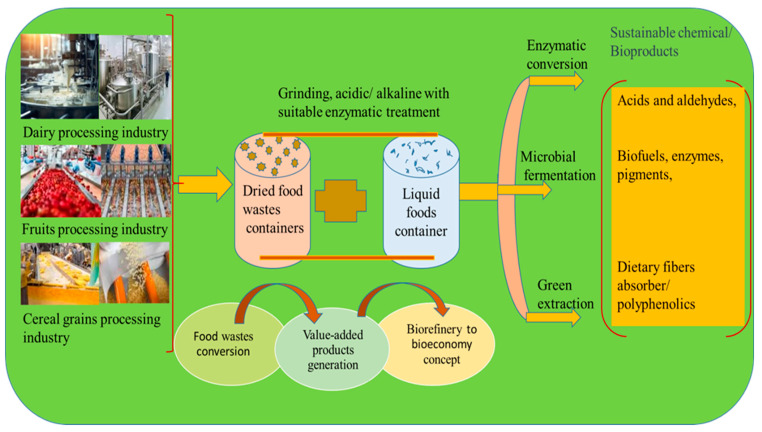
The growing challenge of food waste management presents a critical opportunity for advancing the circular bioeconomy, aiming to transform waste into valuable resources. This paper explores innovative strategies for converting food wastes into renewable food resources, emphasizing the integration of sustainable technologies and zero-waste principles. The main objective is to demonstrate how these approaches can contribute to a more sustainable food system by reducing environmental impacts and enhancing resource efficiency. Novel contributions of this study include the development of bioproducts from various food waste streams, highlighting the potential of underutilized resources like bread and jackfruit waste. Through case studies and experimental findings, the paper illustrates the successful application of green techniques, such as microbial fermentation and bioprocessing, in valorizing food wastes. The implications of this research extend to policy frameworks, encouraging the adoption of circular bioeconomy models that not only address waste management challenges but also foster economic growth and sustainability. These findings underscore the potential for food waste to serve as a cornerstone in the transition to a circular, regenerative economy.
食物浪费管理面临的挑战日益严峻,这为推动循环生物经济提供了关键契机,旨在将废物转化为宝贵资源。本文探讨了将食物垃圾转化为可再生食物资源的创新策略,强调可持续技术与零浪费原则的整合。主要目标是展示这些方法如何通过减少环境影响和提高资源效率,为更可持续的食物系统做出贡献。本研究的新贡献包括从各种食物垃圾流中开发生物产品,突出了面包和菠萝蜜废料等未充分利用资源的潜力。通过案例研究和实验结果,本文阐述了微生物发酵和生物加工等绿色技术在使食物垃圾增值方面的成功应用。这项研究的影响延伸到政策框架,鼓励采用循环生物经济模式,这种模式不仅能应对废物管理挑战,还能促进经济增长和可持续发展。这些发现强调了食物垃圾作为向循环、再生经济转型基石的潜力。