The Leukemia & Lymphoma Society, Rye Brook, NY.
Health Access and Action Consulting, Newton, MA.
JCO Oncol Pract. 2021 Dec;17(12):e1866-e1878. doi: 10.1200/OP.20.01068. Epub 2021 Jun 2.
There are numerous barriers to cancer clinical trial participation in the United States. This paper describes the approach and outcomes of The Leukemia & Lymphoma Society's Clinical Trial Support Center (CTSC), whose nurse navigators assist patients with a blood cancer and their oncologists by identifying all appropriate trials based on clinical data and patient preference, facilitating informed and shared decision making, and minimizing enrollment barriers.
Data on patients served from October 2017 to October 2019 were analyzed using bivariate and multivariate analyses to determine demographic and clinical characteristics associated with enrollment. Reasons for nonenrollment were examined.
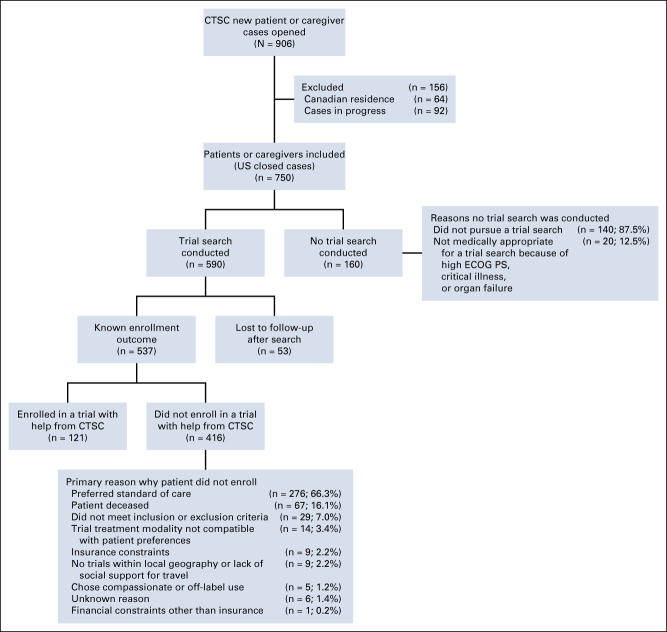
The CTSC opened 906 patient cases during this time frame. Among all US patients with a closed case (n = 750), the clinical trial enrollment rate was 16.1%. Among those with a known enrollment outcome after a trial search (n = 537), the enrollment rate was 22.5%. Multivariate analysis controlling for variables significant in bivariate analyses (insurance, treatment status, Eastern Cooperative Oncology Group performance status, and urban or rural residence) revealed that patients with Medicaid were less likely to enroll than those with private or commercial insurance (adjusted odds ratio, 0.054; CI, 0.003 to 0.899), and patients in treatment or maintenance were less likely to enroll than those relapsed or refractory to most recent therapy (adjusted odds ratio, 0.312; CI, 0.139 to 0.702). Primary reasons for nonenrollment were preference for standard of care (66.3%) and patient passed away (16.1%).
The CTSC is an effective, replicable model for addressing multilevel barriers to clinical trial participation. The findings highlight the need to increase opportunities for trial participation sooner after diagnosis and among patients with Medicaid.
在美国,癌症临床试验参与存在诸多障碍。本文描述了白血病和淋巴瘤协会临床试验支持中心(CTSC)的方法和结果,该中心的护士导航员通过基于临床数据和患者偏好来确定所有合适的试验,协助患有血液癌的患者及其肿瘤医生做出知情和共享的决策,并最大程度地减少入组障碍。
使用双变量和多变量分析对 2017 年 10 月至 2019 年 10 月期间服务的患者数据进行分析,以确定与入组相关的人口统计学和临床特征。检查了未入组的原因。
在此期间,CTSC 共开启了 906 例患者病例。在所有已关闭病例的美国患者中(n=750),临床试验入组率为 16.1%。在经过试验搜索后已知入组结果的患者中(n=537),入组率为 22.5%。多变量分析控制了双变量分析中显著的变量(保险、治疗状态、东部合作肿瘤组表现状态以及城市或农村居住地),结果表明,拥有医疗补助的患者比拥有私人或商业保险的患者入组的可能性更小(调整后的优势比,0.054;CI,0.003 至 0.899),正在接受治疗或维持治疗的患者比最近治疗后复发或难治的患者入组的可能性更小(调整后的优势比,0.312;CI,0.139 至 0.702)。未入组的主要原因是偏好标准治疗(66.3%)和患者去世(16.1%)。
CTSC 是解决临床试验参与多层次障碍的有效且可复制的模式。研究结果强调需要在诊断后不久为更多患者提供参与试验的机会,包括拥有医疗补助的患者。