University of Oklahoma, Department of Microbiology and Plant Biology, Norman, Oklahoma, USA.
University of Oklahoma, Institute for Environmental Genomics, Stephenson Research and Technology Center, Norman, Oklahoma, USA.
mSphere. 2021 Jun 30;6(3):e0116020. doi: 10.1128/mSphere.01160-20. Epub 2021 Jun 2.
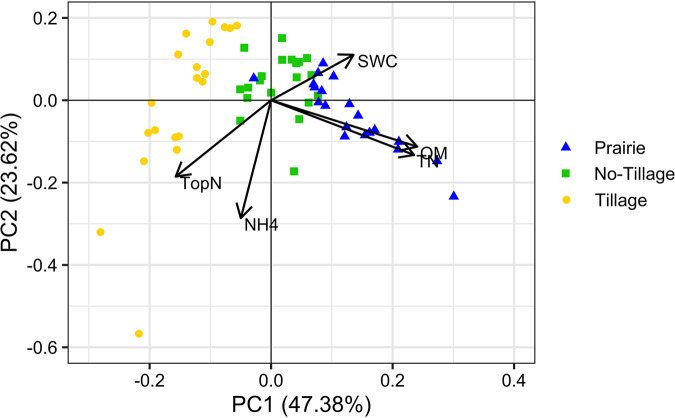
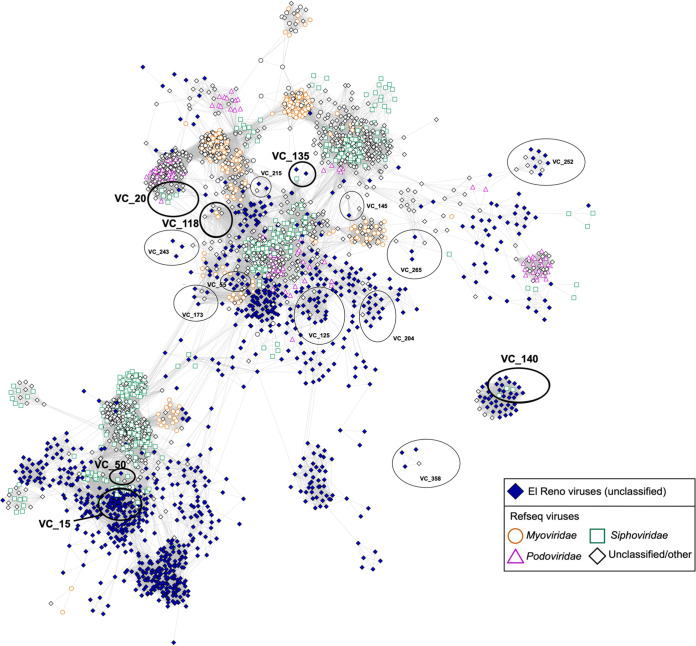
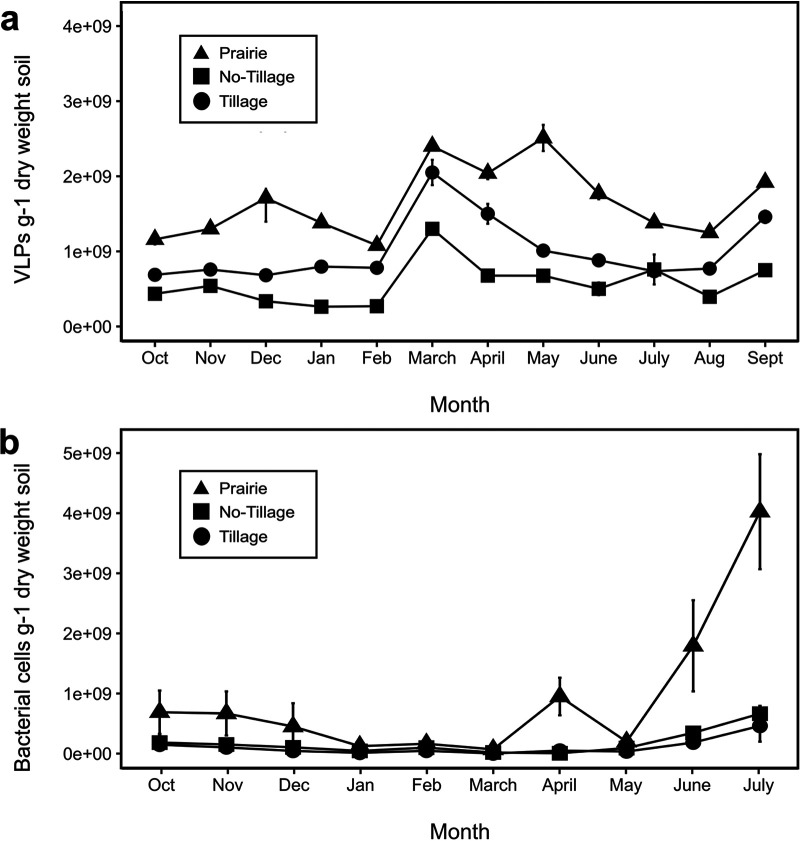
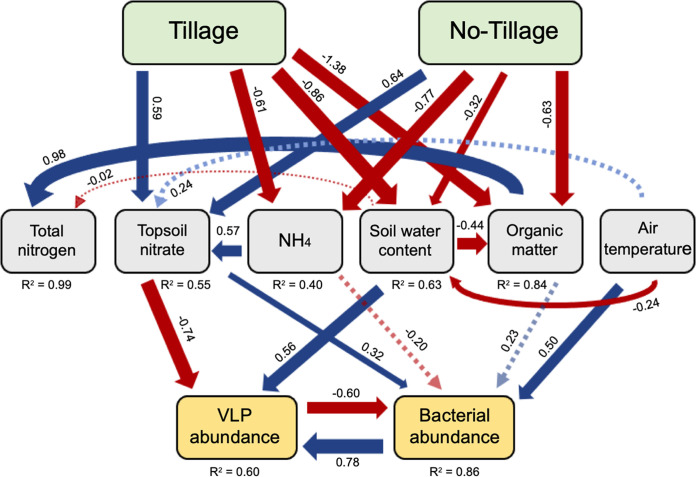
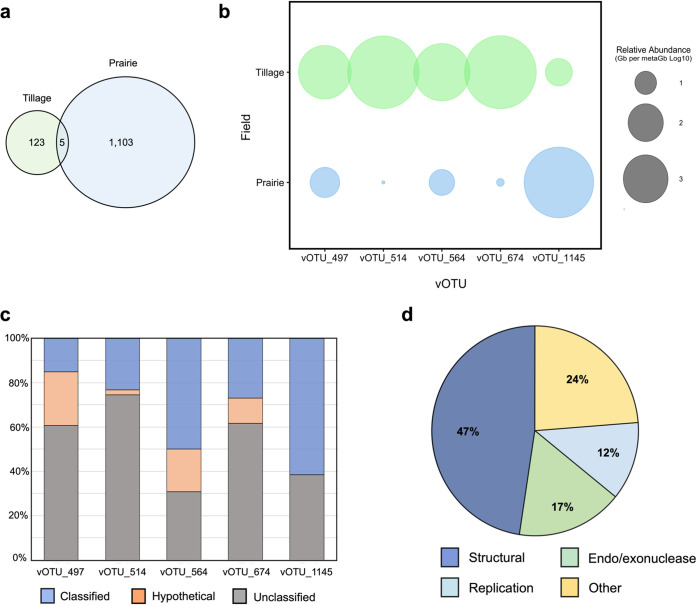
During the last several decades, viruses have been increasingly recognized for their abundance, ubiquity, and important roles in different ecosystems. Despite known contributions to aquatic systems, few studies examine viral abundance and community structure over time in terrestrial ecosystems. The effects of land conversion and land management on soil microbes have been previously investigated, but their effects on virus population are not well studied. This study examined annual dynamics of viral abundance in soils from a native tallgrass prairie and two croplands, conventional till winter wheat and no-till canola, in Oklahoma. Virus-like particle (VLP) abundance varied across sites, and showed clear seasonal shifts. VLP abundance significantly correlated with environmental variables that were generally reflective of land use, including air temperature, soil nitrogen, and plant canopy coverage. Structural equation modeling supported the effects of land use on soil communities by emphasizing interactions between management, environmental factors, and viral and bacterial abundance. Between the viral metagenomes from the prairie and tilled wheat field, 1,231 unique viral operational taxonomic units (vOTUs) were identified, and only five were shared that were rare in the contrasting field. Only 13% of the vOTUs had similarity to previously identified viruses in the RefSeq database, with only 7% having known taxonomic classification. Together, our findings indicated land use and tillage practices influence virus abundance and community structure. Analyses of viromes over time and space are vital to viral ecology in providing insight on viral communities and key information on interactions between viruses, their microbial hosts, and the environment. Conversion of land alters the physiochemical and biological environments by not only changing the aboveground community, but also modifying the soil environment for viruses and microbes. Soil microbial communities are critical to nutrient cycling, carbon mineralization, and soil quality; and viruses are known for influencing microbial abundance, community structure, and evolution. Therefore, viruses are considered an important part of soil functions in terrestrial ecosystems. In aquatic environments, virus abundance generally exceeds bacterial counts by an order of magnitude, and they are thought to be one of the greatest genetic reservoirs on the planet. However, data are extremely limited on viruses in soils, and even less is known about their responses to the disturbances associated with land use and management. The study provides important insights into the temporal dynamics of viral abundance and the structure of viral communities in response to the common practice of turning native habitats into arable soils.
在过去的几十年中,人们越来越认识到病毒在不同生态系统中的丰富度、普遍性和重要作用。尽管已知它们对水生系统有贡献,但很少有研究能够长时间地研究陆地生态系统中病毒的丰度和群落结构。先前已经研究了土地转换和土地管理对土壤微生物的影响,但它们对病毒种群的影响还没有得到很好的研究。本研究检测了俄克拉荷马州原生高草草原和两个农田(传统耕作冬小麦和免耕油菜)土壤中病毒丰度的年度动态。病毒样颗粒(VLP)的丰度在不同地点有所不同,并显示出明显的季节性变化。VLP 的丰度与环境变量显著相关,这些环境变量通常反映了土地利用情况,包括空气温度、土壤氮和植物冠层覆盖率。结构方程模型通过强调管理、环境因素以及病毒和细菌丰度之间的相互作用,支持土地利用对土壤群落的影响。在草原和耕作的冬小麦田的病毒宏基因组之间,鉴定出 1231 个独特的病毒操作分类单元(vOTU),只有 5 个是在对比田地中罕见的共享的。只有 13%的 vOTU 与 RefSeq 数据库中已识别的病毒具有相似性,只有 7%具有已知的分类学分类。总的来说,我们的研究结果表明,土地利用和耕作方式会影响病毒的丰度和群落结构。分析病毒组随时间和空间的变化,对于病毒生态学提供病毒群落的深入了解和病毒与其微生物宿主以及环境之间相互作用的关键信息是至关重要的。土地的转换不仅通过改变地上群落,还通过改变病毒和微生物的土壤环境,改变了理化和生物环境。土壤微生物群落对养分循环、碳矿化和土壤质量至关重要;而病毒则以影响微生物丰度、群落结构和进化而闻名。因此,病毒被认为是陆地生态系统土壤功能的重要组成部分。在水生环境中,病毒的丰度通常比细菌的数量高出一个数量级,它们被认为是地球上最大的遗传库之一。然而,关于土壤中病毒的数据极其有限,而且对它们对与土地利用和管理相关的干扰的反应了解得更少。该研究为了解在将原生栖息地转化为可耕地的常见做法下,病毒丰度的时间动态和病毒群落的结构提供了重要的见解。