Department of Plant Pathology, University of California, Davis, Davis, CA, USA.
Department of Earth, Ocean, and Atmospheric Science, Florida State University, Tallahassee, FL, USA.
Microbiome. 2021 Nov 26;9(1):233. doi: 10.1186/s40168-021-01156-0.
Peatlands are expected to experience sustained yet fluctuating higher temperatures due to climate change, leading to increased microbial activity and greenhouse gas emissions. Despite mounting evidence for viral contributions to these processes in peatlands underlain with permafrost, little is known about viruses in other peatlands. More generally, soil viral biogeography and its potential drivers are poorly understood at both local and global scales. Here, 87 metagenomes and five viral size-fraction metagenomes (viromes) from a boreal peatland in northern Minnesota (the SPRUCE whole-ecosystem warming experiment and surrounding bog) were analyzed for dsDNA viral community ecological patterns, and the recovered viral populations (vOTUs) were compared with our curated PIGEON database of 266,125 vOTUs from diverse ecosystems.
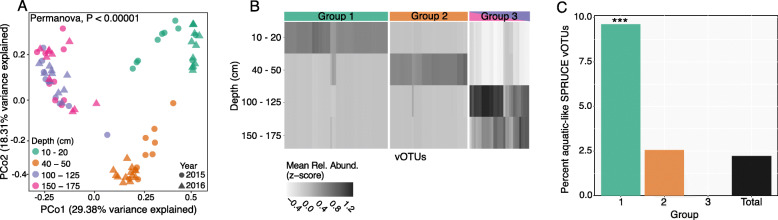
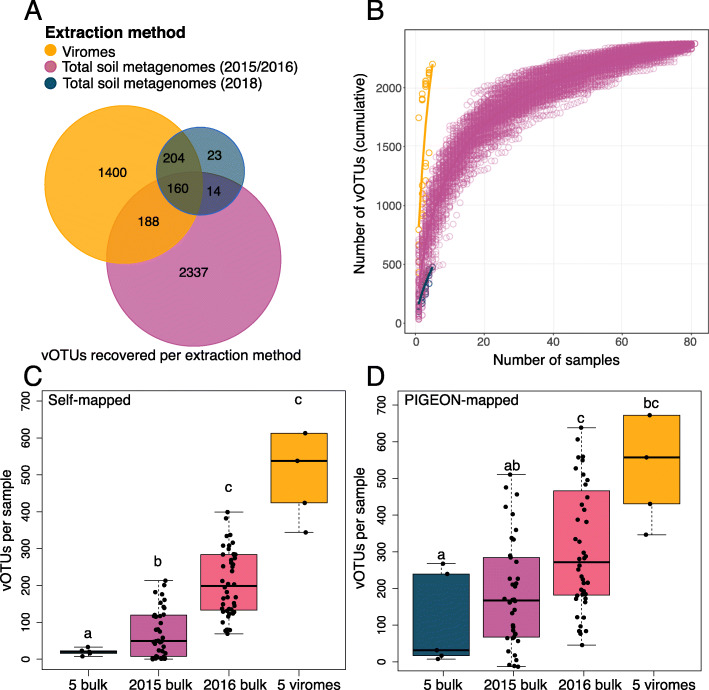
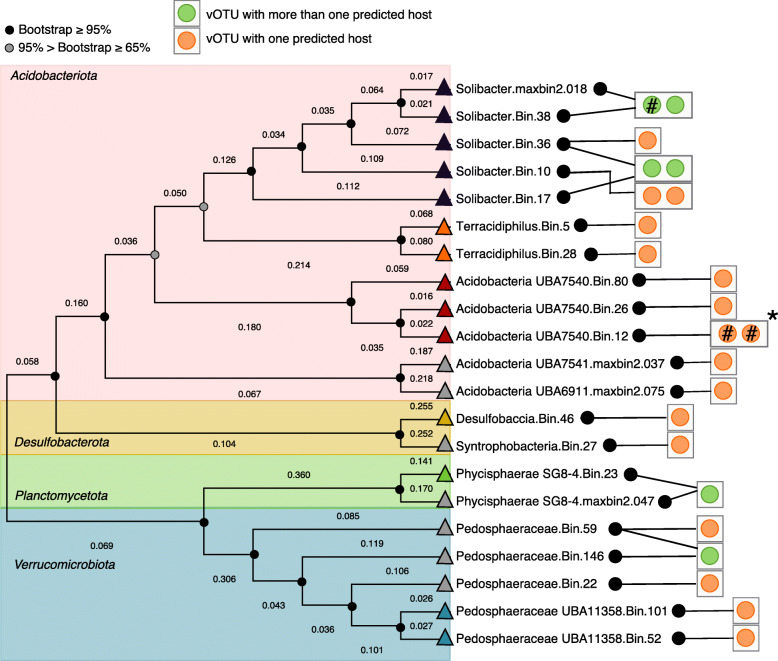
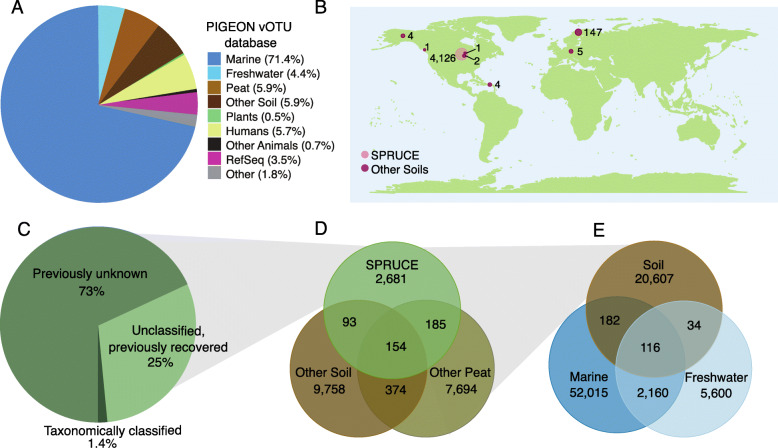
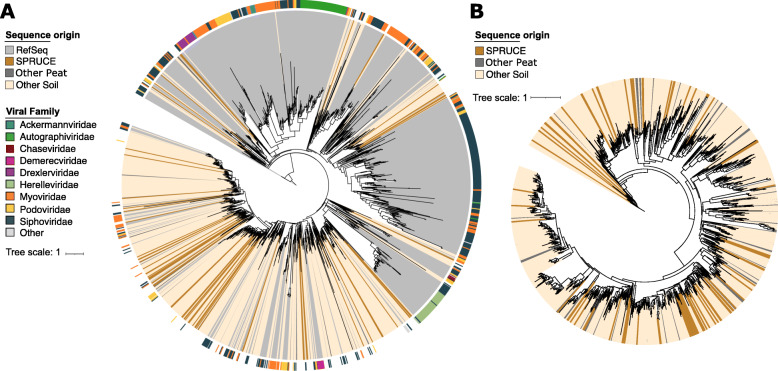
Within the SPRUCE experiment, viral community composition was significantly correlated with peat depth, water content, and carbon chemistry, including CH and CO concentrations, but not with temperature during the first 2 years of warming treatments. Peat vOTUs with aquatic-like signatures (shared predicted protein content with marine and/or freshwater vOTUs) were significantly enriched in more waterlogged surface peat depths. Predicted host ranges for SPRUCE vOTUs were relatively narrow, generally within a single bacterial genus. Of the 4326 SPRUCE vOTUs, 164 were previously detected in other soils, mostly peatlands. None of the previously identified 202,371 marine and freshwater vOTUs in our PIGEON database were detected in SPRUCE peat, but 0.4% of 80,714 viral clusters (VCs, grouped by predicted protein content) were shared between soil and aquatic environments. On a per-sample basis, vOTU recovery was 32 times higher from viromes compared with total metagenomes.
Results suggest strong viral "species" boundaries between terrestrial and aquatic ecosystems and to some extent between peat and other soils, with differences less pronounced at higher taxonomic levels. The significant enrichment of aquatic-like vOTUs in more waterlogged peat suggests that viruses may also exhibit niche partitioning on more local scales. These patterns are presumably driven in part by host ecology, consistent with the predicted narrow host ranges. Although more samples and increased sequencing depth improved vOTU recovery from total metagenomes, the substantially higher per-sample vOTU recovery after viral particle enrichment highlights the utility of soil viromics. Video abstract The importance of Minnesota peat viromes in revealing terrestrial and aquatic niche partitioning for viral populations.
由于气候变化,泥炭地预计将持续但波动地经历更高的温度,导致微生物活动和温室气体排放增加。尽管有越来越多的证据表明,在有永冻层的泥炭地中,病毒对这些过程有贡献,但对于其他泥炭地中的病毒知之甚少。更普遍地说,在本地和全球范围内,土壤病毒生物地理学及其潜在驱动因素都知之甚少。在这里,对明尼苏达州北部一个北方泥炭地(SPRUCE 全生态系统增温实验和周围沼泽)的 87 个宏基因组和 5 个病毒大小分类宏基因组(病毒组)进行了分析,以研究 dsDNA 病毒群落的生态模式,并将回收的病毒种群(vOTUs)与我们从不同生态系统中 curated 的包含 266,125 个 vOTUs 的 PIGEON 数据库进行了比较。
在 SPRUCE 实验中,病毒群落组成与泥炭深度、含水量和碳化学性质(包括 CH 和 CO 浓度)显著相关,但与增温处理的前 2 年的温度无关。具有水生特征的泥炭 vOTUs(与海洋和/或淡水 vOTUs 共享预测的蛋白质含量)在更水淹的表层泥炭深度中显著富集。SPRUCE vOTUs 的预测宿主范围相对较窄,通常在单个细菌属内。在 4326 个 SPRUCE vOTUs 中,有 164 个在其他土壤中,主要是泥炭地中被检测到。我们在 PIGEON 数据库中之前鉴定的 202,371 个海洋和淡水 vOTUs 中没有一个在 SPRUCE 泥炭中被检测到,但在土壤和水生环境中,有 0.4%的 80,714 个病毒聚类(VC,按预测的蛋白质含量分组)是共享的。在每个样本的基础上,与总宏基因组相比,从病毒组中回收的 vOTU 要高出 32 倍。
结果表明,陆地和水生生态系统之间以及在一定程度上泥炭地和其他土壤之间存在很强的病毒“物种”界限,在更高的分类水平上差异不明显。更多水淹泥炭中富含水生特征的 vOTUs 表明,病毒也可能在更局部的尺度上表现出生态位分化。这些模式可能部分是由宿主生态学驱动的,这与预测的狭窄宿主范围一致。尽管更多的样本和增加的测序深度提高了从总宏基因组中回收 vOTUs 的效率,但在病毒颗粒富集后,每个样本的 vOTU 回收效率大大提高,这突出了土壤病毒组学的实用性。视频摘要明尼苏达州泥炭病毒组在揭示病毒种群的陆地和水生生态位分异中的重要性。