Riboli Andrea, Semeria Marco, Coratella Giuseppe, Esposito Fabio
Atalanta B.C., Performance Department, Bergamo, Italy.
Department of Biomedical Sciences for Health, Università degli Studi di Milano, Italy.
Biol Sport. 2021 Jun;38(2):195-205. doi: 10.5114/biolsport.2020.98450. Epub 2020 Sep 1.
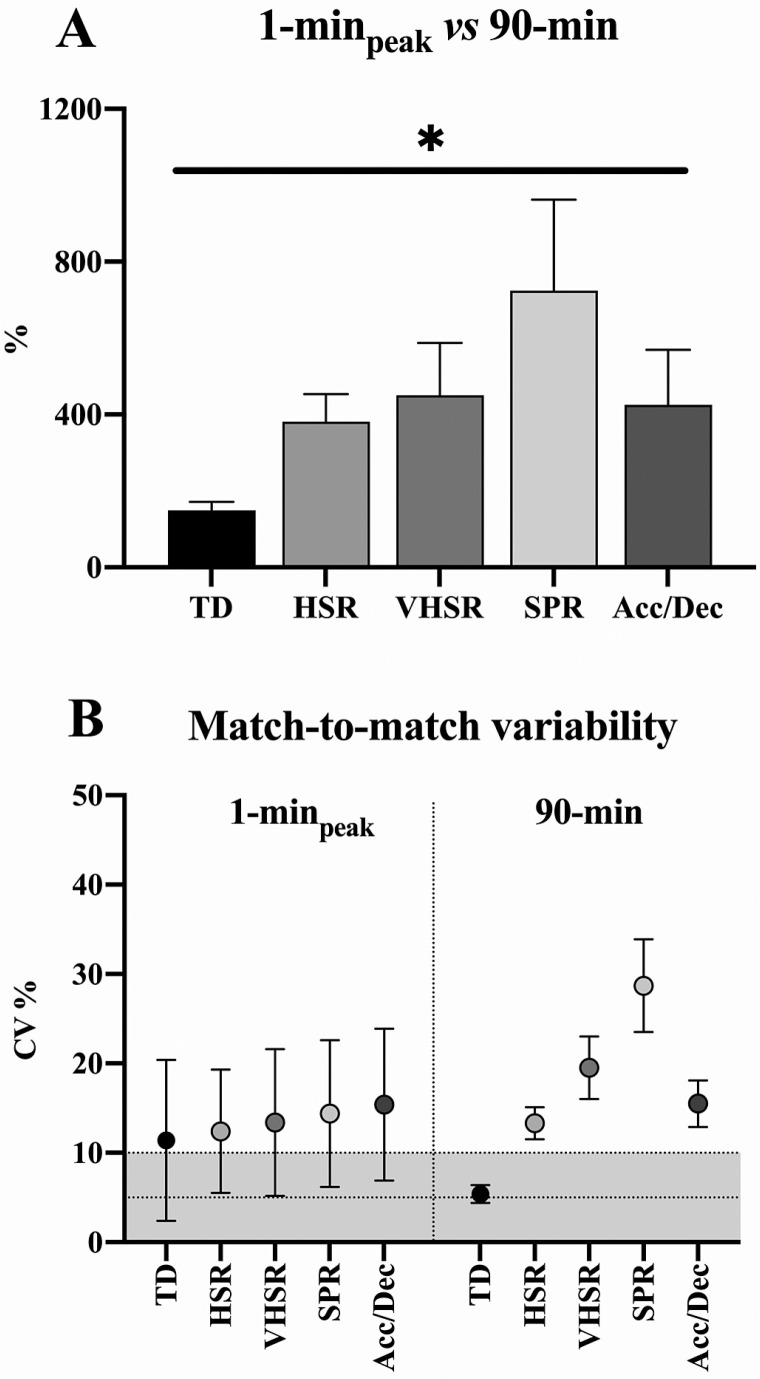
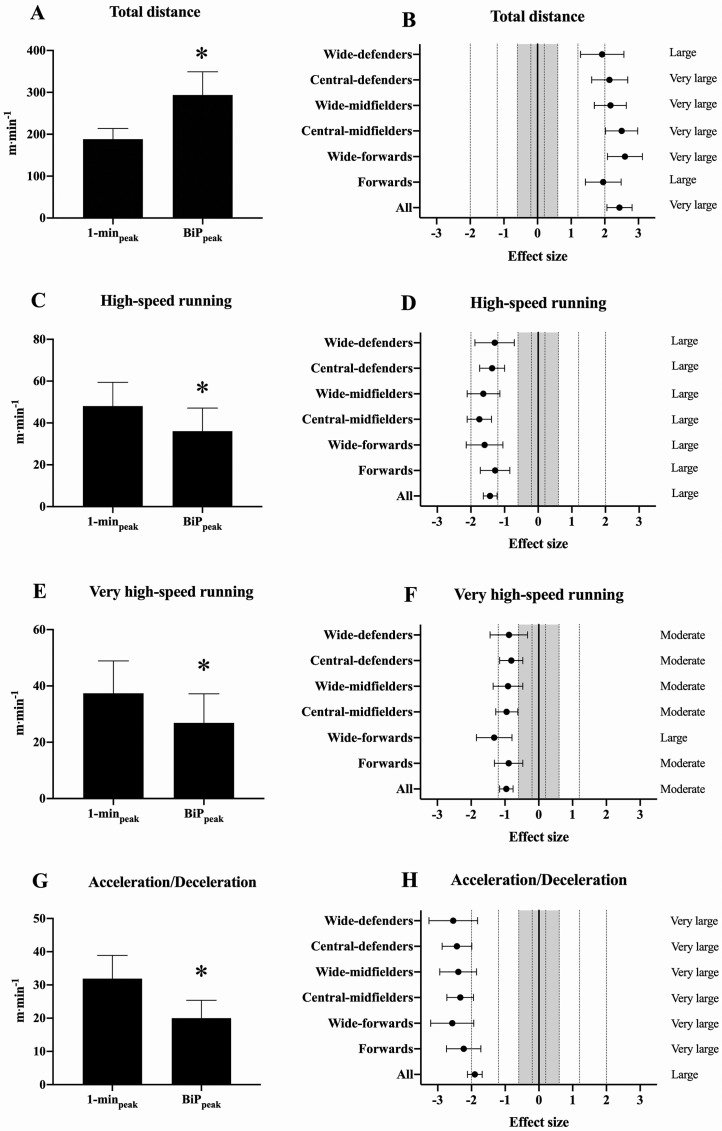
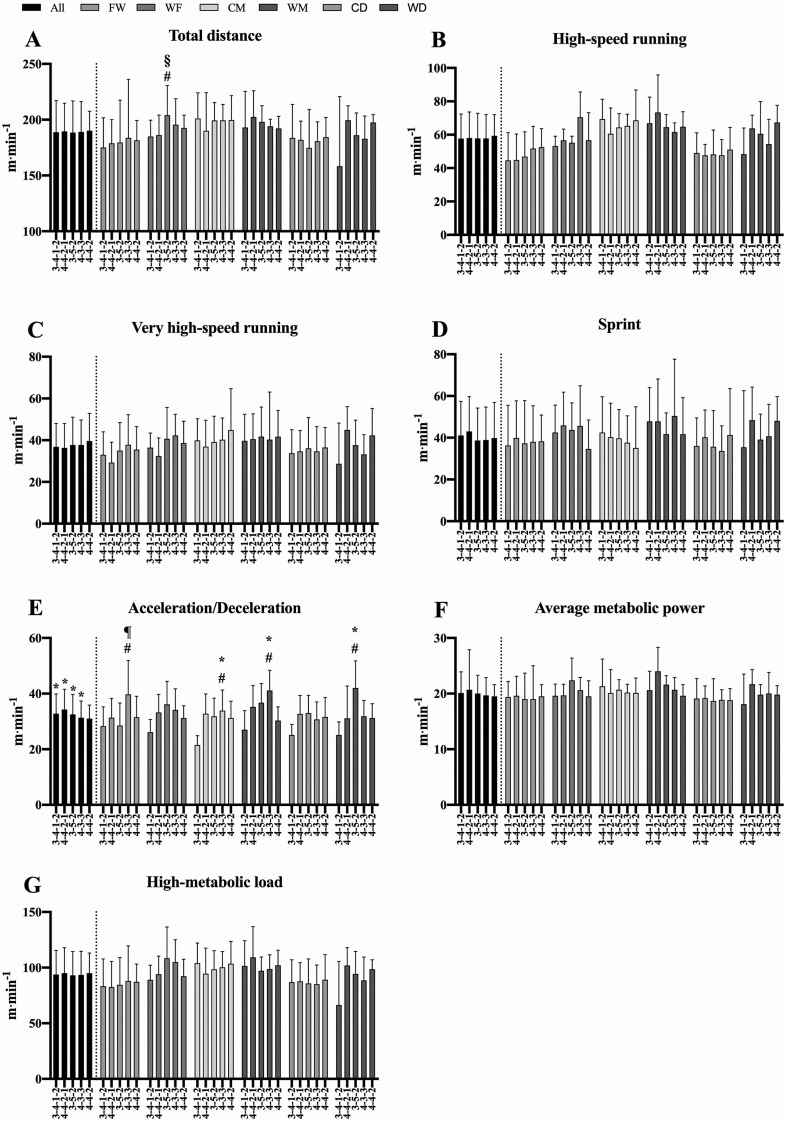
This study examined the most demanding passages of match play (MDP) and the effects of playing formation, ball-in-play (BiP) time and ball possession on the 1-min peak (1-min) demand in elite soccer. During 18 official matches, 305 individual samples from 223 Italian Serie A soccer players were collected. MDP and 1-min were calculated across playing position (central defenders, wide defenders, central midfielders, wide midfielders, wide forwards and forwards). Maximum relative (m·min) total distance (TD), high-speed running (HSR), very high-speed running (VHSR), sprint (SPR), acceleration/deceleration (Acc/Dec), estimated metabolic power (P) and high-metabolic load (HML) distance were calculated across different durations (1-5, 10, 90 min) using a rolling method. Additionally, 1-min demand was compared across playing formation (3-4-1-2, 3-4-2-1, 3-5-2, 4-3-3, 4-4-2), BiP and ball/no-ball possession cycles. MDP showed large to verylarge [effect-size (ES): 1.20/4.06] differences between 1-min vs all durations for each parameter. In 1-min, central midfielders and wide midfielders achieved greater TD and HSR (ES:0.43/1.13) while wide midfielders and wide forwards showed greater SPR and Acc/Dec (ES:0.30/1.15) than other positions. For VHSR, SPR and Acc/Dec 1-min showed fourfold higher locomotor requirements than 90-min. 1-min for Acc/Dec was highest in 4-3-3 for forwards, central and wide midfielders. 1-min was lower during peak BiP (BiP) for HSR, VHSR and Acc/Dec (ES: -2.57/-1.42). Comparing with vs without ball possession, BiP was greater (ES: 0.06/1.48) in forwards and wide forwards and lower (ES: -2.12/-0.07) in central defenders and wide defenders. Positional differences in MDP, 1-min and BiP were observed. Soccer-specific drills should account for positional differences when conditioning players for the peak demands. This may help practitioners to bridge the training/match gap.
本研究调查了精英足球比赛中最具挑战性的对抗阶段(MDP),以及比赛阵型、比赛中球的状态(BiP)和控球情况对1分钟峰值(1分钟)需求的影响。在18场正式比赛中,收集了来自223名意大利甲级联赛足球运动员的305个个体样本。计算了不同场上位置(中后卫、边后卫、中场球员、边锋、边前卫和前锋)的MDP和1分钟需求。使用滚动方法计算了不同时间段(1 - 5分钟、10分钟、90分钟)内的最大相对(米·分钟)总距离(TD)、高速奔跑(HSR)、极高速奔跑(VHSR)、冲刺(SPR)、加速/减速(Acc/Dec)、估计代谢功率(P)和高代谢负荷(HML)距离。此外,还比较了不同比赛阵型(3 - 4 - 1 - 2、3 - 4 - 2 - 1、3 - 5 - 2、4 - 3 - 3、4 - 4 - 2)、BiP以及控球/无球周期下的1分钟需求。每个参数在1分钟与所有其他时间段之间,MDP显示出大到非常大的效应量差异(ES:1.20 / 4.06)。在1分钟内,中场球员和边前卫的TD和HSR更高(ES:0.43 / 1.13),而边前卫和边锋的SPR和Acc/Dec比其他位置更大(ES:0.30 / 1.15)。对于VHSR、SPR和Acc/Dec,1分钟的运动需求比90分钟高四倍。前锋、中场球员和边前卫在4 - 3 - 比赛阵型中的1分钟Acc/Dec最高。在BiP高峰期,HSR、VHSR和Acc/Dec的1分钟需求较低(ES: - 2.57 / - 1.42)。与有球和无球情况相比,前锋和边锋的BiP更大(ES:0.06 / 1.48),而中后卫和边后卫的BiP较小(ES: - 2.12 / - 0.07)。观察到MDP、1分钟需求和BiP的位置差异。在为球员进行峰值需求的体能训练时,特定于足球的训练应考虑到位置差异。这可能有助于从业者缩小训练/比赛之间的差距。