Department of Health Promotion and Community Health, Faculty of Health Sciences, American University of Beirut, Beirut, Lebanon.
Department of Health Management and Policy, Faculty of Health Sciences, American University of Beirut, Beirut, Lebanon.
J Med Internet Res. 2021 Jun 3;23(6):e23473. doi: 10.2196/23473.
Digital health interventions (DHIs) are increasingly being adopted globally to address various public health issues. DHIs can be categorized according to four main types of technology: mobile based, web based, telehealth, and electronic health records. In 2006, Norman and Skinner introduced the eHealth literacy model, encompassing six domains of skills and abilities (basic, health, information, scientific, media, and computer) needed to effectively understand, process, and act on health-related information. Little is known about whether these domains are assessed or accounted for in DHIs.
This study aims to explore how DHIs assess and evaluate the eHealth literacy model, describe which health conditions are addressed, and which technologies are used.
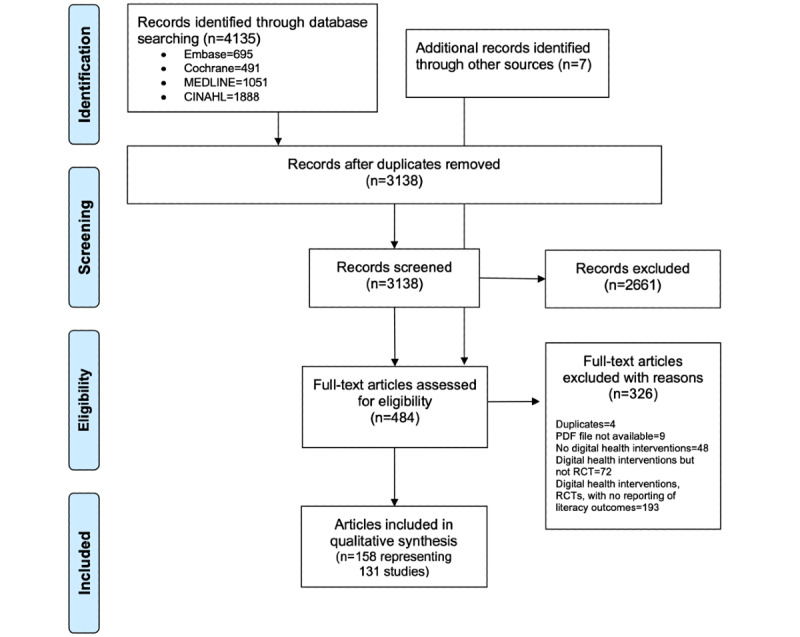
We conducted a scoping review of the literature on DHIs, based on randomized controlled trial design and reporting the assessment of any domain of the eHealth literacy model. MEDLINE, CINAHL, Embase, and Cochrane Library were searched. A duplicate selection and data extraction process was performed; we charted the results according to the country of origin, health condition, technology used, and eHealth literacy domain.
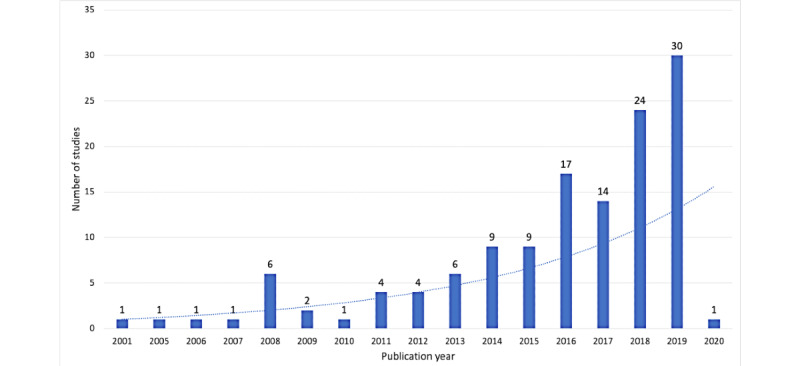
We identified 131 unique DHIs conducted in 26 different countries between 2001 and 2020. Most DHIs were conducted in English-speaking countries (n=81, 61.8%), delivered via the web (n=68, 51.9%), and addressed issues related to noncommunicable diseases (n=57, 43.5%) or mental health (n=26, 19.8%). None of the interventions assessed all six domains of the eHealth literacy model. Most studies focused on the domain of health literacy (n=96, 73.2%), followed by digital (n=19, 14.5%), basic and media (n=4, 3%), and information and scientific literacy (n=1, 0.7%). Of the 131 studies, 7 (5.3%) studies covered both health and digital literacy.
Although many selected DHIs assessed health or digital literacy, no studies comprehensively evaluated all domains of the eHealth literacy model; this evidence might be overlooking important factors that can mediate or moderate the effects of these interventions. Future DHIs should comprehensively assess the eHealth literacy model while developing or evaluating interventions to understand how and why interventions can be effective.
数字健康干预(DHIs)在全球范围内越来越多地被采用,以解决各种公共卫生问题。DHIs 可以根据四种主要技术类型进行分类:基于移动设备、基于网络、远程医疗和电子健康记录。2006 年,Norman 和 Skinner 引入了电子健康素养模型,该模型包含有效理解、处理和采取与健康相关信息所需的六个技能和能力领域(基本、健康、信息、科学、媒体和计算机)。目前尚不清楚这些领域是否在 DHIs 中得到评估或考虑。
本研究旨在探讨 DHIs 如何评估电子健康素养模型,描述解决哪些健康状况以及使用哪些技术。
我们对基于随机对照试验设计并报告评估电子健康素养模型任何领域的 DHIs 文献进行了范围综述。检索了 MEDLINE、CINAHL、Embase 和 Cochrane Library。进行了重复选择和数据提取过程;我们根据原产国、健康状况、使用的技术和电子健康素养领域对结果进行了图表绘制。
我们确定了 2001 年至 2020 年间在 26 个不同国家开展的 131 项独特的 DHIs。大多数 DHIs 是在英语国家进行的(n=81,61.8%),通过网络(n=68,51.9%)交付,解决与非传染性疾病(n=57,43.5%)或心理健康(n=26,19.8%)相关的问题。没有一项干预措施评估了电子健康素养模型的所有六个领域。大多数研究侧重于健康素养领域(n=96,73.2%),其次是数字领域(n=19,14.5%)、基本和媒体领域(n=4,3%)以及信息和科学素养领域(n=1,0.7%)。在 131 项研究中,有 7 项(5.3%)研究涵盖了健康和数字素养。
尽管许多选定的 DHIs 评估了健康或数字素养,但没有研究全面评估电子健康素养模型的所有领域;这一证据可能忽略了可以调解或调节这些干预效果的重要因素。未来的 DHIs 在开发或评估干预措施时应全面评估电子健康素养模型,以了解干预措施为何以及如何有效。