Jiang Huaili, Zhou Lei, He Qiangsheng, Jiang Kanglun, Yuan Jinqiu, Huang Xinsheng
Department of Otolaryngology, Zhongshan Hospital, Fudan University, Shanghai, China.
Cancer Center, Zhongshan Hospital, Fudan University, Shanghai, China.
Cancer Metab. 2021 Jun 3;9(1):25. doi: 10.1186/s40170-021-00261-w.
There are limited evidences clarifying the impact of metabolic syndrome (MS) and its components on head and neck cancer (HNC) incidence risk. We explored the correlation between MS, MS components, and the combined effects of MS and C-reactive protein (CRP) and HNC risk.
This is a prospective analysis of 474,929 participants from the UK Biobank cohort. Cox proportional hazard regression was utilized to assess the hazard ratio (HR) and 95% confidence interval (CI) and to explore the non-linear correlation between an individual MS component and HNC risk.
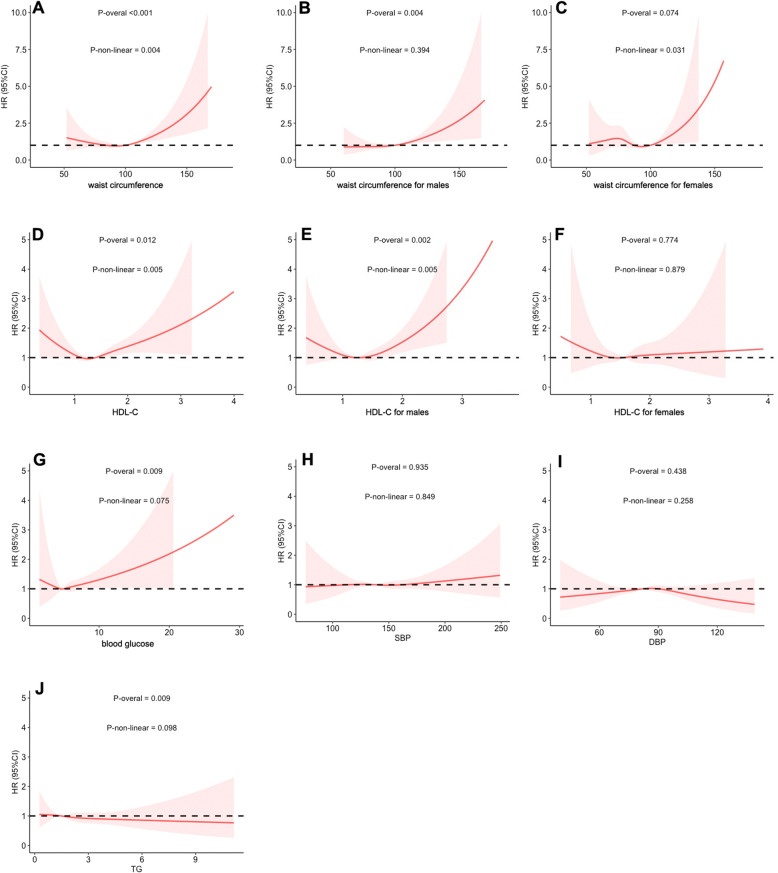
Individuals with MS (HR, 1.05; 95%CI, 0.90-1.22) had no higher HNC risk than those without MS. More MS components showed no higher HNC risk. Nevertheless, hyperglycemia (HR, 1.22; 95%CI, 1.02-1.45) was independently correlated with elevated HNC risk. In a non-linear manner, waist circumference and high-density lipoprotein cholesterol (HDL-C) showed a U-shaped association with HNC risk. Further, piecewise linear model analysis indicated that higher male waist circumference, female waist circumference (≥93.16 cm), blood glucose (≥4.70 mmol/L) and male HDL-C (≥1.26mmo/L), and lower male HDL-C (<1.26mmo/L) were correlated with higher HNC risk. Increased CRP (≥1.00mg/dL) elevated HNC risk and individuals with MS and CRP≥1.00mg/dL had the highest HNC risk (HR, 1.29; 95%CI, 1.05-1.58). But no joint effect between MS and CRP was detected (p-interaction=0.501).
MS are not correlated with elevated HNC risk. High waist circumference and blood glucose are independent risk factor of HNC incidence. Controlling HDL-C in an appropriate range can get the lowest risk of male HNC. No joint effect of MS and CRP exists in HNC tumorigenesis.
关于代谢综合征(MS)及其组分对头颈部癌(HNC)发病风险影响的证据有限。我们探讨了MS、MS组分以及MS与C反应蛋白(CRP)的联合作用与HNC风险之间的相关性。
这是一项对英国生物银行队列中474,929名参与者的前瞻性分析。采用Cox比例风险回归来评估风险比(HR)和95%置信区间(CI),并探讨单个MS组分与HNC风险之间的非线性相关性。
患有MS的个体(HR,1.05;95%CI,0.90 - 1.22)与未患MS的个体相比,HNC风险并无更高。更多的MS组分显示HNC风险也没有更高。然而,高血糖(HR,1.22;95%CI,1.02 - 1.45)与HNC风险升高独立相关。腰围和高密度脂蛋白胆固醇(HDL-C)以非线性方式与HNC风险呈U形关联。此外,分段线性模型分析表明,男性腰围、女性腰围(≥93.16 cm)、血糖(≥4.70 mmol/L)和男性HDL-C(≥1.26mmol/L)升高以及男性HDL-C降低(<1.26mmol/L)与更高的HNC风险相关。CRP升高(≥1.00mg/dL)会增加HNC风险,且患有MS且CRP≥1.00mg/dL的个体HNC风险最高(HR,1.29;95%CI,1.05 - 1.58)。但未检测到MS与CRP之间的联合作用(p交互作用 = 0.501)。
MS与HNC风险升高无关。高腰围和高血糖是HNC发病的独立危险因素。将HDL-C控制在适当范围内可使男性HNC风险最低。在HNC肿瘤发生过程中不存在MS与CRP的联合作用。