Research Institute of Child Development and Education, University of Amsterdam, Nieuwe Achtergracht 127, P.O. Box 15780, 1018 WS, Amsterdam, Netherlands.
Clin Child Fam Psychol Rev. 2021 Sep;24(3):553-578. doi: 10.1007/s10567-021-00353-5. Epub 2021 Jun 4.
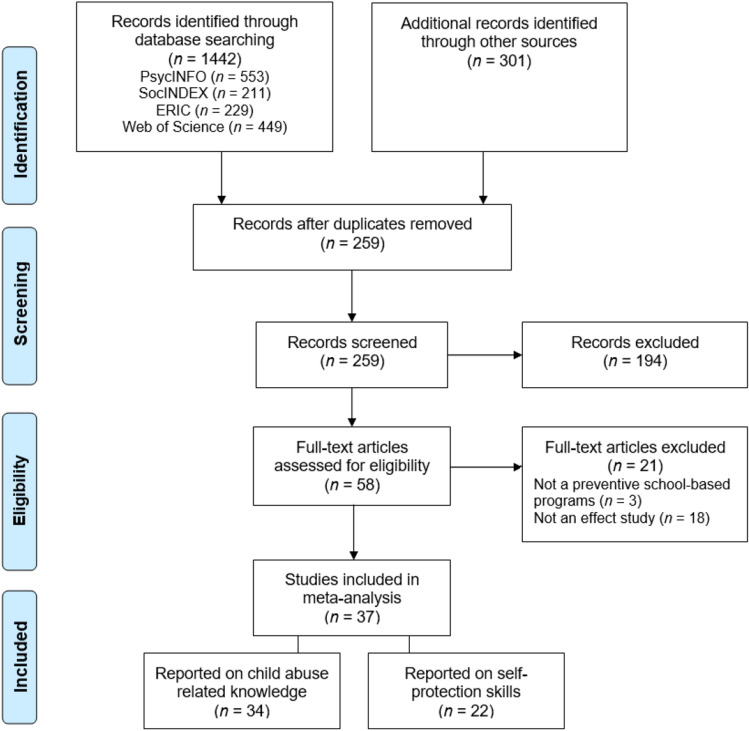
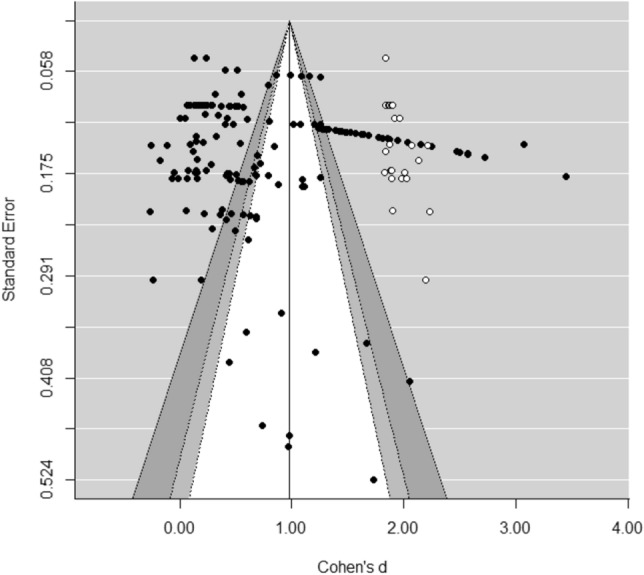
School-based programs seem promising for child abuse prevention. However, research mainly focused on sexual child abuse and knowledge is lacking on how individual program components contribute to the effectiveness of school-based prevention programs for any form of child abuse. This study aimed to examine the overall effect of these school-based programs on (a) children's child abuse-related knowledge and (b) self-protection skills by conducting two three-level meta-analyses. Furthermore, moderator analyses were performed to identify how program components and delivery techniques were associated with effectiveness. A literature search yielded 34 studies (158 effect sizes; N = 11,798) examining knowledge of child abuse and 22 studies (99 effect sizes; N = 7804) examining self-protection skills. A significant overall effect was found of school-based programs on both knowledge (d = 0.572, 95% CI [0.408, 0.737], p < 0.001) and self-protection skills (d = 0.528, 95% CI [0.262, 0.794], p < 0.001). The results of the first meta-analysis on children's child abuse knowledge suggest that program effects were larger in programs addressing social-emotional skills of children (d = 0.909 for programs with this component versus d = 0.489 for programs without this component) and self-blame (d = 0.776 versus d = 0.412), and when puppets (d = 1.096 versus d = 0.500) and games or quizzes (d = 0.966 versus d = 0.494) were used. The second meta-analysis on children's self-protections skills revealed that no individual components or techniques were associated with increased effectiveness. Several other study and program characteristics did moderate the overall effects and are discussed. In general, school-based prevention programs show positive effects on both knowledge and self-protection skills, and the results imply that program effectiveness can be improved by implementing specific components and techniques.
学校为基础的项目似乎在预防儿童虐待方面有很大的前景。然而,研究主要集中在性虐待儿童方面,对于个体项目组成部分如何为任何形式的儿童虐待的学校为基础的预防项目的有效性做出贡献,这方面的知识还很缺乏。本研究旨在通过进行两项三级元分析,来检验这些学校为基础的项目对(a)儿童的虐待相关知识和(b)自我保护技能的整体效果。此外,还进行了调节分析,以确定项目组成部分和传递技术与效果之间的关系。文献检索产生了 34 项研究(158 个效应量;N=11798),研究了虐待儿童的知识,以及 22 项研究(99 个效应量;N=7804),研究了自我保护技能。研究发现,学校为基础的项目对知识(d=0.572,95%置信区间[0.408,0.737],p<0.001)和自我保护技能(d=0.528,95%置信区间[0.262,0.794],p<0.001)都有显著的整体效果。对儿童虐待知识的第一项元分析的结果表明,在针对儿童社会情感技能的项目中(有此组成部分的项目效果为 d=0.909,而无此组成部分的项目效果为 d=0.489),自我责备(d=0.776 对 d=0.412)和使用木偶(d=1.096 对 d=0.500)以及游戏或测验(d=0.966 对 d=0.494)的项目效果更大。对儿童自我保护技能的第二项元分析显示,没有单个组成部分或技术与增加的效果有关。还讨论了其他一些研究和项目特征对总体效果的调节作用。总的来说,学校为基础的预防项目对知识和自我保护技能都有积极的影响,结果表明,通过实施特定的组成部分和技术,可以提高项目的效果。