School of Sport, Exercise and Rehabilitation Sciences, University of Birmingham, Birmingham, West Midlands, B15 2TT, UK.
Int J Behav Nutr Phys Act. 2021 Jun 5;18(1):72. doi: 10.1186/s12966-021-01138-3.
The objectives of this systematic review were to update the evidence base on social media interventions for physical activity and diet since 2014, analyse the characteristics of interventions that resulted in changes to physical activity and diet-related behaviours, and assess differences in outcomes across different population groups.
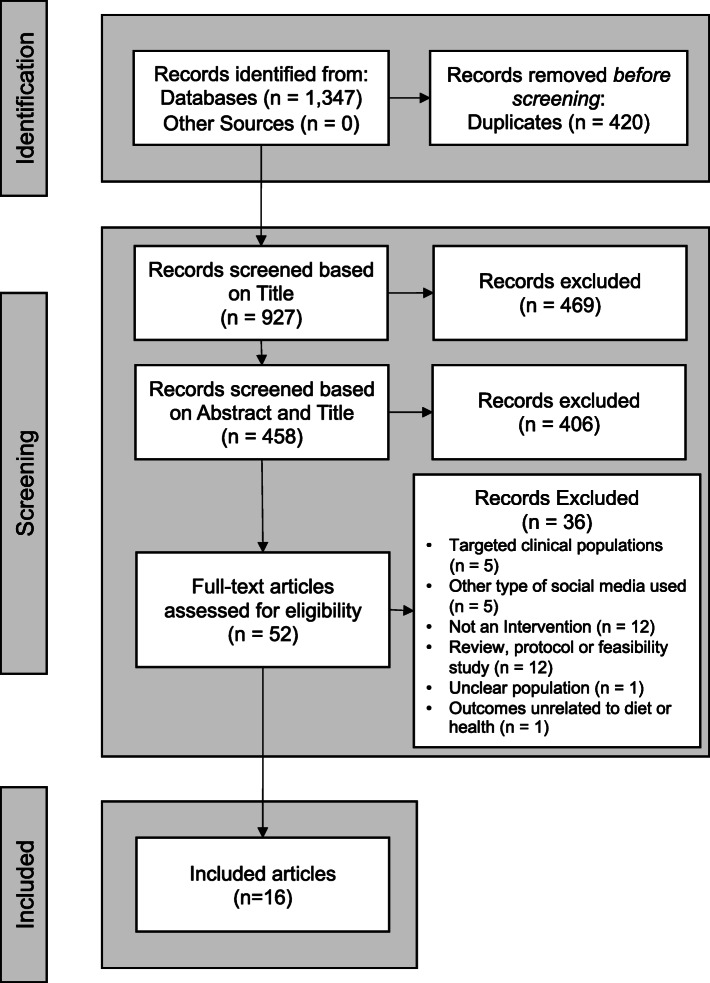
A systematic search of the literature was conducted across 5 databases (Medline, Embase, EBSCO Education, Wiley and Scopus) using key words related to social media, physical activity, diet, and age. The inclusion criteria were: participants age 13+ years in the general population; an intervention that used commercial social media platform(s); outcomes related to changes to diet/eating or physical activity behaviours; and quantitative, qualitative and mixed methods studies. Quality appraisal tools that aligned with the study designs were used. A mixed methods approach was used to analyse and synthesise all evidence.
Eighteen studies were included: randomised control trials (n = 4), non-controlled trials (n = 3), mixed methods studies (n = 3), non-randomised controlled trials (n = 5) and cross-sectional studies (n = 3). The target population of most studies was young female adults (aged 18-35) attending college/university. The interventions reported on positive changes to physical activity and diet-related behaviours through increases in physical activity levels and modifications to food intake, body composition and/or body weight. The use of Facebook, Facebook groups and the accessibility of information and interaction were the main characteristics of social media interventions. Studies also reported on Instagram, Reddit, WeChat and Twitter and the use of photo sharing and editing, groups and sub-groups and gamification.
Social media interventions can positively change physical activity and diet-related behaviours, via increases in physical activity levels, healthy modifications to food intake, and beneficial changes to body composition or body weight. New evidence is provided on the contemporary uses of social media (e.g. gamification, multi-model application, image sharing/editing, group chats) that can be used by policy makers, professionals, organisations and/or researchers to inform the design of future social media interventions. This study had some limitations that mainly relate to variation in study design, over-reliance of self-reported measures and sample characteristics, that prevented comparative analysis. Registration number: PROPSERO; CRD42020210806 .
本系统评价的目的是更新 2014 年以来社交媒体干预对体力活动和饮食的证据基础,分析导致体力活动和饮食相关行为改变的干预措施的特点,并评估不同人群群体的结果差异。
使用与社交媒体、体力活动、饮食和年龄相关的关键词,在 5 个数据库(Medline、Embase、EBSCO Education、Wiley 和 Scopus)中进行了系统文献检索。纳入标准为:年龄在 13 岁及以上的一般人群中的参与者;使用商业社交媒体平台的干预措施;与饮食/进食或体力活动行为变化相关的结果;以及定量、定性和混合方法研究。使用与研究设计一致的质量评估工具进行质量评估。采用混合方法分析和综合所有证据。
纳入了 18 项研究:随机对照试验(n=4)、非对照试验(n=3)、混合方法研究(n=3)、非随机对照试验(n=5)和横断面研究(n=3)。大多数研究的目标人群是年轻的成年女性(18-35 岁),他们在大学/大学就读。这些干预措施报告称,通过增加体力活动水平和改变食物摄入量、身体成分和/或体重,对体力活动和饮食相关行为产生了积极的影响。社交媒体干预的主要特征是使用 Facebook、Facebook 群组以及信息和互动的可及性。研究还报告了 Instagram、Reddit、微信和 Twitter 的使用情况,以及照片分享和编辑、群组和子群组以及游戏化的使用情况。
社交媒体干预可以通过增加体力活动水平、对食物摄入进行健康调整以及对身体成分或体重产生有益的变化,积极改变体力活动和饮食相关行为。本研究提供了关于社交媒体的当代使用(例如游戏化、多模式应用、图像共享/编辑、群聊)的新证据,可供政策制定者、专业人员、组织和/或研究人员用于为未来的社交媒体干预措施提供信息。本研究存在一些局限性,主要与研究设计的变化、对自我报告措施和样本特征的过度依赖有关,这阻碍了比较分析。注册号:PROPSERO;CRD42020210806。