Bulucu Büyüksoy Gizem Deniz, Çatıker Aslıhan, Özdil Kamuran
Department of Nursing, Kırşehir Ahi Evran University Faculty of Health Sciences, Kırşehir, Turkey.
Department of Nursing, Ordu University Faculty of Health Sciences, Ordu, Turkey.
Disaster Med Public Health Prep. 2021 Jun 7:1-6. doi: 10.1017/dmp.2021.172.
The aim of this study was to examine the incidence of food insecurity and affecting factors in households with children in Turkey during the coronavirus disease 2019 (COVID-19) pandemic.
This is a cross-sectional study. The participants were recruited by the snowball sampling method, and the data were collected by means of a link sent to their smartphones through their social media accounts. This study included 211 households with at least 1 child.
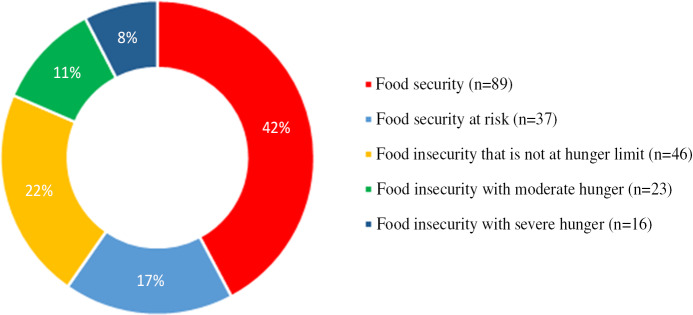
The study revealed that 21.8% households had food insecurity that was not at the hunger threshold. The monthly income of 80.6% of the households was below the poverty line and monthly income decreased in more than half of the households during the pandemic. Food insecurity increased 2.5 times when the households comprised workers or self-employed individuals (odds ratio [OR] = 2.529; P = 0.002), increased 3 times when the monthly income of the households decreased (OR = 3.131; P = 0.000), and increased 2 times when total monthly income of the household fell below poverty line during the pandemic (OR = 2.001; P = 0.049).
It is determined that nearly half the households have food insecurity and that the pandemic poses a risk in terms of food security. We recommend that public health studies should be planned to ensure accessibility to healthy foods.
本研究旨在调查2019年冠状病毒病(COVID-19)大流行期间土耳其有孩子家庭的粮食不安全发生率及其影响因素。
这是一项横断面研究。采用滚雪球抽样法招募参与者,并通过社交媒体账户向其智能手机发送链接的方式收集数据。本研究纳入了211个至少有1个孩子的家庭。
研究显示,21.8%的家庭存在未达到饥饿阈值的粮食不安全状况。80.6%的家庭月收入低于贫困线,且在大流行期间超过半数家庭的月收入有所下降。当家庭中有工人或个体经营者时,粮食不安全增加2.5倍(优势比[OR]=2.529;P=0.002);当家庭月收入下降时,粮食不安全增加3倍(OR=3.131;P=0.000);当家庭月总收入在大流行期间低于贫困线时,粮食不安全增加2倍(OR=2.001;P=0.049)。
已确定近半数家庭存在粮食不安全状况,且大流行对粮食安全构成风险。我们建议应规划公共卫生研究,以确保人们能够获取健康食品。