Department of Econometrics and Statistics, Institute of Economics and Finance, Warsaw University of Life Sciences (WULS), 02-776 Warsaw, Poland.
Department of Dietetics, Institute of Human Nutrition Sciences, Warsaw University of Life Sciences (WULS), 02-776 Warsaw, Poland.
Int J Environ Res Public Health. 2020 Aug 27;17(17):6221. doi: 10.3390/ijerph17176221.
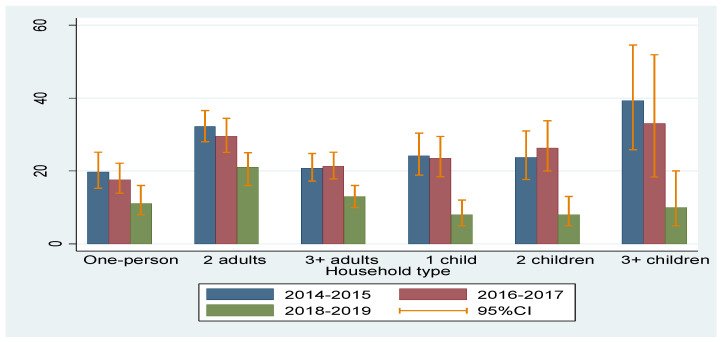
While food insecurity (FI) has been extensively studied in many countries, there have been few empirical contributions in Poland to date. The main objective of our research was to identify the socio-demographic factors affecting the risk of FI in Poland within 2014-2019. Moreover, we aimed to examine the effects of the family-oriented social program "Family 500+" by comparing the situation in various types of households with children a few years before and after the program was launched. The analysis was based on the set of eight-item FI indicators adopted by the Food and Agriculture Organization using the Gallup World Poll nationally representative survey data. Based on our results the most vulnerable groups in the context of FI were identified. We confirmed the importance of education, gender, age, marital status, household composition, status of employment and income in preventing FI. The effectiveness of the support program in reducing FI was demonstrated as households with at least three children experienced significant improvement in the FI status during the studied years. These findings should be especially important in the context of the impact of the COVID-19 pandemic on FI. As FI can affect the quality and quantity of food choices it is associated with a poorer health status, which increases the risk of infection, including COVID-19, and worsens recovery prognosis. Planning an efficient response to the pandemic requires a comprehension of the increased risk of exposure experienced by people, especially those who are food insecure.
尽管在许多国家都广泛研究了粮食不安全问题,但波兰在这方面的实证研究却很少。我们的主要研究目标是确定 2014 年至 2019 年期间影响波兰粮食不安全风险的社会人口因素。此外,我们还旨在通过比较该计划推出前后几年有孩子的各种类型家庭的情况,来检验以家庭为导向的社会计划“家庭 500+”的效果。分析基于粮农组织采用的八项粮食不安全指标集,使用盖洛普世界民意调查的全国代表性调查数据。根据我们的结果,确定了粮食不安全方面最脆弱的群体。我们证实了教育、性别、年龄、婚姻状况、家庭构成、就业状况和收入在预防粮食不安全方面的重要性。支持计划在减少粮食不安全方面的有效性得到了证明,因为至少有三个孩子的家庭在研究期间粮食不安全状况显著改善。在 COVID-19 大流行对粮食不安全产生影响的背景下,这些发现尤为重要。由于粮食不安全会影响食物选择的质量和数量,因此与较差的健康状况相关,从而增加了感染的风险,包括 COVID-19,并且恶化了康复预后。规划对大流行的有效应对措施需要了解人们,特别是那些粮食不安全的人所面临的风险增加。