School of Economics and Management, Harbin Engineering University, Harbin 150001, China.
Int J Environ Res Public Health. 2020 Aug 10;17(16):5775. doi: 10.3390/ijerph17165775.
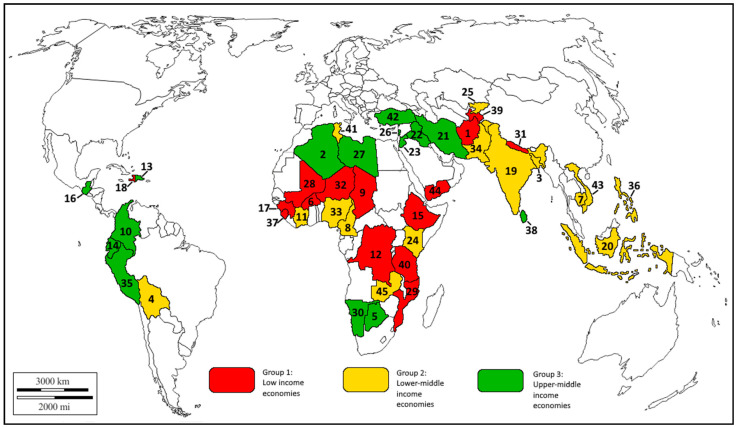
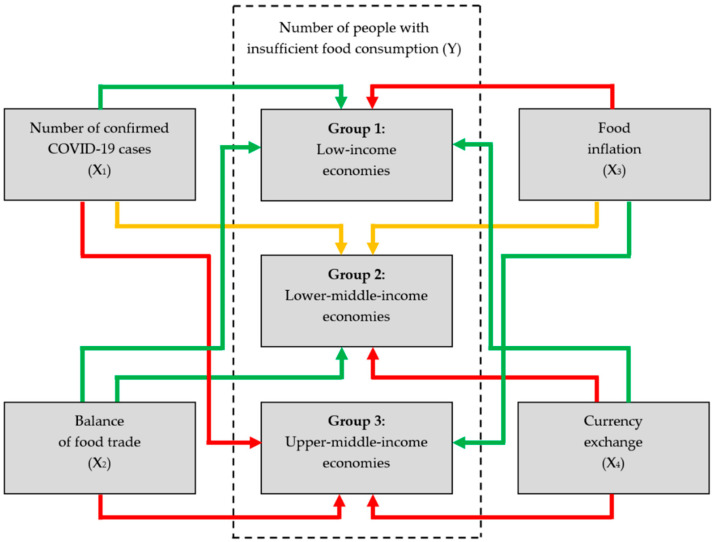
The stability of food supply chains is crucial to the food security of people around the world. Since the beginning of 2020, this stability has been undergoing one of the most vigorous pressure tests ever due to the COVID-19 outbreak. From a mere health issue, the pandemic has turned into an economic threat to food security globally in the forms of lockdowns, economic decline, food trade restrictions, and rising food inflation. It is safe to assume that the novel health crisis has badly struck the least developed and developing economies, where people are particularly vulnerable to hunger and malnutrition. However, due to the recency of the COVID-19 problem, the impacts of macroeconomic fluctuations on food insecurity have remained scantily explored. In this study, the authors attempted to bridge this gap by revealing interactions between the food security status of people and the dynamics of COVID-19 cases, food trade, food inflation, and currency volatilities. The study was performed in the cases of 45 developing economies distributed to three groups by the level of income. The consecutive application of the autoregressive distributed lag method, Yamamoto's causality test, and variance decomposition analysis allowed the authors to find the food insecurity effects of COVID-19 to be more perceptible in upper-middle-income economies than in the least developed countries. In the latter, food security risks attributed to the emergence of the health crisis were mainly related to economic access to adequate food supply (food inflation), whereas in higher-income developing economies, availability-sided food security risks (food trade restrictions and currency depreciation) were more prevalent. The approach presented in this paper contributes to the establishment of a methodology framework that may equip decision-makers with up-to-date estimations of health crisis effects on economic parameters of food availability and access to staples in food-insecure communities.
食品供应链的稳定性对全球人民的食品安全至关重要。自 2020 年初以来,由于 COVID-19 疫情的爆发,食品供应链稳定性经受了有史以来最剧烈的压力测试之一。从单纯的健康问题开始,大流行已经以封锁、经济衰退、粮食贸易限制和粮食通胀上升的形式,对全球粮食安全构成了经济威胁。可以肯定的是,这场新的卫生危机对最不发达国家和发展中国家造成了严重打击,这些国家的人民特别容易遭受饥饿和营养不良。然而,由于 COVID-19 问题的新近出现,宏观经济波动对粮食不安全的影响仍鲜有探讨。在这项研究中,作者试图通过揭示人民的粮食安全状况与 COVID-19 病例、粮食贸易、粮食通胀和货币波动的动态之间的相互作用来填补这一空白。该研究针对 45 个发展中经济体进行,这些经济体根据收入水平分为三组。连续应用自回归分布滞后方法、Yamamoto 因果关系检验和方差分解分析,使作者能够发现 COVID-19 对中高收入经济体的粮食不安全影响比最不发达国家更为明显。在后者中,与卫生危机出现相关的粮食安全风险主要与获得充足粮食供应的经济机会(粮食通胀)有关,而在较高收入的发展中经济体中,可用性方面的粮食安全风险(粮食贸易限制和货币贬值)更为普遍。本文提出的方法有助于建立一个方法论框架,使决策者能够及时估计卫生危机对粮食不安全社区的粮食供应和获取主食的经济参数的影响。