Department of Molecular and Biomedical Sciences, Jožef Stefan Institute, Jamova cesta 39, SI-1000 Ljubljana, Slovenia.
Université Côte d'Azur (UCA), Centre National de la Recherche Scientifique (CNRS), Institut de Pharmacologie Moléculaire et Cellulaire (IPMC), UMR7275, Valbonne Sophia Antipolis, France.
Biochimie. 2021 Oct;189:40-50. doi: 10.1016/j.biochi.2021.05.017. Epub 2021 Jun 16.
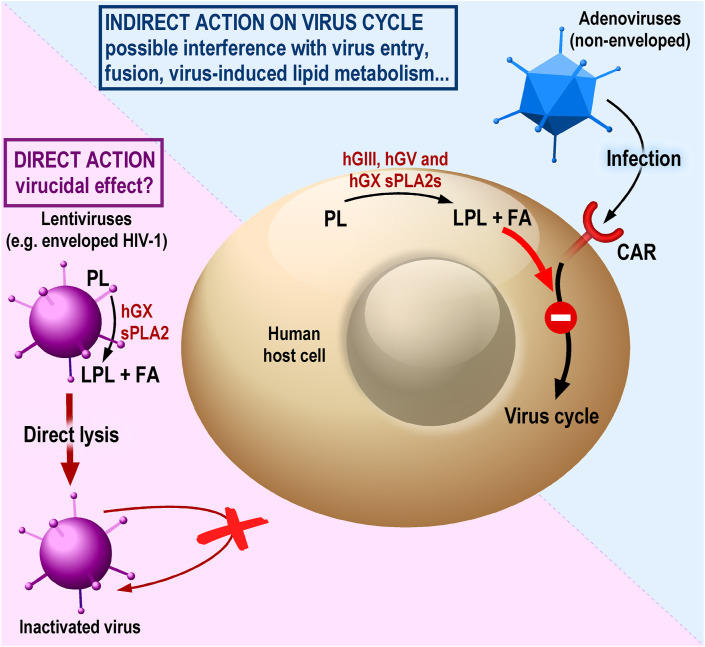
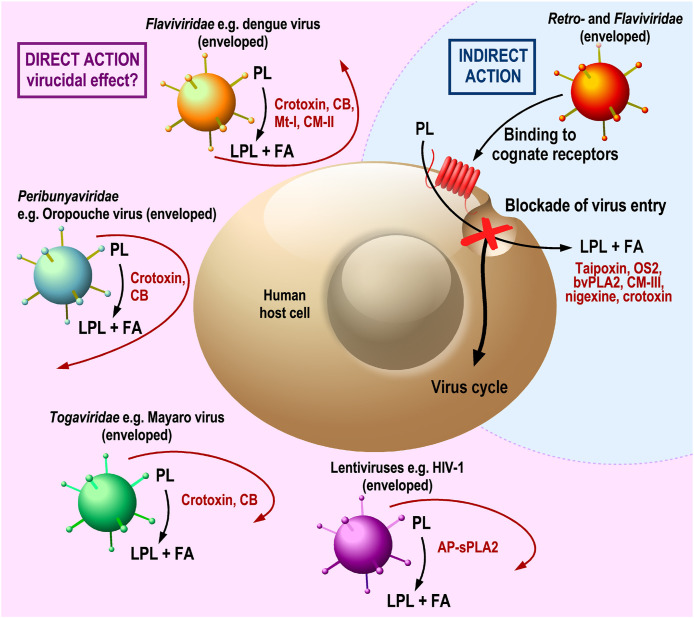
Secreted phospholipases A (sPLAs) form a widespread group of structurally-related enzymes that catalyse the hydrolysis of the sn-2 ester bond of glycerophospholipids to produce free fatty acids and lysophospholipids. In humans, nine catalytically active and two inactive sPLA proteins have been identified. These enzymes play diverse biological roles, including host defence against bacteria, parasites and viruses. Several of these endogenous sPLAs may play a defensive role in viral infections, as they display in vitro antiviral activity by both direct and indirect mechanisms. However, endogenous sPLAs may also exert an offensive and negative role, dampening the antiviral response or promoting inflammation in animal models of viral infection. Similarly, several exogenous sPLAs, most of them from snake venoms and other animal venoms, possess in vitro antiviral activities. Thus, both endogenous and exogenous sPLAs may be exploited for the development of new antiviral substances or as therapeutic targets for antagonistic drugs that may promote a more robust antiviral response. In this review, the antiviral versus proviral role of both endogenous and exogenous sPLAs against various viruses including coronaviruses is presented. Based on the highlighted developments in this area of research, possible directions of future investigation are envisaged. One of them is also a possibility of exploiting sPLAs as biological markers of the severity of the Covid-19 pandemic caused by SARS-CoV-2 infection.
分泌型磷脂酶 A(sPLA)是一组广泛存在的结构相关酶,能够催化甘油磷脂 sn-2 酯键的水解,生成游离脂肪酸和溶血磷脂。在人类中,已经鉴定出九种具有催化活性的和两种无活性的 sPLA 蛋白。这些酶具有多种生物学功能,包括宿主对细菌、寄生虫和病毒的防御。其中一些内源性 sPLA 在病毒感染中可能发挥防御作用,因为它们通过直接和间接机制在体外表现出抗病毒活性。然而,内源性 sPLA 也可能发挥进攻性和负面作用,抑制抗病毒反应或在病毒感染的动物模型中促进炎症。同样,几种外源性 sPLA,大多数来自蛇毒和其他动物毒液,具有体外抗病毒活性。因此,内源性和外源性 sPLA 都可以被开发用于新的抗病毒物质,或者作为拮抗药物的治疗靶点,这些药物可能促进更强大的抗病毒反应。在这篇综述中,介绍了内源性和外源性 sPLA 对各种病毒(包括冠状病毒)的抗病毒与促病毒作用。基于该研究领域的突出进展,设想了未来可能的研究方向。其中之一是利用 sPLA 作为 SARS-CoV-2 感染引起的 COVID-19 大流行严重程度的生物学标志物的可能性。