Sutton R E, Boothroyd J C
Department of Medical Microbiology, Stanford University School of Medicine, CA 94305.
EMBO J. 1988 May;7(5):1431-7. doi: 10.1002/j.1460-2075.1988.tb02960.x.
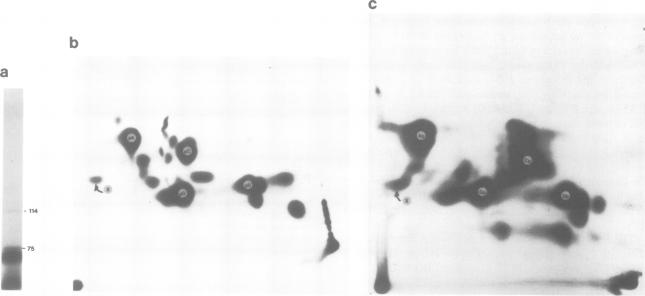
The 5' ends of trypanosome mRNAs consist of an identical sequence of 39 nucleotides which is derived from a discrete transcript of approximately 140 nucleotides (medRNA). It has been proposed that generation of chimeric mRNAs in trypanosomes occurs by the process of trans-splicing involving medRNA and an acceptor RNA. Part of the basis for this suggestion comes from the ability of HeLa cell extracts (known to contain debranching activity) to catalyze the release of the intron portion of medRNA (minRNA) implying a Y-branched intermediate in the splicing process. Here we provide direct chemical analysis that miniRNA is attached to higher mol. wt RNA molecules by a 2'-5' phosphodiester bond (i.e. as a branched structure). We also demonstrate that trypanosomes have substantial amounts of debranching activity which is similar in nature to that of HeLa cells. These results provide further evidence for trans-splicing in trypanosomes and highlights its similarity to cis-splicing in other eukaryotes.
锥虫mRNA的5'端由39个核苷酸的相同序列组成,该序列源自约140个核苷酸的离散转录本(medRNA)。有人提出,锥虫中嵌合mRNA的产生是通过涉及medRNA和受体RNA的反式剪接过程发生的。这一推测的部分依据来自于HeLa细胞提取物(已知含有去分支活性)催化medRNA内含子部分(minRNA)释放的能力,这意味着剪接过程中存在Y形分支中间体。在此,我们提供直接化学分析表明,minRNA通过2'-5'磷酸二酯键连接到更高分子量的RNA分子上(即作为一种分支结构)。我们还证明,锥虫具有大量的去分支活性,其性质与HeLa细胞的相似。这些结果为锥虫中的反式剪接提供了进一步的证据,并突出了其与其他真核生物顺式剪接的相似性。