Medical Oncology, Tata Memorial Centre, Mumbai, India.
Medical Oncology, Basavatkaram Indo American Cancer Hospital, Hyderabad, India.
JCO Glob Oncol. 2021 Jun;7:849-861. doi: 10.1200/GO.21.00051.
There are deficient data on prevalence of germline mutations in breast cancer susceptibility genes 1 and 2 (/) in Indian patients with ovarian cancer who are not selected by clinical features.
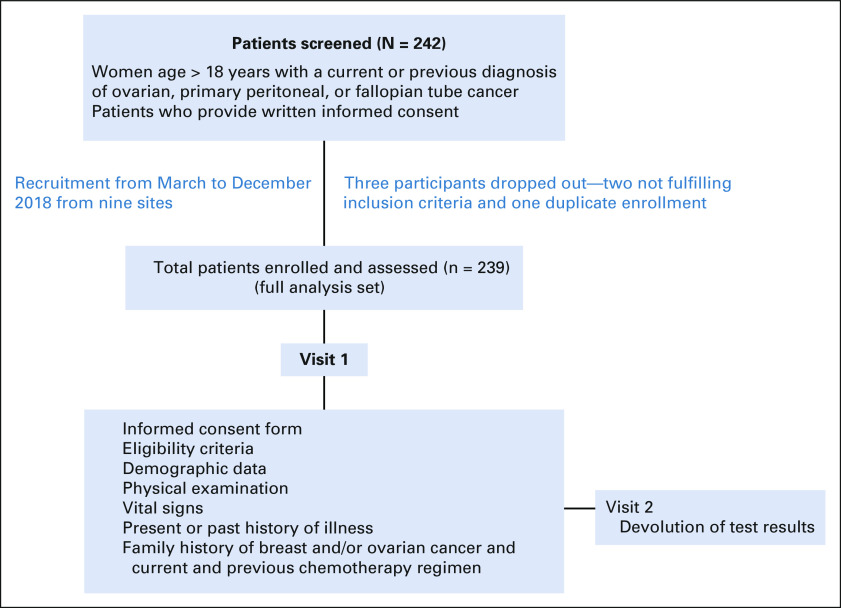
This prospective, cross-sectional, noninterventional study in nine Indian centers included patients with newly diagnosed or relapsed epithelial ovarian, primary peritoneal, or fallopian tube cancer. The primary objective was to assess the prevalence of / mutations, and the secondary objective was to correlate / status with clinicopathologic characteristics. Mutation testing was performed by a standard next-generation sequencing assay.
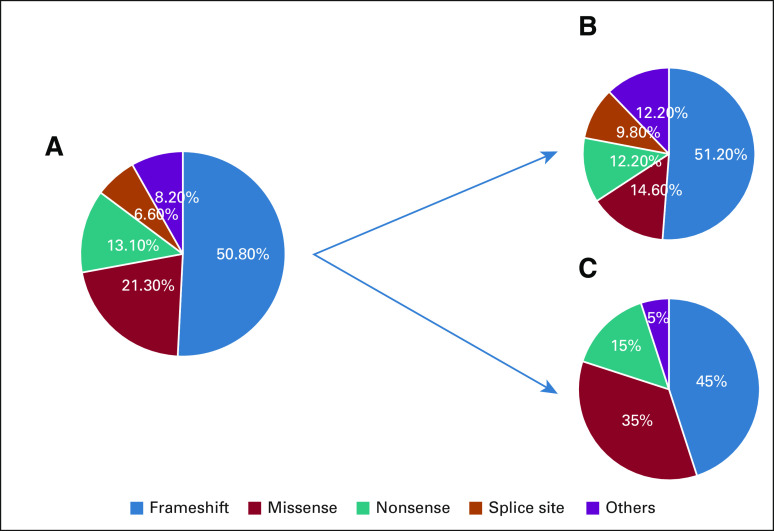
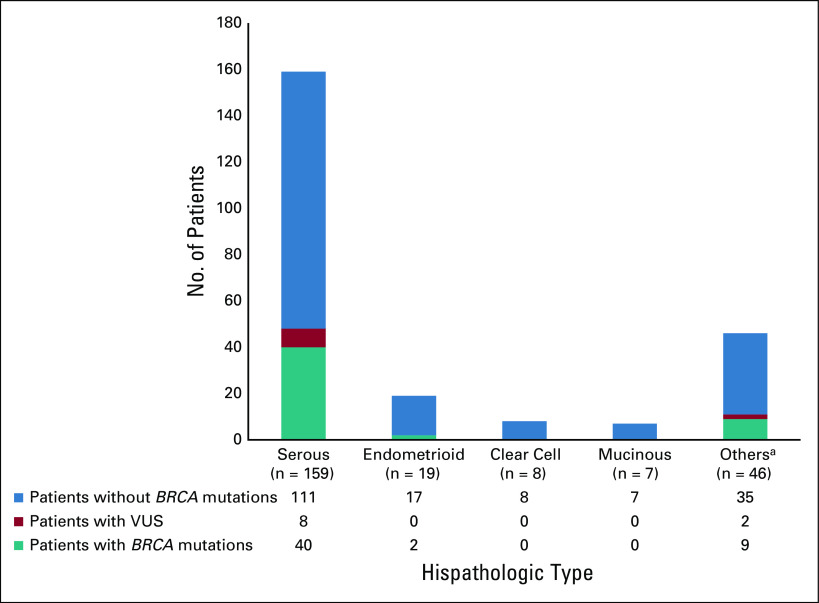
Between March 2018 and December 2018, 239 patients with a median age of 53.0 (range, 23.0-86.0 years) years were included, of whom 203 (84.9%) had newly diagnosed disease, 36 (15.1%) had family history of ovarian or breast cancer, and 159 (66.5%) had serous subtype of epithelial ovarian cancer. Germline pathogenic or likely pathogenic mutations in and were detected in 37 (15.5%; 95% CI, 11.1 to 20.7) and 14 (5.9%; 95% CI, 3.2 to 9.6) patients, respectively, whereas variants of uncertain significance in these genes were seen in four (1.7%; 95% CI, 0.5 to 4.2) and six (2.5%; 95% CI, 0.9 to 5.4) patients, respectively. The prevalence of pathogenic or likely pathogenic mutations in patients with serous versus nonserous tumors, with versus without relevant family history, and ≤ 50 years versus > 50 years, were 40 of 159 (25.2%; 95% CI, 18.6 to 32.6) versus 11 of 80 (13.8%; 95% CI, 7.1 to 23.3; = .0636), 20 of 36 (55.6%; 95% CI, 38.1 to 72.1) versus 41 of 203 (20.2%; 95% CI, 14.9 to 26.4; < .0001), and 20 of 90 (22.2%; 95% CI, 14.1 to 32.2) versus 31 of 149 (20.8%; 95% CI, 14.6 to 28.2; = .7956), respectively.
There is a high prevalence of pathogenic or likely pathogenic germline mutations in Indian patients with ovarian cancer.
在未通过临床特征选择的患有卵巢癌的印度患者中,关于乳腺癌易感基因 1 和 2(/)种系突变的流行率数据较少。
本研究为在印度 9 个中心进行的前瞻性、横断面、非干预性研究,纳入了新诊断或复发的上皮性卵巢癌、原发性腹膜癌或输卵管癌患者。主要目的是评估/突变的流行率,次要目的是分析/状态与临床病理特征的相关性。突变检测采用标准的下一代测序分析。
2018 年 3 月至 2018 年 12 月期间,共纳入 239 例中位年龄为 53.0(范围:23.0-86.0 岁)岁的患者,其中 203 例(84.9%)为新诊断疾病,36 例(15.1%)有卵巢癌或乳腺癌家族史,159 例(66.5%)为浆液性上皮性卵巢癌。在 37 例(15.5%;95%CI:11.1-20.7)和 14 例(5.9%;95%CI:3.2-9.6)患者中分别检测到/基因的致病性或可能致病性突变,而在这两个基因中发现了 4 例(1.7%;95%CI:0.5-4.2)和 6 例(2.5%;95%CI:0.9-5.4)患者的意义不确定的变异。在浆液性肿瘤与非浆液性肿瘤、有或无相关家族史、≤50 岁与>50 岁的患者中,致病性或可能致病性/突变的流行率分别为 159 例中的 40 例(25.2%;95%CI:18.6-32.6)与 80 例中的 11 例(13.8%;95%CI:7.1-23.3;=0.0636)、36 例中的 20 例(55.6%;95%CI:38.1-72.1)与 203 例中的 41 例(20.2%;95%CI:14.9-26.4;<0.0001)和 90 例中的 20 例(22.2%;95%CI:14.1-32.2)与 149 例中的 31 例(20.8%;95%CI:14.6-28.2;=0.7956)。
印度卵巢癌患者中存在高比例的致病性或可能致病性/种系突变。