Department of Pediatrics and Neonatology, OLVG, Amsterdam, The Netherlands.
Department of Pediatrics, Emma Children's Hospital, Amsterdam UMC, University of Amsterdam, Vrije Universiteit, Amsterdam, The Netherlands.
PLoS One. 2021 Jun 9;16(6):e0252074. doi: 10.1371/journal.pone.0252074. eCollection 2021.
Active parent participation in neonatal care and collaboration between parents and professionals during infant hospitalization in the neonatal intensive care unit (NICU) is beneficial for infants and their parents. A tool is needed to support parents and to study the effects and implementation of parent-partnered models of neonatal care.
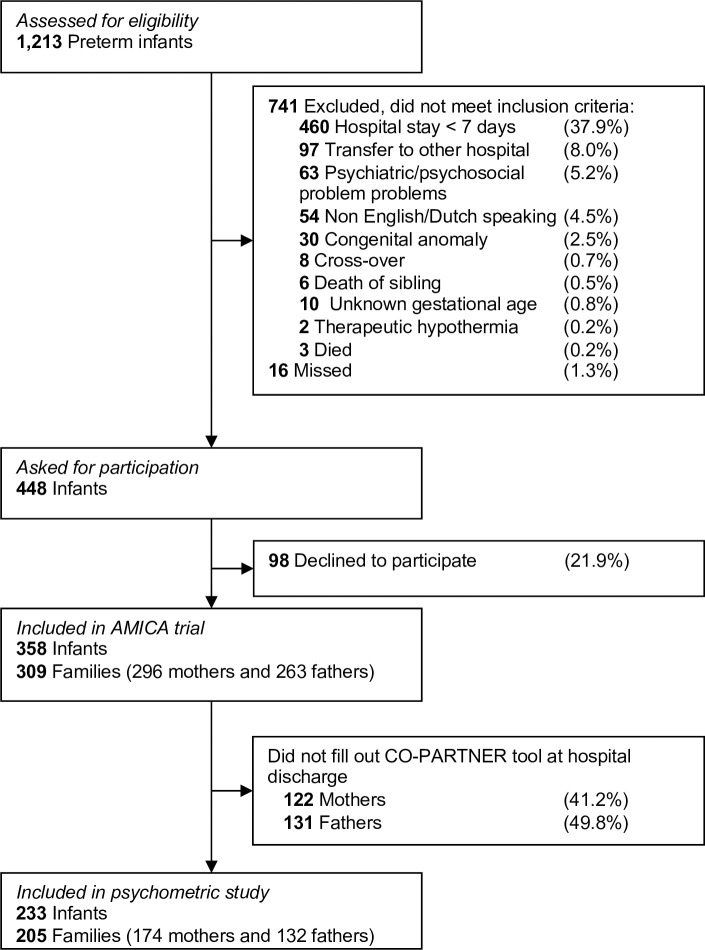
We developed and psychometrically evaluated a tool measuring active parent participation and collaboration in neonatal care within six domains: Daily Care, Medical Care, Acquiring Information, Parent Advocacy, Time Spent with Infant and Closeness and Comforting the Infant. Items were generated in focus group discussions and in-depth interviews with professionals and parents. The tool was completed at NICU-discharge by 306 parents (174 mothers and 132 fathers) of preterm infants. Subsequently, we studied structural validity with confirmatory factor analysis (CFA), construct validity, using the Average Variance Extracted and Heterotrait-Monotrait ratio of correlations, and hypothesis testing with correlations and univariate linear regression. For internal consistency we calculated composite reliability (CR). We performed multiple imputations by chained equations for missing data.
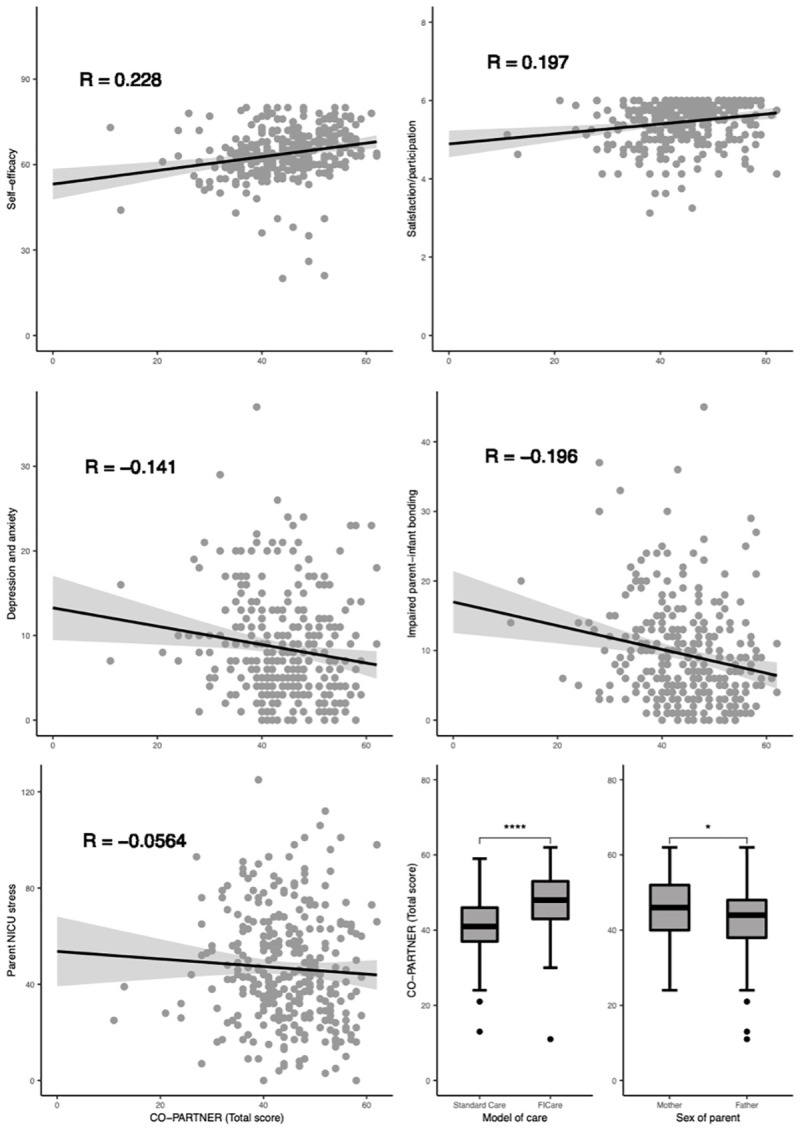
A 31 item tool for parent participation and collaboration in neonatal care was developed. CFA revealed high factor loadings of items within each domain. Internal consistency was 0.558 to 0.938. Convergent validity and discriminant validity were strong. Higher scores correlated with less parent depressive symptoms (r = -0.141, 95%CI -0.240; -0.029, p = 0.0141), less impaired parent-infant bonding (r = -0.196, 95%CI -0.302; -0.056, p<0.0001), higher parent self-efficacy (r = 0.228, 95%CI 0.117; 0.332, p<0.0001), and higher parent satisfaction (r = 0.197, 95%CI 0.090; 0.308, p = 0.001). Parents in a family integrated care model had higher scores than in standard care (beta 6.020, 95%CI 4.144; 7.895, p<0.0001) and mothers scored higher than fathers (beta 2.103,95%CI 0.084; 4.121, p = 0.041).
The CO-PARTNER tool explicitly measures parents' participation and collaboration with professionals in neonatal care incorporating their unique roles in care provision, leadership, and connection to their infant. The tool consists of 31 items within six domains with good face, content, construct and structural validity.
积极的父母参与新生儿护理以及父母和专业人员在新生儿重症监护病房(NICU)住院期间的协作,对婴儿及其父母都有益处。需要一种工具来支持父母,并研究父母参与式新生儿护理模式的效果和实施情况。
我们开发了一种工具,并对其进行了心理测量评估,该工具用于测量六个领域的积极父母参与和协作情况:日常护理、医疗护理、获取信息、父母倡导、与婴儿共度的时间以及与婴儿的亲密感和安慰。这些项目是通过专业人员和父母的焦点小组讨论和深入访谈产生的。306 名早产儿的父母(174 名母亲和 132 名父亲)在 NICU 出院时完成了该工具。随后,我们使用确认性因素分析(CFA)、平均方差提取和特质-共同特质比相关来研究结构有效性,并使用相关性和单变量线性回归进行假设检验。对于内部一致性,我们计算了综合可靠性(CR)。我们通过链式方程对缺失数据进行了多次插补。
开发了一种用于父母参与和协作式新生儿护理的 31 项工具。CFA 显示每个领域内项目的因子负荷都很高。内部一致性在 0.558 到 0.938 之间。收敛有效性和判别有效性都很强。较高的分数与父母抑郁症状较轻(r = -0.141,95%CI -0.240;-0.029,p = 0.0141)、父母与婴儿的联系受损程度较轻(r = -0.196,95%CI -0.302;-0.056,p < 0.0001)、父母自我效能感较高(r = 0.228,95%CI 0.117;0.332,p < 0.0001)和父母满意度较高(r = 0.197,95%CI 0.090;0.308,p = 0.001)相关。在家庭综合护理模式中,父母的得分高于标准护理(β 6.020,95%CI 4.144;7.895,p < 0.0001),母亲的得分高于父亲(β 2.103,95%CI 0.084;4.121,p = 0.041)。
CO-PARTNER 工具明确衡量了父母在新生儿护理方面与专业人员的参与和协作情况,其中包括他们在护理提供、领导能力以及与婴儿联系方面的独特角色。该工具由 6 个领域的 31 个项目组成,具有良好的表面、内容、结构和结构有效性。