Rehabilitation Sciences Program, College of Health & Rehabilitation, Sargent College, Boston University, 940 Commonwealth Ave W, Boston, MA, 02215, USA.
Center for Psychiatric Rehabilitation, College of Health & Rehabilitation, Sargent College, Boston University, Boston, MA, USA.
Implement Sci. 2021 Jun 10;16(1):61. doi: 10.1186/s13012-021-01132-0.
Knowledge about the development of organizational readiness for implementation (ORI) is limited. ORI, referred to as the willingness and capacity of all relevant stakeholders to change practice, is critical for increasing the adoption rate of evidence-based practices and improving implementation outcomes. However, no methodology currently guides ORI's enhancement or addresses differences in readiness needs across an organization. This study used the transtheoretical model (TTM) as a framework for classifying a well-established compilation of implementation strategies into three readiness stages: pre-contemplation, contemplation, and preparation.
A modified Delphi method was used to establish consensus among a panel of purposefully selected research and field implementation experts. The Delphi process involved three rounds of online questionnaires. The third round also included a live video discussion to clarify definitions in an effort to increase consensus among experts.
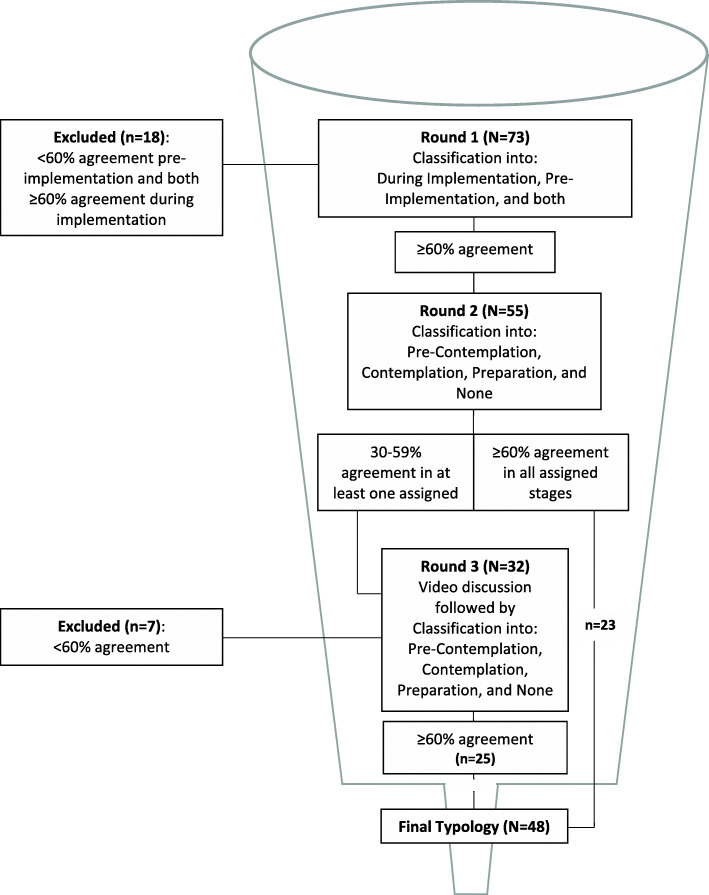
Of the 73 strategies reviewed, the experts identified 75% (n = 55) as relevant for pre-implementation and reached a high-level agreement on the assignment of 7% (n = 5) of the strategies to the pre-contemplation stage (ORI-1), 25% (n = 18) to the contemplation stage (ORI-2), and 52% (n = 38) to the preparation stage (ORI-3). Several strategies were identified as relevant to more than one stage.
Participating experts were able to reach high-level agreement on the relevance of specific sets of implementation strategies to each of the three ORI stages. The lowest number of strategies was assigned to ORI-1 and the highest number to ORI-3. Given the overlap of strategies across ORI stages, there is a need to better understand the specific utilization of such strategies at different stages. Future studies are needed to empirically evaluate the relevance and applicability of this expert-informed typology based on implementers' experiences in the field.
对实施组织准备就绪(ORI)发展的了解有限。ORI 是指所有相关利益相关者改变实践的意愿和能力,对于提高基于证据的实践的采用率和改善实施结果至关重要。然而,目前没有方法学指导 ORI 的增强,也无法解决组织内准备就绪需求的差异。本研究使用跨理论模型(TTM)作为框架,将一套成熟的实施策略分类为三个准备就绪阶段:前沉思、沉思和准备。
使用改良 Delphi 法在经过精心挑选的研究和现场实施专家小组中达成共识。Delphi 流程涉及三轮在线问卷。第三轮还包括现场视频讨论,以澄清定义,努力增加专家之间的共识。
在所审查的 73 项策略中,专家确定了 75%(n=55)与实施前相关,并就 7%(n=5)的策略分配到前沉思阶段(ORI-1)、25%(n=18)到沉思阶段(ORI-2)和 52%(n=38)到准备阶段(ORI-3)达成了高度一致。一些策略被确定与多个阶段相关。
参与的专家能够就特定实施策略集对每个 ORI 阶段的相关性达成高度一致。分配给 ORI-1 的策略数量最少,分配给 ORI-3 的策略数量最多。鉴于策略在 ORI 阶段之间存在重叠,需要更好地了解不同阶段中此类策略的具体利用情况。未来的研究需要根据实施者在现场的经验,对基于专家意见的这种分类法的相关性和适用性进行实证评估。