Institute of Environmental and Occupational Health Science, College of Public Health, National Taiwan University, Taipei, Taiwan.
Department of Pediatrics, National Taiwan University Hospital, Taipei, Taiwan.
J Formos Med Assoc. 2021 Jun;120 Suppl 1:S19-S25. doi: 10.1016/j.jfma.2021.05.008. Epub 2021 Jun 1.
As COVID-19 has become a pandemic emerging infectious disease it is important to examine whether there was a spatiotemporal clustering phenomenon in the globe during the rapid spread after the first outbreak reported from southern China.
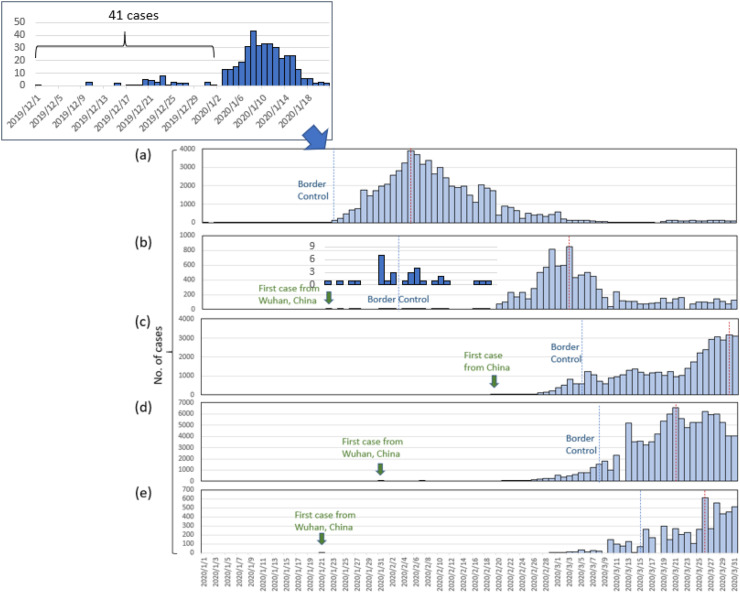
The open data on the number of COVID-19 cases reported at daily basis form the globe were used to assess the evolution of outbreaks with international air link on the same latitude and also including Taiwan. The dynamic Susceptible-Infected-Recovered model was used to evaluate continental transmission from December 2019 to March 2020 before the declaration of COVID-19 pandemic with basic reproductive number and effective reproductive number before and after containment measurements.
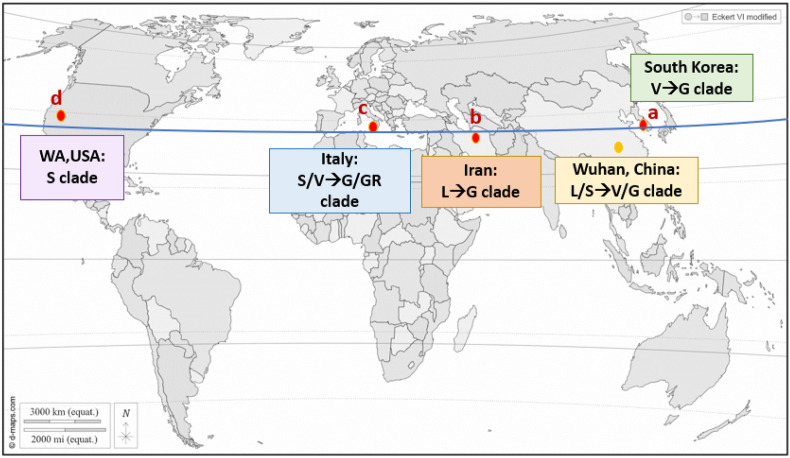
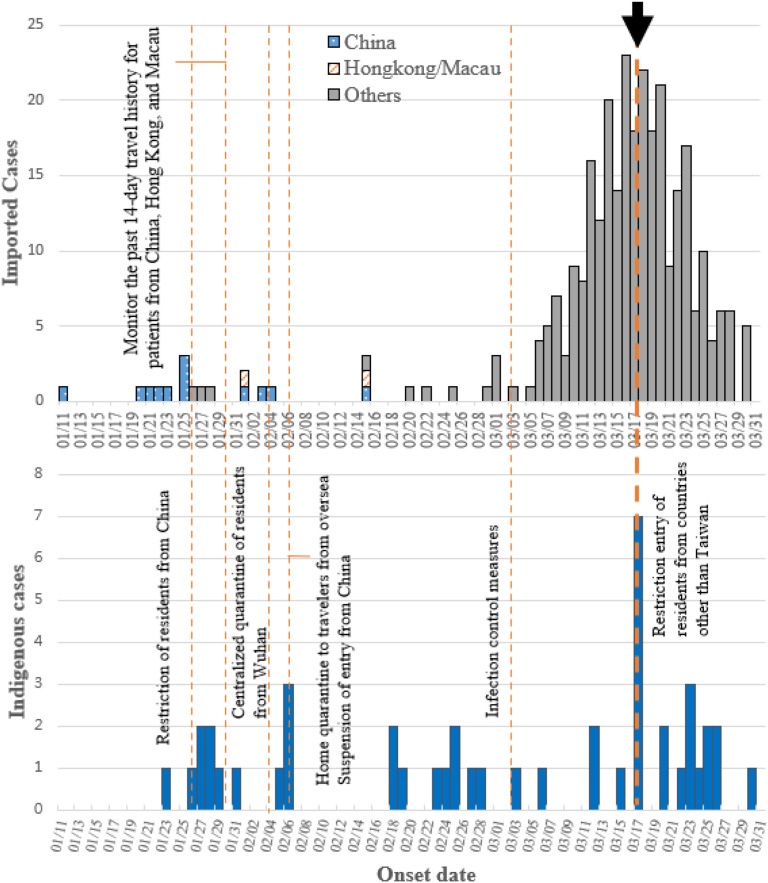
For the initial COVID-19 outbreak in China, the estimated reproductive number was reduced from 2.84 during the overwhelming outbreaks in early January to 0.43 after the strict lockdown policy. It is very surprising to find there were three countries (including South Korea, Iran, and Italy) and the Washington state of the USA on the 38° North Latitude involved with large-scale community-acquired outbreaks since the first imported COVID-19 cases from China. The propagation of continental transmission was augmented from hotspot to hotspot with higher reproductive number immediately before the declaration of pandemic. By contrast, there was not any large community-acquired outbreak in Taiwan.
The propagated spatiotemporal transmission from China to other hotspots may explain the emerging pandemic that can only be exempted by timely border control and preparedness of containment measurements according to Taiwan experience.
随着 COVID-19 成为一种大流行的新发传染病,重要的是要检查在中国南方首次报告后迅速传播期间,全球是否存在时空聚集现象。
使用来自全球的 COVID-19 病例每日报告的公开数据,评估具有国际航空联系的疫情爆发情况,包括台湾。使用动态易感染-感染-恢复模型来评估 2019 年 12 月至 2020 年 3 月宣布 COVID-19 大流行之前的大陆传播,包括遏制措施前后的基本繁殖数和有效繁殖数。
对于中国最初的 COVID-19 爆发,在 1 月初疫情爆发期间估计的繁殖数从 2.84 降至严格封锁政策实施后的 0.43。非常令人惊讶的是,自中国首例输入性 COVID-19 病例以来,有三个国家(包括韩国、伊朗和意大利)和美国华盛顿州在 38°北纬线上出现了大规模社区获得性爆发。在宣布大流行之前,大陆传播从热点到热点的传播增强,繁殖数更高。相比之下,台湾没有任何大规模的社区获得性爆发。
从中国传播到其他热点的时空传播可能解释了这种新兴的大流行,根据台湾的经验,只有及时采取边境控制和遏制措施准备才能避免。