Lai Chao-Chih, Hsu Chen-Yang, Jen Hsiao-Hsuan, Yen Amy Ming-Fang, Chan Chang-Chuan, Chen Hsiu-Hsi
Emergency Department of Taipei City Hospital, Ren-Ai Branch, Taipei, 106 Taiwan.
Institute of Epidemiology and Preventive Medicine, College of Public Health, National Taiwan University, Room 533, No. 17, Xu-Zhou Road, Taipei, 100 Taiwan.
Stoch Environ Res Risk Assess. 2021;35(7):1319-1333. doi: 10.1007/s00477-020-01968-w. Epub 2021 Jan 26.
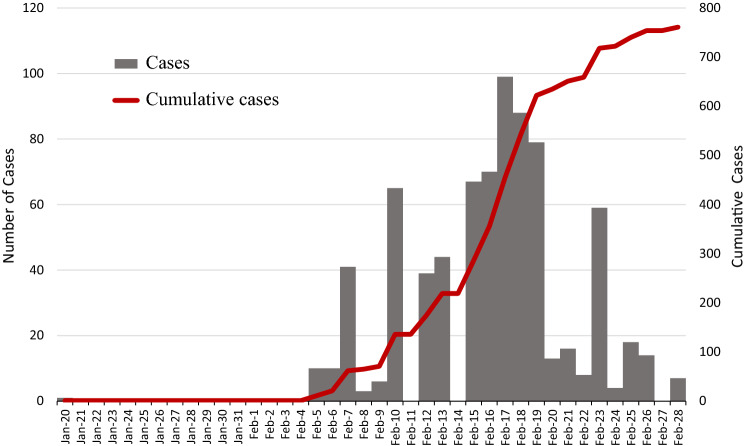
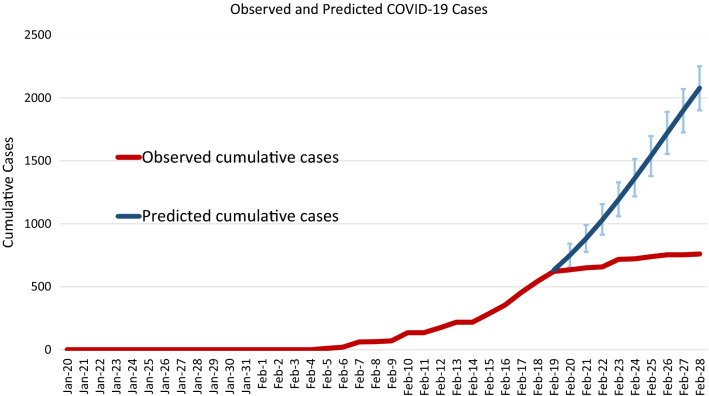
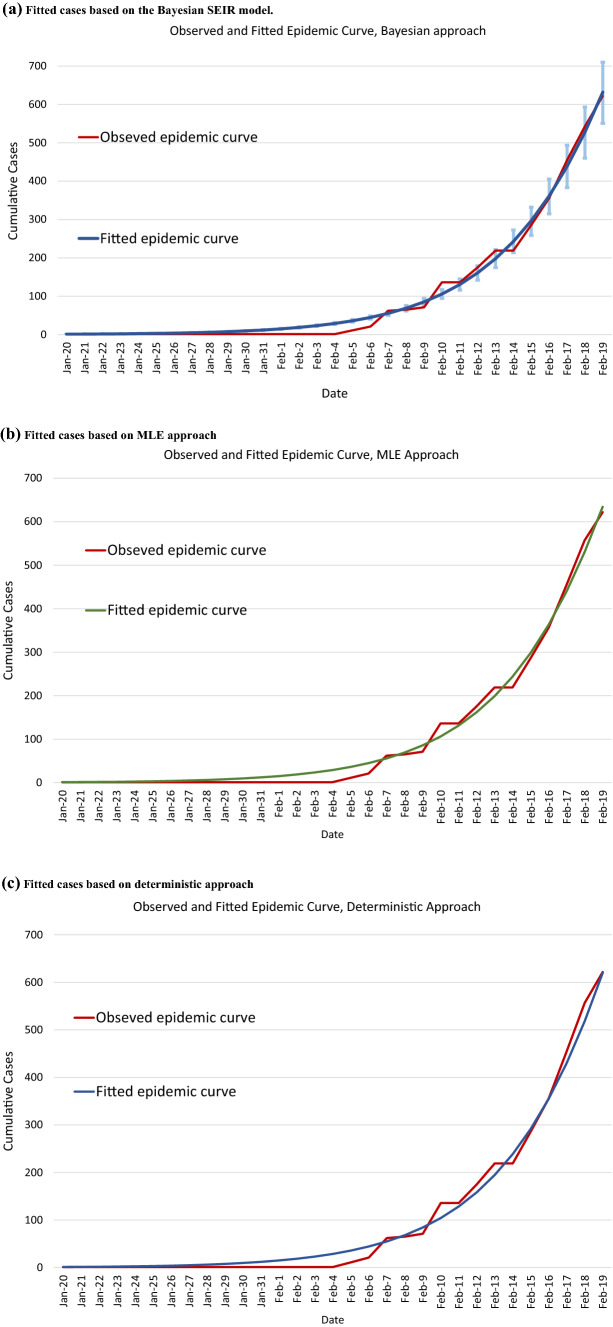
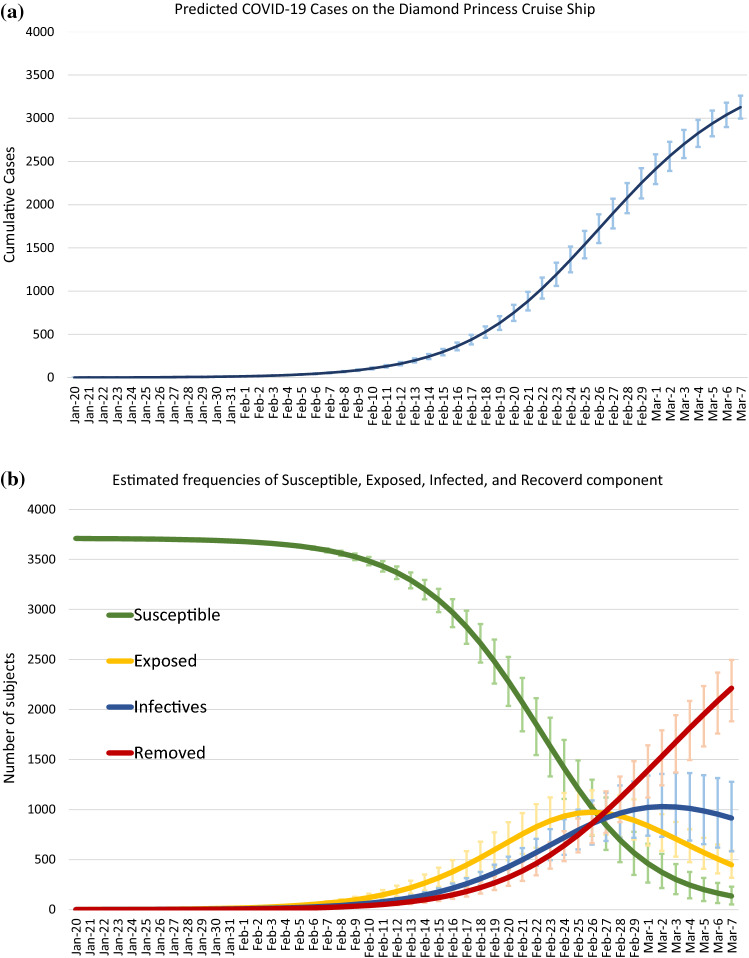
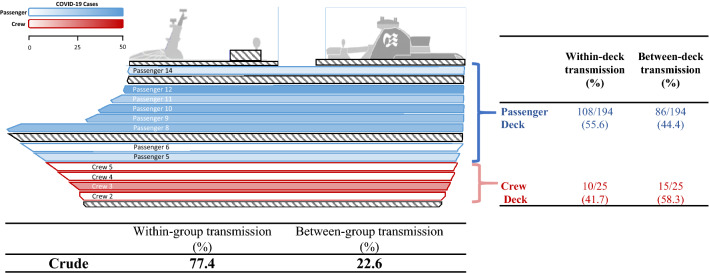
The outbreak of COVID-19 on the Diamond Princess Cruise Ship provides an unprecedented opportunity to estimate its original transmissibility with basic reproductive number (R) and the effectiveness of containment measures. We developed an ordinary differential equation-based Susceptible-Exposed-Infected-Recovery (SEIR) model with Bayesian underpinning to estimate the main parameter of R determined by transmission coefficients, incubation period, and the recovery rate. Bayesian Markov Chain Monte Carlo (MCMC) estimation method was used to tackle the parameters of uncertainty resulting from the outbreak of COVID-19 given a small cohort of the cruise ship. The extended stratified SEIR model was also proposed to elucidate the heterogeneity of transmission route by the level of deck with passengers and crews. With the application of the overall model, R was estimated as high as 5.70 (95% credible interval: 4.23-7.79). The entire epidemic period without containment measurements was approximately 47 days and reached the peak one month later after the index case. The partial containment measure reduced 63% (95% credible interval: 60-66%) infected passengers. With the deck-specific SEIR model, the heterogeneity of R estimates by each deck was noted. The estimated R figures were 5.18 for passengers (5-14 deck), mainly from the within-deck transmission, and 2.46 for crews (2-4 deck), mainly from the between-deck transmission. Modelling the dynamic of COVID-19 on the cruise ship not only provides an insight into timely evacuation and early isolation and quarantine but also elucidates the relative contributions of different transmission modes on the cruise ship though the deck-stratified SEIR model.
The online version contains supplementary material available at (10.1007/s00477-020-01968-w).
“钻石公主号”邮轮上新冠病毒病(COVID-19)的爆发提供了一个前所未有的机会,可通过基本再生数(R)来估计其初始传播力以及防控措施的效果。我们开发了一种基于常微分方程的易感-暴露-感染-康复(SEIR)模型,并采用贝叶斯方法来估计由传播系数、潜伏期和康复率所决定的主要参数R。鉴于邮轮上病例数较少,采用贝叶斯马尔可夫链蒙特卡洛(MCMC)估计方法来处理因COVID-19爆发而产生的参数不确定性问题。还提出了扩展分层SEIR模型,以阐明不同甲板上乘客和船员传播途径的异质性。应用整体模型估计R高达5.70(95%可信区间:4.23 - 7.79)。在没有防控措施的情况下,整个疫情期约为47天,在首例病例出现后一个月达到高峰。部分防控措施使受感染乘客减少了63%(95%可信区间:60 - 66%)。通过特定甲板的SEIR模型,注意到各甲板R估计值的异质性。乘客(5 - 14号甲板)的估计R值为5.18,主要来自甲板内传播;船员(2 - 4号甲板)的估计R值为2.46,主要来自甲板间传播。对邮轮上COVID-19动态进行建模,不仅有助于深入了解及时疏散、早期隔离和检疫措施,还通过甲板分层SEIR模型阐明了邮轮上不同传播模式的相对作用。
在线版本包含补充材料,可在(10.1007/s00477-020-01968-w)获取。