Widener Michael J, Ren Linda, Astbury Chloe C, Smith Lindsey G, Penney Tarra L
Department of Geography and Planning, University of Toronto - St. George, 100 St. George St. Toronto, ON, M5S3G3, Canada.
School of Global Health, York University, 4700, Keele Street, Toronto, ON, M3J 1P3, Canada.
SSM Popul Health. 2021 May 21;15:100818. doi: 10.1016/j.ssmph.2021.100818. eCollection 2021 Sep.
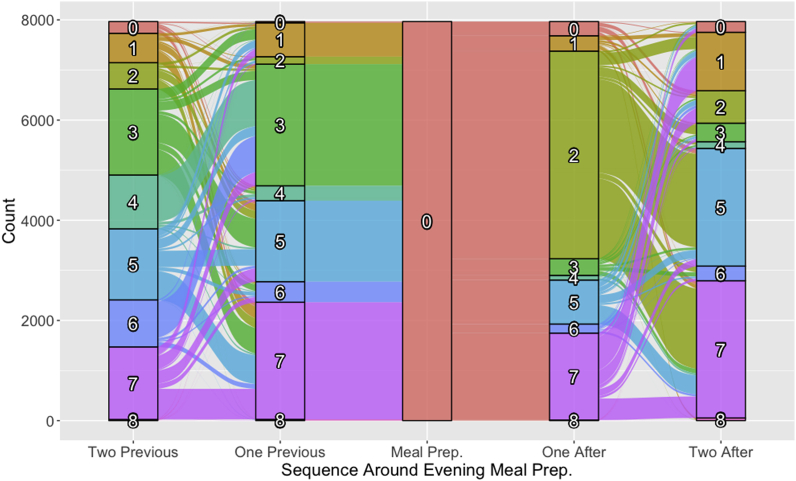
While previous work has provided a foundation for understanding the importance of the links between time use and diet, there has been little done to link time use to health outcomes. In this study, time use and self-rated health variables from the 2015 Time Use Cycle of Statistics Canada's General Social Survey are used to explore whether there are direct associations between time spent on meal preparation and health for Canadian Adults. In addition, this paper uses respondents' sequences of activities data from a time use diary to provide novel findings about the context of activities that precede and follow meal preparation. Proportional odds and logistic regression models are computed and show that there are significant relationships between spending more time on meal preparation and improved mental health and lower levels of stress. More time on meal preparation is also linked to general feelings of having less time. The analysis of activities preceding and following meal preparation activities demonstrates that individuals with different levels of self-rated stress or feelings of having extra time have significantly different activity sequence distributions (e.g., those reporting higher levels of stress are more likely to participate in chores and care activities). Exploring activity sequences related to meal preparation provides a first step in furthering the research community's grasp of the causal relationship between food-related time use and health and well-being outcome variables. Ultimately, this paper builds on the past literature on time use and meal preparation by establishing direct links between time spent on meal preparation activities, self-rated health and time use variables, in addition to offering insights into what activities surround this important activity via a novel sequence analysis.
虽然先前的研究为理解时间利用与饮食之间联系的重要性奠定了基础,但在将时间利用与健康结果联系起来方面做得很少。在本研究中,利用加拿大统计局综合社会调查2015年时间利用周期中的时间利用和自评健康变量,探讨加拿大成年人花在 meal preparation(准备膳食)上的时间与健康之间是否存在直接关联。此外,本文使用来自时间使用日记的受访者活动顺序数据,以提供关于准备膳食前后活动背景的新发现。计算了比例优势模型和逻辑回归模型,结果表明,花更多时间准备膳食与改善心理健康和降低压力水平之间存在显著关系。花更多时间准备膳食也与普遍感觉时间更少有关。对准备膳食活动前后的活动分析表明,自评压力水平或有额外时间感受不同的个体,其活动顺序分布存在显著差异(例如,报告压力水平较高的人更有可能参与家务和护理活动)。探索与准备膳食相关的活动顺序,为进一步加深研究界对与食物相关的时间利用与健康及幸福结果变量之间因果关系的理解迈出了第一步。最终,本文在过去关于时间利用和准备膳食的文献基础上,建立了花在准备膳食活动上的时间、自评健康和时间利用变量之间的直接联系,此外还通过新颖的顺序分析,深入了解围绕这一重要活动的是哪些活动。