Department of Nutrition, University of North Carolina, Chapel Hill, Chapel Hill, North Carolina, NC 27516-3997, USA.
Nutr J. 2013 Apr 11;12:45. doi: 10.1186/1475-2891-12-45.
It has been well-documented that Americans have shifted towards eating out more and cooking at home less. However, little is known about whether these trends have continued into the 21st century, and whether these trends are consistent amongst low-income individuals, who are increasingly the target of public health programs that promote home cooking. The objective of this study is to examine how patterns of home cooking and home food consumption have changed from 1965 to 2008 by socio-demographic groups.
This is a cross-sectional analysis of data from 6 nationally representative US dietary surveys and 6 US time-use studies conducted between 1965 and 2008. Subjects are adults aged 19 to 60 years (n= 38,565 for dietary surveys and n=55,424 for time-use surveys). Weighted means of daily energy intake by food source, proportion who cooked, and time spent cooking were analyzed for trends from 1965-1966 to 2007-2008 by gender and income. T-tests were conducted to determine statistical differences over time.
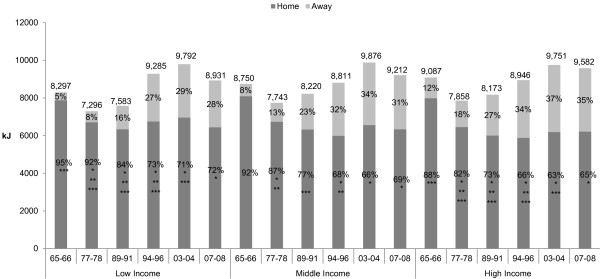
The percentage of daily energy consumed from home food sources and time spent in food preparation decreased significantly for all socioeconomic groups between 1965-1966 and 2007-2008 (p ≤ 0.001), with the largest declines occurring between 1965 and 1992. In 2007-2008, foods from the home supply accounted for 65 to 72% of total daily energy, with 54 to 57% reporting cooking activities. The low income group showed the greatest decline in the proportion cooking, but consumed more daily energy from home sources and spent more time cooking than high income individuals in 2007-2008 (p ≤ 0.001).
US adults have decreased consumption of foods from the home supply and reduced time spent cooking since 1965, but this trend appears to have leveled off, with no substantial decrease occurring after the mid-1990's. Across socioeconomic groups, people consume the majority of daily energy from the home food supply, yet only slightly more than half spend any time cooking on a given day. Efforts to boost the healthfulness of the US diet should focus on promoting the preparation of healthy foods at home while incorporating limits on time available for cooking.
有大量文献记载美国人的饮食习惯已经从过去更倾向于在家做饭转变为更倾向于外出就餐。然而,目前尚不清楚这些趋势是否延续到了 21 世纪,以及这些趋势在低收入人群中是否一致,因为低收入人群正日益成为促进在家烹饪的公共卫生项目的目标人群。本研究的目的是调查从 1965 年到 2008 年,不同社会经济群体的在家烹饪和家庭食品消费模式发生了哪些变化。
本研究采用 1965 年至 2008 年期间进行的 6 项美国全国代表性饮食调查和 6 项美国时间使用研究的数据进行横断面分析。研究对象为年龄在 19 至 60 岁的成年人(饮食调查为 38565 人,时间使用调查为 55424 人)。根据性别和收入分析了 1965-1966 年至 2007-2008 年期间食物来源的每日能量摄入、烹饪比例和烹饪时间的加权平均值趋势。采用 t 检验比较不同时间点的统计学差异。
在 1965-1966 年至 2007-2008 年期间,所有社会经济群体的家庭食品来源消费的每日能量百分比和食物准备时间都显著下降(p ≤ 0.001),1965 年至 1992 年期间降幅最大。2007-2008 年,家庭供应的食物占每日总能量的 65%至 72%,有 54%至 57%的人报告有烹饪活动。低收入群体在烹饪比例上的降幅最大,但在 2007-2008 年期间,他们从家庭供应中获取的每日能量更多,烹饪时间也更长(p ≤ 0.001)。
自 1965 年以来,美国成年人减少了家庭供应食品的消费和烹饪时间,但这一趋势似乎已经趋于平稳,在 20 世纪 90 年代中期之后没有出现实质性的下降。在所有社会经济群体中,人们主要从家庭食品供应中获取日常能量,但每天只有略多于一半的人花费时间烹饪。为了促进美国饮食的健康,应该重点促进在家准备健康食品,同时限制烹饪可用时间。