Miele Ylenia, Medveczky Zsófia, Holló Gábor, Tegze Borbála, Derényi Imre, Hórvölgyi Zoltán, Altamura Emiliano, Lagzi István, Rossi Federico
Department of Chemistry and Biology "A. Zambelli", University of Salerno Via Giovanni Paolo II 132, 84084 - Fisciano SA Italy
Department of Physics, Budapest University of Technology and Economics H-1111, Budafoki ut 8 Budapest Hungary
Chem Sci. 2020 Mar 4;11(12):3228-3235. doi: 10.1039/c9sc05195c.
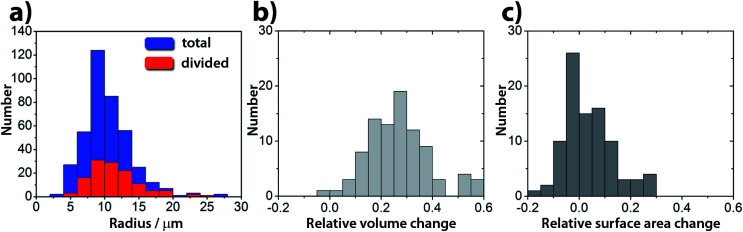
Self-division is one of the most common phenomena in living systems and one of the most important properties of life driven by internal mechanisms of cells. Design and engineering of synthetic cells from abiotic components can recreate a life-like function thus contributing to the understanding of the origin of life. Existing methods to induce the self-division of vesicles require external and non-autonomous triggers (temperature change and the addition of membrane precursors). Here we show that pH-responsive giant unilamellar vesicles on the micrometer scale can undergo self-division triggered by an internal autonomous chemical stimulus driven by an enzymatic (urea-urease) reaction coupled to a cross-membrane transport of the substrate, urea. The bilayer of the artificial cells is composed of a mixture of phospholipids (POPC, 1-palmitoyl-2-oleoyl--glycero-3-phosphatidylcholine) and oleic acid molecules. The enzymatic reaction increases the pH in the lumen of the vesicles, which concomitantly changes the protonation state of the oleic acid in the inner leaflet of the bilayer causing the removal of the membrane building blocks into the lumen of the vesicles thus decreasing the inner membrane area with respect to the outer one. This process coupled to the osmotic stress (responsible for the volume loss of the vesicles) leads to the division of a mother vesicle into two smaller daughter vesicles. These two processes must act in synergy; none of them alone can induce the division. Overall, our self-dividing system represents a step forward in the design and engineering of a complex autonomous model of synthetic cells.
自我分裂是生命系统中最常见的现象之一,也是由细胞内部机制驱动的生命最重要的特性之一。利用非生物成分设计和构建合成细胞能够重现类似生命的功能,从而有助于理解生命的起源。现有的诱导囊泡自我分裂的方法需要外部的、非自主的触发因素(温度变化和添加膜前体)。在此,我们展示了微米级的pH响应性巨型单层囊泡能够在由酶(尿素-脲酶)反应驱动的内部自主化学刺激引发下进行自我分裂,该反应与底物尿素的跨膜运输相耦合。人工细胞的双层膜由磷脂(POPC,1-棕榈酰-2-油酰-sn-甘油-3-磷脂酰胆碱)和油酸分子的混合物组成。酶促反应会提高囊泡内腔的pH值,这会随之改变双层膜内小叶中油酸的质子化状态,导致膜构建单元被转运到囊泡内腔,从而使内膜面积相对于外膜面积减小。这一过程与渗透应激(导致囊泡体积减小)共同作用,致使母囊泡分裂为两个较小的子囊泡。这两个过程必须协同作用;单独任何一个都无法诱导分裂。总体而言,我们的自我分裂系统代表了在设计和构建复杂的合成细胞自主模型方面向前迈进了一步。