Altaf Farwa, Wu Shourong, Kasim Vivi
The Key Laboratory of Biorheological Science and Technology, Ministry of Education, College of Bioengineering, Chongqing University, Chongqing, China.
The 111 Project Laboratory of Biomechanics and Tissue Repair, College of Bioengineering, Chongqing University, Chongqing, China.
Front Mol Biosci. 2021 May 28;8:680397. doi: 10.3389/fmolb.2021.680397. eCollection 2021.
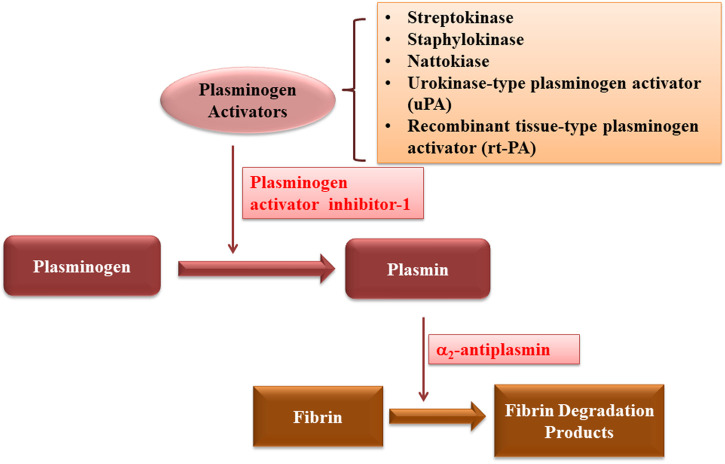
Thrombosis, a major cause of deaths in this modern era responsible for 31% of all global deaths reported by WHO in 2017, is due to the aggregation of fibrin in blood vessels which leads to myocardial infarction or other cardiovascular diseases (CVDs). Classical agents such as anti-platelet, anti-coagulant drugs or other enzymes used for thrombosis treatment at present could leads to unwanted side effects including bleeding complication, hemorrhage and allergy. Furthermore, their high cost is a burden for patients, especially for those from low and middle-income countries. Hence, there is an urgent need to develop novel and low-cost drugs for thrombosis treatment. Fibrinolytic enzymes, including plasmin like proteins such as proteases, nattokinase, and lumbrokinase, as well as plasminogen activators such as urokinase plasminogen activator, and tissue-type plasminogen activator, could eliminate thrombi with high efficacy rate and do not have significant drawbacks by directly degrading the fibrin. Furthermore, they could be produced with high-yield and in a cost-effective manner from microorganisms as well as other sources. Hence, they have been considered as potential compounds for thrombosis therapy. Herein, we will discuss about natural mechanism of fibrinolysis and thrombus formation, the production of fibrinolytic enzymes from different sources and their application as drugs for thrombosis therapy.
血栓形成是现代社会主要的死亡原因之一,据世界卫生组织报告,2017年全球所有死亡病例中有31% 归因于此。血栓形成是由于血管中纤维蛋白聚集,进而导致心肌梗死或其他心血管疾病(CVDs)。目前用于治疗血栓形成的传统药物,如抗血小板药、抗凝血药或其他酶类,可能会导致不良副作用,包括出血并发症、大出血和过敏反应。此外,这些药物成本高昂,给患者带来负担,尤其是低收入和中等收入国家的患者。因此,迫切需要开发新型低成本的血栓治疗药物。纤维蛋白溶解酶,包括蛋白酶、纳豆激酶和蚓激酶等类纤溶酶蛋白,以及尿激酶型纤溶酶原激活剂和组织型纤溶酶原激活剂等纤溶酶原激活剂,能够高效消除血栓,且直接降解纤维蛋白不会产生明显的副作用。此外,它们可以通过微生物及其他来源高产且经济高效地生产。因此,它们被认为是血栓治疗的潜在化合物。在此,我们将讨论纤维蛋白溶解和血栓形成的自然机制、不同来源纤维蛋白溶解酶的生产及其作为血栓治疗药物的应用。