Nix Cindy, Hemmati Maryam, Cobraiville Gaël, Servais Anne-Catherine, Fillet Marianne
Laboratory for the Analysis of Medicines, Department of Pharmacy, CIRM, University of Liège, Liège, Belgium.
Front Mol Biosci. 2021 May 27;8:681400. doi: 10.3389/fmolb.2021.681400. eCollection 2021.
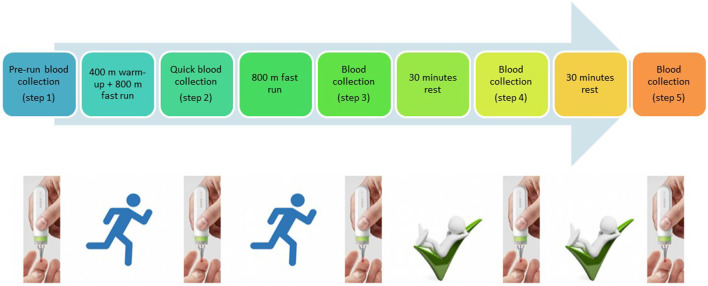
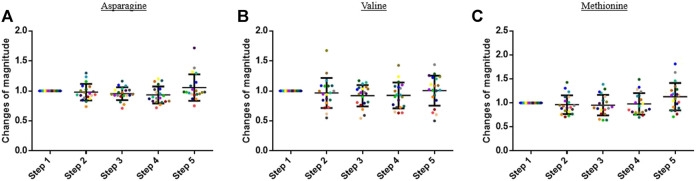
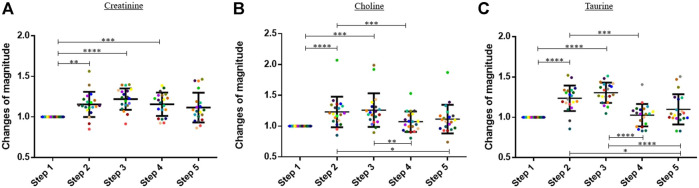
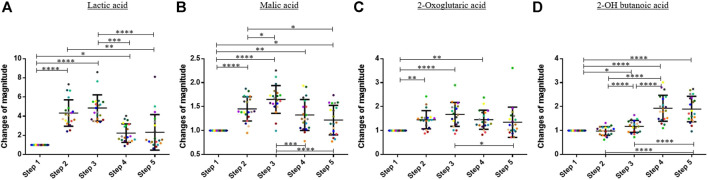
Monitoring approaches and technical improvements are key factors to improve a sportsman's health, training, and recovery after an injury. In this study, a targeted metabolomics approach using microsampling with hemaPEN was developed to measure changes in blood concentrations of nine amino acids and four organic acids before, during, and after exercise. The aim of this research project was to investigate if a reliable monitoring of metabolite levels during sports activity can be achieved by collecting one drop of whole blood at different time points. A hemaPEN device is an easy-to-use and noninvasive microsampling technique designed to collect four accurate and precise blood volumes simultaneously (10.96 µl). Twenty healthy volunteers between 19 and 30 years of age were included in this study. Physical activity consisted in running as fast as possible 1,600 m after 400 m warm-up. One drop of blood was collected at five time points: before exercise, after 800-m running, after 1,600 m, and 30 min and 60 min after finishing the exercise. The influence of physical activity on metabolite levels was evaluated using two ultrahigh-performance liquid chromatography coupled to tandem mass spectrometry (UHPLC-MS/MS) methods. Analytical performance criteria such as metabolite stability, method precision, trueness, and accuracy were found to be satisfactory. Expected significant metabolic changes were identified for lactic acid, main TCA cycle intermediates, and some amino acids (e.g., creatinine, choline, and taurine). This preliminary study performed on a small cohort demonstrated a high interest of using microsampling for fluxomics analysis, not only to collect quickly and easily biological samples during sports events but also because it is much easier to store and to process the samples than classical plasma/serum samples obtained by venipuncture. The present results open new avenue for fluxomics analysis in the context of health care.
监测方法和技术改进是提高运动员健康水平、训练效果以及受伤后恢复情况的关键因素。在本研究中,开发了一种使用hemaPEN进行微量采样的靶向代谢组学方法,以测量运动前、运动中和运动后九种氨基酸和四种有机酸的血液浓度变化。本研究项目的目的是调查通过在不同时间点采集一滴全血,是否能够可靠地监测体育活动期间的代谢物水平。hemaPEN设备是一种易于使用的非侵入性微量采样技术,旨在同时采集四份准确且精确的血量(10.96微升)。本研究纳入了20名年龄在19至30岁之间的健康志愿者。体育活动包括在400米热身之后尽可能快地跑1600米。在五个时间点采集一滴血:运动前、800米跑步后、1600米跑步后以及运动结束后30分钟和60分钟。使用两种超高效液相色谱-串联质谱(UHPLC-MS/MS)方法评估体育活动对代谢物水平的影响。发现代谢物稳定性、方法精密度、真实性和准确性等分析性能标准令人满意。乳酸、三羧酸循环主要中间产物以及一些氨基酸(如肌酐、胆碱和牛磺酸)出现了预期的显著代谢变化。这项对一小群人进行的初步研究表明,使用微量采样进行通量组学分析具有很高的价值,这不仅是因为在体育赛事期间能够快速轻松地采集生物样本,还因为与通过静脉穿刺获得的传统血浆/血清样本相比,微量采样的样本储存和处理要容易得多。目前结果为医疗保健领域的通量组学分析开辟了新途径。