Obstetrics and Gynecology Hospital, Fudan University, Shanghai, 200011, China.
The Shanghai Key Laboratory of Female Reproductive Endocrine-Related Diseases, Shanghai, 200011, China.
Endocrinology. 2021 Aug 1;162(8). doi: 10.1210/endocr/bqab117.
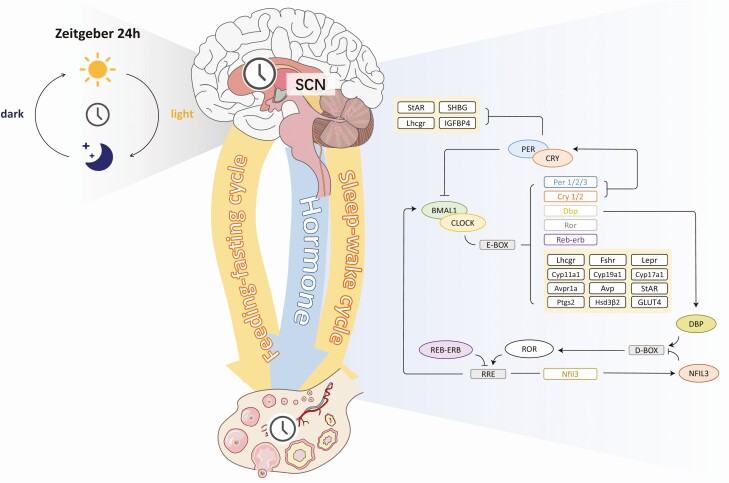
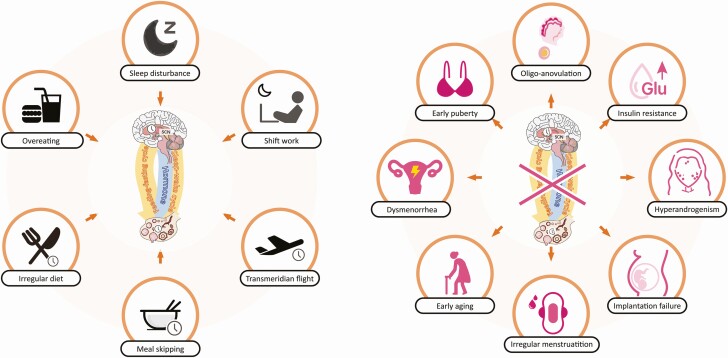
Declining female fertility has become a global health concern. It results partially from an abnormal circadian clock caused by unhealthy diet and sleep habits in modern life. The circadian clock system is a hierarchical network consisting of central and peripheral clocks. It not only controls the sleep-wake and feeding-fasting cycles but also coordinates and maintains the required reproductive activities in the body. Physiologically, the reproductive processes are governed by the hypothalamic-pituitary-gonadal (HPG) axis in a time-dependent manner. The HPG axis releases hormones, generates female characteristics, and achieves fertility. Conversely, an abnormal daily rhythm caused by aberrant clock genes or abnormal environmental stimuli contributes to disorders of the female reproductive system, such as polycystic ovarian syndrome and premature ovarian insufficiency. Therefore, breaking the "time code" of the female reproductive system is crucial. In this paper, we review the interplay between circadian clocks and the female reproductive system and present its regulatory principles, moving from normal physiology regulation to disease etiology.
女性生育力下降已成为全球关注的健康问题。部分原因是现代生活中不健康的饮食和睡眠习惯导致生物钟异常。生物钟系统是一个由中央时钟和外周时钟组成的层次网络。它不仅控制着睡眠-觉醒和摄食-禁食周期,还协调和维持着体内所需的生殖活动。从生理学上讲,生殖过程受下丘脑-垂体-性腺(HPG)轴的时间依赖性调节。HPG 轴释放激素,产生女性特征,实现生育能力。相反,时钟基因异常或环境刺激异常导致的异常日常节律会导致女性生殖系统紊乱,如多囊卵巢综合征和卵巢早衰。因此,打破女性生殖系统的“时间密码”至关重要。本文综述了生物钟与女性生殖系统的相互作用及其调控原则,从正常生理调节到疾病发病机制。