Duke-Margolis Center for Health Policy, Duke University, Durham, NC, USA; Fuqua School of Business, Duke University, Durham, NC, USA.
Duke-Margolis Center for Health Policy, Duke University, Durham, NC, USA.
Patient Educ Couns. 2022 Mar;105(3):599-605. doi: 10.1016/j.pec.2021.06.013. Epub 2021 Jun 11.
This study aimed to characterize the use and impact of assessments of understanding in parent-clinician communication for critically ill infants.
We enrolled parents and clinicians participating in family conferences for infants with neurologic conditions. Family conferences were audio recorded as they occurred. We used a directed content analysis approach to identify clinician assessments of understanding and parent responses to those assessments. Assessments were classified based on an adapted framework; responses were characterized as "absent," "yes/no," or "elaborated."
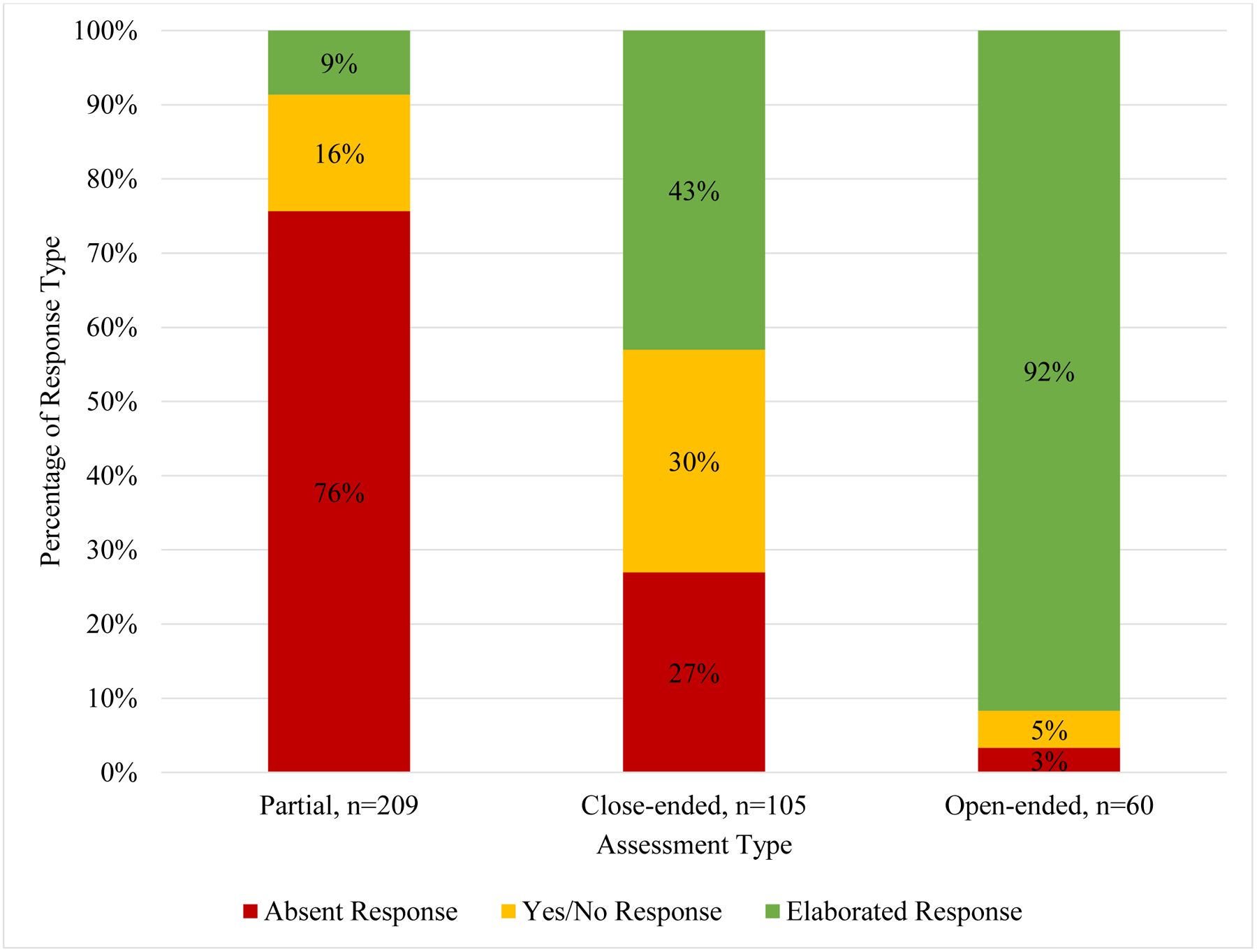
Fifty conferences involving the care of 25 infants were analyzed; these contained 374 distinct assessments of understanding. Most (n = 209/374, 56%) assessments were partial (i.e. okay?); a minority (n = 60/374, 16%) were open-ended. When clinicians asked open-ended questions, parents elaborated in their answers most of the time (n = 55/60, 92%). Approximately three-quarter of partial assessments yielded no verbal response from parents. No conferences included a teach-back.
Although common, most clinician assessments of understanding were partial or close-ended and rarely resulted in elaborated responses from parents. Open-ended assessments are an effective, underutilized strategy to increase parent engagement and clinician awareness of information needs.
Clinicians hoping to facilitate parent engagement and question-asking should rely on open-ended statements to assess understanding.
本研究旨在描述在危重症婴儿的医患沟通中,理解评估的使用情况及其影响。
我们招募了参与神经疾病婴儿家庭会议的家长和临床医生。家庭会议按照发生的顺序进行录音。我们使用定向内容分析方法来识别临床医生的理解评估和家长对这些评估的反应。评估是根据一个改编的框架进行分类的;反应被描述为“缺失”、“是/否”或“详细说明”。
共分析了涉及 25 名婴儿护理的 50 次会议,这些会议包含了 374 个不同的理解评估。大多数(n=209/374,56%)评估是部分(即好吗?)的;少数(n=60/374,16%)是开放式的。当临床医生提出开放式问题时,家长在回答中大多进行了详细说明(n=55/60,92%)。大约四分之三的部分评估没有得到家长的口头回应。没有会议包括回述。
尽管很常见,但大多数临床医生的理解评估是部分或封闭式的,很少能得到家长的详细回应。开放式评估是一种有效的、未充分利用的策略,可以增加家长的参与度和临床医生对信息需求的意识。
希望促进家长参与和提问的临床医生应该依靠开放式陈述来评估理解。