German Center for Neurodegenerative Diseases (DZNE), Göttingen, Germany.
Bernstein Center for Computational Neuroscience (BCCN), Berlin, Germany.
Hum Brain Mapp. 2021 Oct 1;42(14):4478-4496. doi: 10.1002/hbm.25559. Epub 2021 Jun 16.
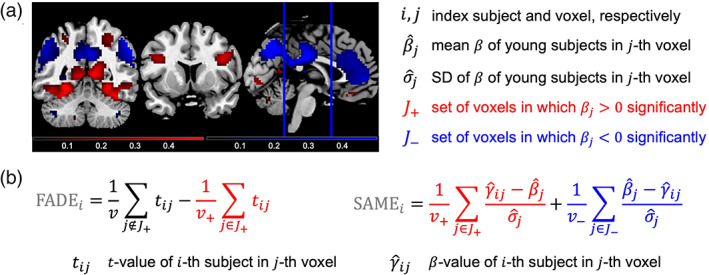
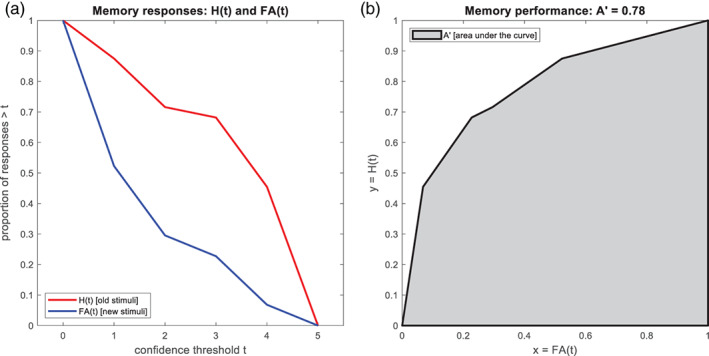
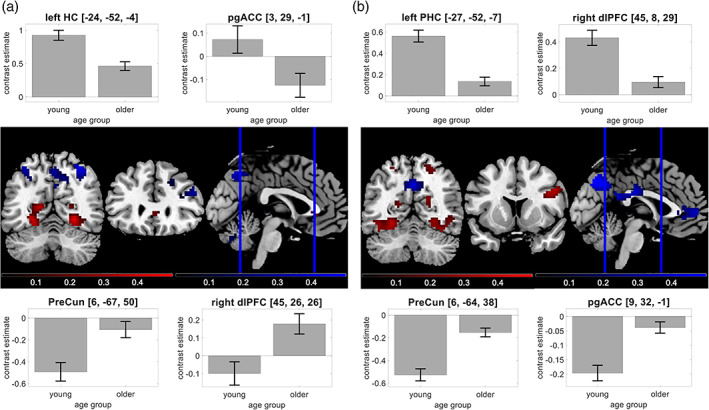
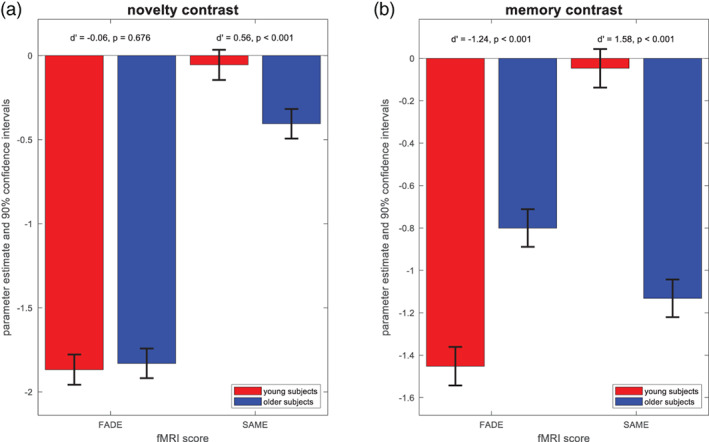
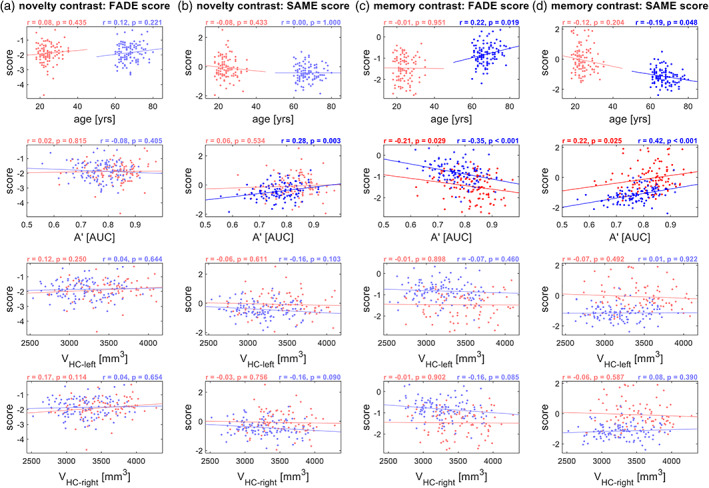
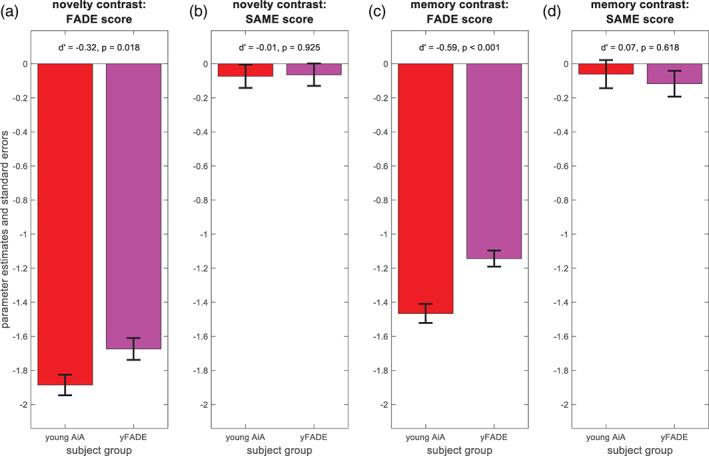
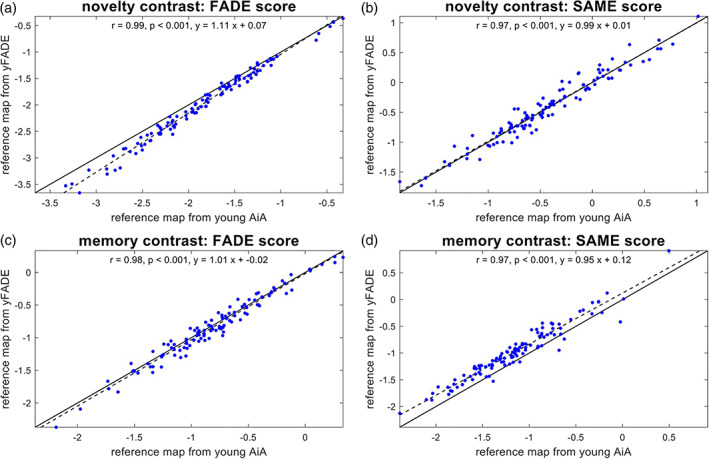
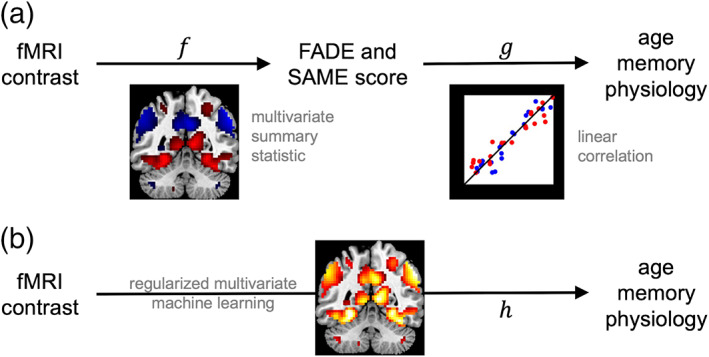
Older adults and particularly those at risk for developing dementia typically show a decline in episodic memory performance, which has been associated with altered memory network activity detectable via functional magnetic resonance imaging (fMRI). To quantify the degree of these alterations, a score has been developed as a putative imaging biomarker for successful aging in memory for older adults (Functional Activity Deviations during Encoding, FADE; Düzel et al., Hippocampus, 2011; 21: 803-814). Here, we introduce and validate a more comprehensive version of the FADE score, termed FADE-SAME (Similarity of Activations during Memory Encoding), which differs from the original FADE score by considering not only activations but also deactivations in fMRI contrasts of stimulus novelty and successful encoding, and by taking into account the variance of young adults' activations. We computed both scores for novelty and subsequent memory contrasts in a cohort of 217 healthy adults, including 106 young and 111 older participants, as well as a replication cohort of 117 young subjects. We further tested the stability and generalizability of both scores by controlling for different MR scanners and gender, as well as by using different data sets of young adults as reference samples. Both scores showed robust age-group-related differences for the subsequent memory contrast, and the FADE-SAME score additionally exhibited age-group-related differences for the novelty contrast. Furthermore, both scores correlate with behavioral measures of cognitive aging, namely memory performance. Taken together, our results suggest that single-value scores of memory-related fMRI responses may constitute promising biomarkers for quantifying neurocognitive aging.
老年人,尤其是那些有发展为痴呆症风险的老年人,通常表现出情景记忆表现的下降,这与通过功能磁共振成像 (fMRI) 检测到的记忆网络活动改变有关。为了量化这些改变的程度,已经开发出一种分数作为老年人记忆成功的成像生物标志物(功能性活动偏差在编码期间,FADE;Düzel 等人,海马体,2011 年;21:803-814)。在这里,我们引入并验证了 FADE 评分的更全面版本,称为 FADE-SAME(记忆编码期间激活的相似性),它与原始 FADE 评分的不同之处在于不仅考虑了 fMRI 对比刺激新颖性和成功编码的激活,还考虑了年轻人激活的方差。我们在包括 106 名年轻人和 111 名老年人在内的 217 名健康成年人的队列中计算了新奇和后续记忆对比的两个分数,以及 117 名年轻参与者的复制队列。我们进一步通过控制不同的磁共振扫描仪和性别,以及使用不同的年轻成年人数据集作为参考样本,测试了这两个分数的稳定性和通用性。这两个分数都表现出与年龄组相关的后续记忆对比的稳健差异,而 FADE-SAME 分数还表现出与年龄组相关的新奇对比差异。此外,这两个分数都与认知老化的行为测量相关,即记忆表现。总之,我们的结果表明,与记忆相关的 fMRI 反应的单一数值分数可能是量化神经认知老化的有前途的生物标志物。