Wu Tianyi, Wu Lizhao
Department of Pathophysiology, College of Basic Medical Sciences, China Medical University, Shenyang, China.
Front Oncol. 2021 May 31;11:655630. doi: 10.3389/fonc.2021.655630. eCollection 2021.
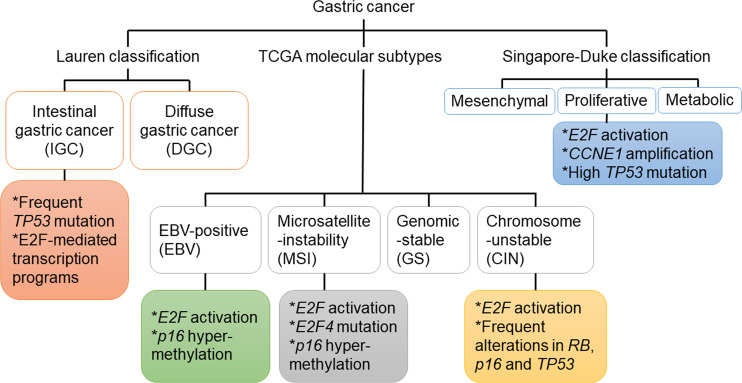
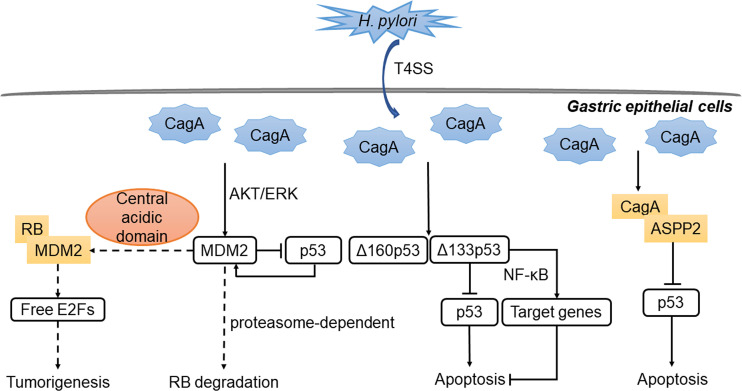
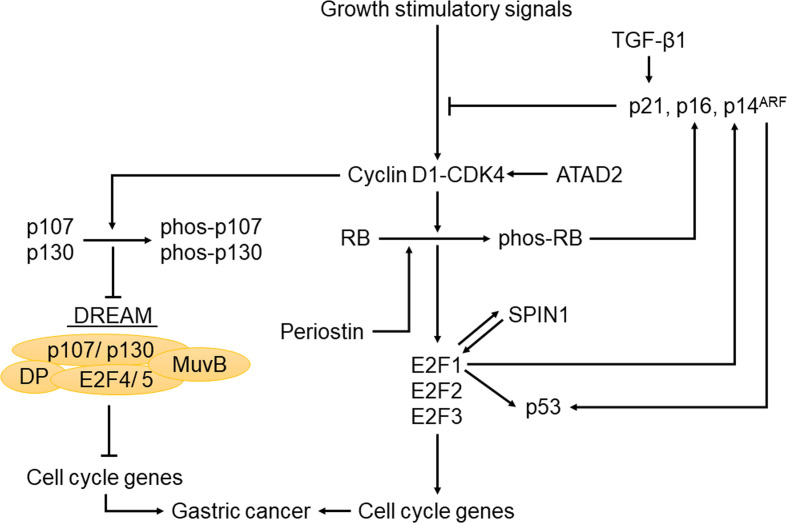
Gastric cancer is the most common malignant tumor in the digestive tract, with very high morbidity and mortality in developing countries. The pathogenesis of gastric cancer is a complex biological process mediated by abnormal regulation of proto-oncogenes and tumor suppressor genes. Although there have been some in-depth studies on gastric cancer at the molecular level, the specific mechanism has not been fully elucidated. RB family proteins (including RB, p130, and p107) are involved in cell cycle regulation, a process that largely depends on members of the gene family that encode transcriptional activators and repressors. In gastric cancer, inactivation of the RB-E2F pathway serves as a core transcriptional mechanism that drives cell cycle progression, and is regulated by cyclins, cyclin-dependent kinases, cyclin-dependent kinase inhibitors, p53, and some other upstream molecules. The E2F proteins are encoded by eight genes (i.e. to ), each of which may play a specific role in gastric cancer. Interestingly, a single E2F such as E2F1 can activate or repress transcription, and enhance or inhibit cell proliferation, depending on the cell environment. Thus, the function of the E2F transcription factor family is very complex and needs further exploration. Importantly, the presence of in stomach mucosa may affect the RB and p53 tumor suppressor systems, thereby promoting the occurrence of gastric cancer. This review aims to summarize recent research progress on important roles of the complex RB-E2F signaling network in the development and effective treatment of gastric cancer.
胃癌是消化道最常见的恶性肿瘤,在发展中国家的发病率和死亡率都非常高。胃癌的发病机制是一个复杂的生物学过程,由原癌基因和抑癌基因的异常调控介导。尽管在分子水平上对胃癌已经有了一些深入研究,但具体机制尚未完全阐明。RB家族蛋白(包括RB、p130和p107)参与细胞周期调控,这一过程在很大程度上依赖于编码转录激活因子和抑制因子的基因家族成员。在胃癌中,RB-E2F通路的失活是驱动细胞周期进程的核心转录机制,并受细胞周期蛋白、细胞周期蛋白依赖性激酶、细胞周期蛋白依赖性激酶抑制剂、p53和其他一些上游分子的调控。E2F蛋白由八个基因(即E2F1至E2F8)编码,每个基因在胃癌中可能发挥特定作用。有趣的是,单个E2F如E2F1根据细胞环境可激活或抑制转录,并增强或抑制细胞增殖。因此,E2F转录因子家族的功能非常复杂,需要进一步探索。重要的是,胃黏膜中HPV的存在可能影响RB和p53抑癌系统,从而促进胃癌的发生。本综述旨在总结RB-E2F复杂信号网络在胃癌发生发展及有效治疗中的重要作用的最新研究进展。