Sydney School of Veterinary Science, The University of Sydney, Camden, New South Wales, Australia.
Mahidol-Oxford Tropical Medicine Research Unit, Faculty of Tropical Medicine, Mahidol University, Bangkok, Thailand.
Transbound Emerg Dis. 2021 Sep;68(5):2897-2908. doi: 10.1111/tbed.14193. Epub 2021 Jul 7.
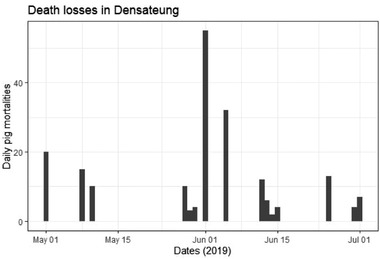
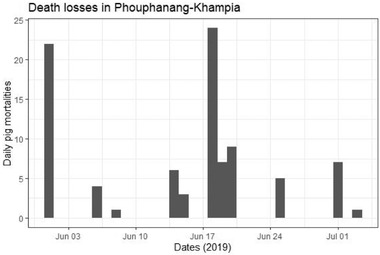
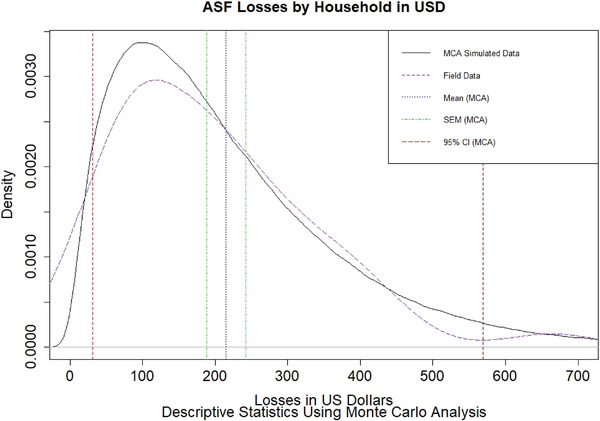
African swine fever virus (ASFV) causes a deadly disease of pigs which spread through southeast Asia in 2019. We investigated one of the first outbreaks of ASFV in Lao People's Democratic Republic amongst smallholder villages of Thapangtong District, Savannakhet Province. In this study, two ASFV affected villages were compared to two unaffected villages. Evidence of ASFV-like clinical signs appeared in pig herds as early as May 2019, with median epidemic days on 1 and 18 June in the two villages, respectively. Using participatory epidemiology mapping techniques, we found statistically significant spatial clustering in both outbreaks (p < 0.001). Villagers reported known risk factors for ASFV transmission - such as free-ranging management systems and wild boar access - in all four villages. The villagers reported increased pig trader activity from Vietnam before the outbreaks; however, the survey did not determine a single outbreak source. The outbreak caused substantial household financial losses with an average of nine pigs lost to the disease, and Monte Carlo analysis estimated this to be USD 215 per household. ASFV poses a significant threat to food and financial security in smallholder communities such as Thapangtong, where 40.6% of the district's population are affected by poverty. This study shows ASFV management in the region will require increased local government resources, knowledge of informal trader activity and wild boar monitoring alongside education and support to address intra-village risk factors such as free-ranging, incorrect waste disposal and swill feeding.
非洲猪瘟病毒(ASFV)可导致猪的致命疾病,该病毒于 2019 年在东南亚传播。我们调查了老挝人民民主共和国萨凡纳凯特区塔邦通县的首例非洲猪瘟小型农户爆发疫情。在这项研究中,我们将两个受 ASFV 影响的村庄与两个未受影响的村庄进行了比较。早在 2019 年 5 月,猪群就出现了类似 ASF 的临床症状,两个村庄的疫情高峰期分别在 6 月 1 日和 18 日。使用参与式流行病学绘图技术,我们发现两次疫情均存在统计学上显著的空间聚类(p<0.001)。村民们报告了所有四个村庄都存在 ASFV 传播的已知风险因素,例如自由放养管理制度和野猪接触。村民们报告称,在疫情爆发之前,来自越南的猪贩子活动有所增加;然而,调查并未确定单一的疫情来源。疫情给每个家庭造成了巨大的经济损失,平均每家有 9 头猪死于该病,蒙特卡罗分析估计每个家庭损失 215 美元。ASFV 对像塔邦通这样的小型农户社区的粮食和金融安全构成了重大威胁,该地区 40.6%的人口受到贫困的影响。本研究表明,该地区的 ASFV 管理将需要增加地方政府资源、了解非正式贸易者活动和野猪监测,同时还需要提供教育和支持,以解决村内自由放养、废物处理不当和泔水喂养等风险因素。