• 文献检索
  • 文档翻译
  • 深度研究
  • 学术资讯
  • Suppr Zotero 插件Zotero 插件
  • 邀请有礼
  • 套餐&价格
  • 历史记录
应用&插件
Suppr Zotero 插件Zotero 插件浏览器插件Mac 客户端Windows 客户端微信小程序
定价
高级版会员购买积分包购买API积分包
服务
文献检索文档翻译深度研究API 文档MCP 服务
关于我们
关于 Suppr公司介绍联系我们用户协议隐私条款
关注我们

Suppr 超能文献

核心技术专利:CN118964589B侵权必究
粤ICP备2023148730 号-1Suppr @ 2026

文献检索

告别复杂PubMed语法,用中文像聊天一样搜索,搜遍4000万医学文献。AI智能推荐,让科研检索更轻松。

立即免费搜索

文件翻译

保留排版,准确专业,支持PDF/Word/PPT等文件格式,支持 12+语言互译。

免费翻译文档

深度研究

AI帮你快速写综述,25分钟生成高质量综述,智能提取关键信息,辅助科研写作。

立即免费体验

有效但脆弱?对基于助推的重复信息预防新冠病毒感染传播的反应

Effective but fragile? Responses to repeated nudge-based messages for preventing the spread of COVID-19 infection.

作者信息

Sasaki Shusaku, Kurokawa Hirofumi, Ohtake Fumio

机构信息

Faculty of Economics, Tohoku Gakuin University, 1-3-1 Tsuchitoi, Aoba-ku, Sendai, Miyagi 985-8537 Japan.

Center for Infectious Disease Education and Research (CiDER), Osaka University, 2-8, Yamadaoka, Suita City, Osaka 565-0871 Japan.

出版信息

Jpn Econ Rev (Oxf). 2021;72(3):371-408. doi: 10.1007/s42973-021-00076-w. Epub 2021 Jun 14.

DOI:10.1007/s42973-021-00076-w
PMID:34149295
原文链接:https://pmc.ncbi.nlm.nih.gov/articles/PMC8200318/
Abstract

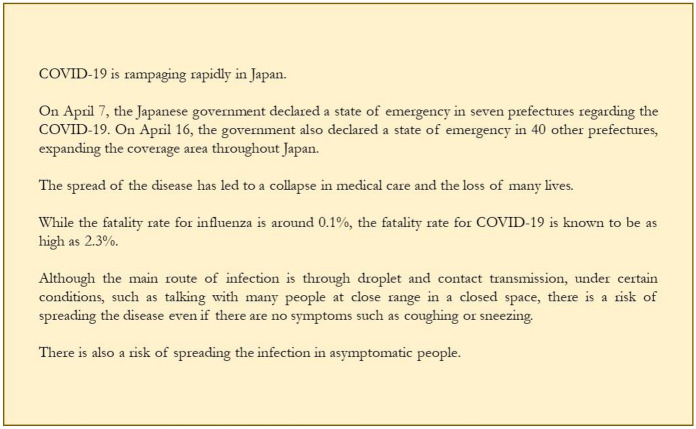
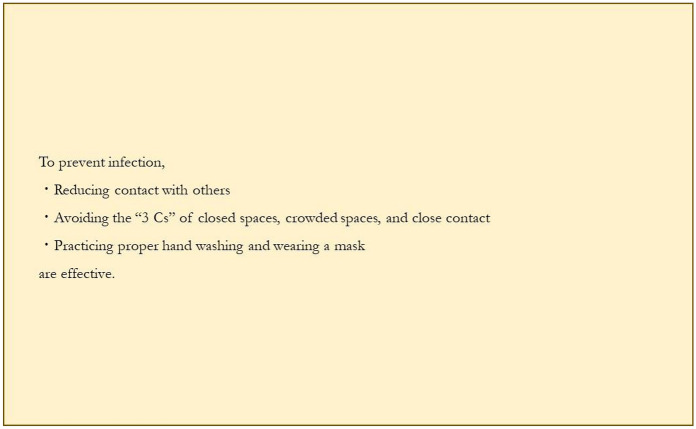
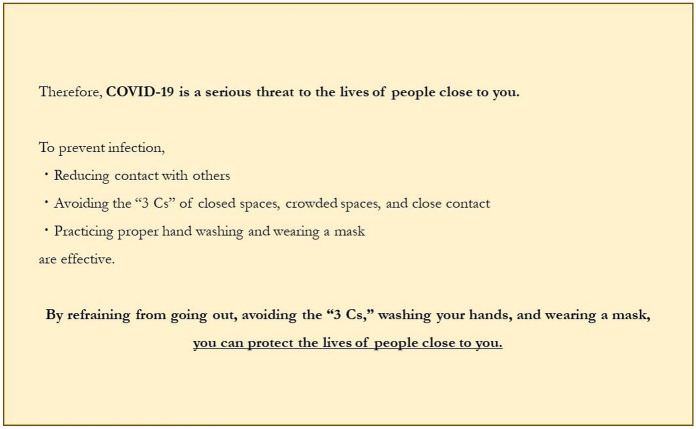
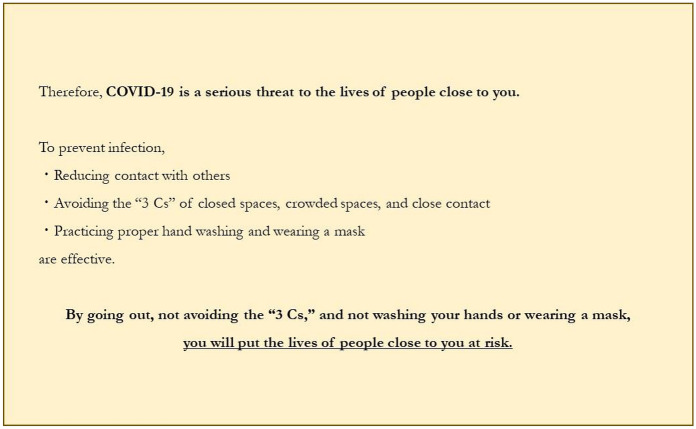
Nudge-based messages have been employed in various countries to encourage voluntary contact-avoidance and infection-prevention behaviors to control the spread of COVID-19. People have been repeatedly exposed to such messages; however, whether the messages keep exerting a significant impact over time remains unclear. From April to August 2020, we conducted a four-wave online survey experiment to examine how five types of nudge-based messages influence Japanese people's self-reported preventive behaviors. In particular, we investigate how their behaviors are affected by repeated displays over time. The analysis with 4241 participants finds that only a gain-framed altruistic message, emphasizing their behavioral adherence would protect the lives of people close to them, reduces their frequency of going out and contacting others. We do not find similar behavioral changes in messages that contain an altruistic element but emphasize it in a loss-frame or describe their behavioral adherence as protecting both one's own and others' lives. Furthermore, the behavioral change effect of the gain-framed altruistic message disappears in the third and fourth waves, although its impact of reinforcing intentions remains. This message has even an adverse effect of worsening the compliance level of infection-prevention behaviors for the subgroup who went out less frequently before the experiment. The study's results imply that when using nudge-based messages as a countermeasure for COVID-19, policymakers and practitioners need to carefully scrutinize the message elements and wording and examine to whom and how the messages should be delivered while considering their potential adverse and side effects.

摘要

基于助推的信息已在各国被用于鼓励自愿避免接触和预防感染行为,以控制新冠病毒的传播。人们反复接触此类信息;然而,随着时间推移这些信息是否持续产生重大影响仍不清楚。2020年4月至8月,我们进行了一项四波次的在线调查实验,以研究五种基于助推的信息如何影响日本人自我报告的预防行为。特别是,我们调查随着时间的重复展示,他们的行为是如何受到影响的。对4241名参与者的分析发现,只有一条强调行为坚持能保护身边人生命的收益框架利他信息,会减少他们外出和与他人接触的频率。我们在包含利他元素但以损失框架强调或描述行为坚持为保护自己和他人生命的信息中,未发现类似的行为变化。此外,收益框架利他信息的行为改变效果在第三波和第四波中消失了,尽管其强化意图的影响仍然存在。对于实验前外出频率较低的亚组,这条信息甚至产生了使感染预防行为合规水平恶化的不利影响。该研究结果表明,在将基于助推的信息用作应对新冠疫情的对策时,政策制定者和从业者需要仔细审查信息元素和措辞,并在考虑其潜在不利影响和副作用的同时,研究信息应传达给谁以及如何传达。
https://cdn.ncbi.nlm.nih.gov/pmc/blobs/ecc0/8200318/b97a20963864/42973_2021_76_Fig10_HTML.jpg
https://cdn.ncbi.nlm.nih.gov/pmc/blobs/ecc0/8200318/cdc013ebffce/42973_2021_76_Fig3_HTML.jpg
https://cdn.ncbi.nlm.nih.gov/pmc/blobs/ecc0/8200318/a578405c8eba/42973_2021_76_Fig4_HTML.jpg
https://cdn.ncbi.nlm.nih.gov/pmc/blobs/ecc0/8200318/5e33f91f759c/42973_2021_76_Fig5_HTML.jpg
https://cdn.ncbi.nlm.nih.gov/pmc/blobs/ecc0/8200318/6103fd8c49c8/42973_2021_76_Fig6_HTML.jpg
https://cdn.ncbi.nlm.nih.gov/pmc/blobs/ecc0/8200318/959a3ab3891d/42973_2021_76_Fig7_HTML.jpg
https://cdn.ncbi.nlm.nih.gov/pmc/blobs/ecc0/8200318/c9cbc9523c1c/42973_2021_76_Fig8_HTML.jpg
https://cdn.ncbi.nlm.nih.gov/pmc/blobs/ecc0/8200318/26e197734fcb/42973_2021_76_Fig9_HTML.jpg
https://cdn.ncbi.nlm.nih.gov/pmc/blobs/ecc0/8200318/b97a20963864/42973_2021_76_Fig10_HTML.jpg
https://cdn.ncbi.nlm.nih.gov/pmc/blobs/ecc0/8200318/cdc013ebffce/42973_2021_76_Fig3_HTML.jpg
https://cdn.ncbi.nlm.nih.gov/pmc/blobs/ecc0/8200318/a578405c8eba/42973_2021_76_Fig4_HTML.jpg
https://cdn.ncbi.nlm.nih.gov/pmc/blobs/ecc0/8200318/5e33f91f759c/42973_2021_76_Fig5_HTML.jpg
https://cdn.ncbi.nlm.nih.gov/pmc/blobs/ecc0/8200318/6103fd8c49c8/42973_2021_76_Fig6_HTML.jpg
https://cdn.ncbi.nlm.nih.gov/pmc/blobs/ecc0/8200318/959a3ab3891d/42973_2021_76_Fig7_HTML.jpg
https://cdn.ncbi.nlm.nih.gov/pmc/blobs/ecc0/8200318/c9cbc9523c1c/42973_2021_76_Fig8_HTML.jpg
https://cdn.ncbi.nlm.nih.gov/pmc/blobs/ecc0/8200318/26e197734fcb/42973_2021_76_Fig9_HTML.jpg
https://cdn.ncbi.nlm.nih.gov/pmc/blobs/ecc0/8200318/b97a20963864/42973_2021_76_Fig10_HTML.jpg

相似文献

1
Effective but fragile? Responses to repeated nudge-based messages for preventing the spread of COVID-19 infection.有效但脆弱?对基于助推的重复信息预防新冠病毒感染传播的反应
Jpn Econ Rev (Oxf). 2021;72(3):371-408. doi: 10.1007/s42973-021-00076-w. Epub 2021 Jun 14.
2
Can nudges save lives?助推能挽救生命吗?
Jpn Econ Rev (Oxf). 2022;73(2):245-268. doi: 10.1007/s42973-021-00095-7. Epub 2021 Sep 7.
3
The influence of framed messages and self-affirmation on indoor tanning behavioral intentions in 18- to 30-year-old women.框架信息和自我肯定对18至30岁女性室内晒黑行为意图的影响。
Health Psychol. 2016 Feb;35(2):123-30. doi: 10.1037/hea0000253. Epub 2015 Jul 20.
4
What Strategy Is Better for Promoting COVID-19 Vaccination? A Comparison Between Gain-Framed, Loss-Framed, and Altruistic Messages.促进 COVID-19 疫苗接种的策略哪个更好?增益框架、损失框架和利他主义信息的比较。
Ann Behav Med. 2022 Apr 2;56(4):325-331. doi: 10.1093/abm/kaab070.
5
Effects of Message Framing on Cancer Prevention and Detection Behaviors, Intentions, and Attitudes: Systematic Review and Meta-analysis.信息框架对癌症预防和检测行为、意图和态度的影响:系统评价和荟萃分析。
J Med Internet Res. 2021 Sep 16;23(9):e27634. doi: 10.2196/27634.
6
In COVID-19 Health Messaging, Loss Framing Increases Anxiety with Little-to-No Concomitant Benefits: Experimental Evidence from 84 Countries.在新冠疫情健康信息传播中,损失框架增加焦虑且几乎没有相应益处:来自84个国家的实验证据。
Affect Sci. 2022 Sep 26;3(3):577-602. doi: 10.1007/s42761-022-00128-3. eCollection 2022 Sep.
7
Does the Message Frame Promote People's Willingness to Vaccinate when they Worry about Side Effects from the COVID-19 Vaccine? Evidence from an Online Survey Experiment in China.当人们担心新冠疫苗的副作用时,信息框架会促进他们的接种意愿吗?来自中国一项在线调查实验的证据。
Health Commun. 2023 Jul;38(8):1688-1696. doi: 10.1080/10410236.2022.2028469. Epub 2022 Jan 20.
8
Strategic exploration of the COVID-19 prevention campaign message: based on South Koreans' perception type.新冠疫情防控宣传策略探索:基于韩国民众感知类型视角。
BMC Public Health. 2022 Jun 28;22(1):1262. doi: 10.1186/s12889-022-13671-2.
9
The Impact of Gain- and Loss-Framed Messages on Young Adults' Sexual Decision Making: An Experimental Study.得失框架信息对青少年性决策的影响:一项实验研究
Arch Sex Behav. 2017 Feb;46(2):385-394. doi: 10.1007/s10508-015-0679-x. Epub 2015 Dec 22.
10
Comparing responses to differently framed and formatted persuasive messages to encourage help-seeking for depression in Japanese adults: a cross-sectional study with 2-month follow-up.比较不同框架和格式的说服性信息对鼓励日本成年人寻求抑郁症帮助的反应:一项具有 2 个月随访的横断面研究。
BMJ Open. 2018 Nov 12;8(11):e020823. doi: 10.1136/bmjopen-2017-020823.

引用本文的文献

1
Vaccine hesitancy and its relationship with adverse childhood and protective and compensatory experiences: A cross-sectional study.疫苗犹豫及其与儿童期不良经历以及保护性和补偿性经历的关系:一项横断面研究。
Medicine (Baltimore). 2025 Aug 1;104(31):e43614. doi: 10.1097/MD.0000000000043614.
2
Healthcare utilization among Japanese older adults during later stage of prolonged pandemic.长期疫情后期日本老年人的医疗保健利用情况。
Sci Rep. 2025 Apr 22;15(1):13813. doi: 10.1038/s41598-025-98908-x.
3
Adherence to COVID-19 measures and the associated factors: evidence from a two-wave longitudinal study in Singapore.

本文引用的文献

1
Economic preferences and compliance in the social stress test of the COVID-19 crisis.新冠疫情危机社会压力测试中的经济偏好与依从性
J Public Econ. 2021 Feb;194:104322. doi: 10.1016/j.jpubeco.2020.104322. Epub 2020 Nov 11.
2
Promoting social distancing in a pandemic: Beyond good intentions.在大流行期间促进社交距离:不仅仅是出于好意。
PLoS One. 2021 Dec 2;16(12):e0260457. doi: 10.1371/journal.pone.0260457. eCollection 2021.
3
Don't get it or don't spread it: comparing self-interested versus prosocial motivations for COVID-19 prevention behaviors.
遵守 COVID-19 措施及相关因素:来自新加坡两波纵向研究的证据。
BMC Public Health. 2024 Oct 15;24(1):2839. doi: 10.1186/s12889-024-20256-8.
4
Understanding COVID-19 vaccination behaviors and intentions in Ghana: A Behavioral Insights (BI) study.了解加纳的 COVID-19 疫苗接种行为和意愿:一项行为洞察(BI)研究。
PLoS One. 2024 Feb 9;19(2):e0292532. doi: 10.1371/journal.pone.0292532. eCollection 2024.
5
The Effect of Nudging on Compliance with Individual Prevention Measures against COVID-19: An Online Experiment on Greek University Students.推动希腊大学生遵守个人 COVID-19 预防措施的效果:一项在线实验。
Int J Environ Res Public Health. 2023 Dec 25;21(1):31. doi: 10.3390/ijerph21010031.
6
Assessing Hand Sanitizer Usage in Japanese Elderly Day Care Centers: An Observational and Interventional Study.评估日本老年日托中心的洗手液使用情况:一项观察性和干预性研究。
Cureus. 2023 Oct 11;15(10):e46834. doi: 10.7759/cureus.46834. eCollection 2023 Oct.
7
The Dosing of Mobile-Based Just-in-Time Adaptive Self-Management Prompts for Caregivers: Preliminary Findings From a Pilot Microrandomized Study.针对护理人员的基于移动设备的即时自适应自我管理提示的剂量:一项微型随机试验的初步结果
JMIR Form Res. 2023 Sep 14;7:e43099. doi: 10.2196/43099.
8
Gender Differences of the Effect of Vaccination on Perceptions of COVID-19 and Mental Health in Japan.日本接种疫苗对新冠病毒认知及心理健康影响的性别差异
Vaccines (Basel). 2023 Apr 10;11(4):822. doi: 10.3390/vaccines11040822.
9
Association between the COVID-19 Vaccine and Preventive Behaviors: Panel Data Analysis from Japan.新冠疫苗与预防行为之间的关联:来自日本的面板数据分析。
Vaccines (Basel). 2023 Apr 6;11(4):810. doi: 10.3390/vaccines11040810.
10
A Bibliometric Analysis and Review of Nudge Research Using VOSviewer.使用VOSviewer对助推研究的文献计量分析与综述
Behav Sci (Basel). 2022 Dec 25;13(1):19. doi: 10.3390/bs13010019.
勿受感染或勿传播:比较对 COVID-19 预防行为的自利动机与亲社会动机。
Sci Rep. 2021 Oct 12;11(1):20222. doi: 10.1038/s41598-021-97617-5.
4
Prosociality predicts health behaviors during the COVID-19 pandemic.亲社会行为可预测新冠疫情期间的健康行为。
J Public Econ. 2021 Mar;195:104367. doi: 10.1016/j.jpubeco.2021.104367. Epub 2021 Jan 28.
5
Motivating social distancing during the COVID-19 pandemic: An online experiment.在 COVID-19 大流行期间激励社会隔离:一项在线实验。
Soc Sci Med. 2020 Nov;265:113478. doi: 10.1016/j.socscimed.2020.113478. Epub 2020 Oct 27.
6
Emotional responses to prosocial messages increase willingness to self-isolate during the COVID-19 pandemic.在新冠疫情期间,对亲社会信息的情感反应会增加自我隔离的意愿。
Pers Individ Dif. 2021 Feb 15;170:110420. doi: 10.1016/j.paid.2020.110420. Epub 2020 Oct 15.
7
Japanese citizens' behavioral changes and preparedness against COVID-19: An online survey during the early phase of the pandemic.日本民众在新冠疫情大流行早期针对 COVID-19 的行为变化与准备情况:一项在线调查。
PLoS One. 2020 Jun 11;15(6):e0234292. doi: 10.1371/journal.pone.0234292. eCollection 2020.
8
What we can learn from five naturalistic field experiments that failed to shift commuter behaviour.从五个未能改变通勤者行为的自然主义实地实验中我们可以学到什么。
Nat Hum Behav. 2020 Feb;4(2):169-176. doi: 10.1038/s41562-019-0795-z. Epub 2019 Dec 23.
9
Nudge Units to Improve the Delivery of Health Care.推动单位以改善医疗保健服务。
N Engl J Med. 2018 Jan 18;378(3):214-216. doi: 10.1056/NEJMp1712984.
10
Nudge: a new and better way to improve health?推动:改善健康的新方法?
Health Policy. 2012 Feb;104(2):200-3. doi: 10.1016/j.healthpol.2011.10.013. Epub 2011 Nov 21.