Harvard Business School, Boston, USA.
Sloan School of Management, Massachusetts Institute of Technology, Cambridge, USA.
Sci Rep. 2021 Oct 12;11(1):20222. doi: 10.1038/s41598-021-97617-5.
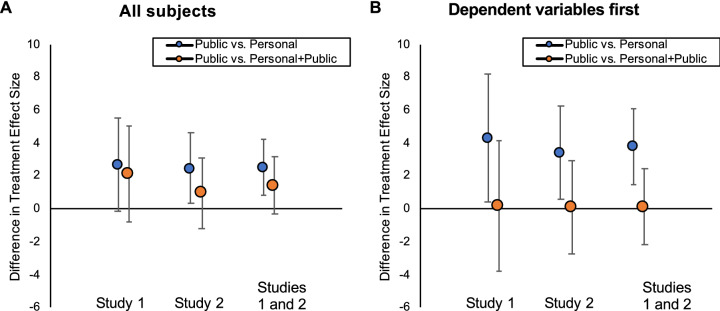
COVID-19 prevention behaviors may be seen as self-interested or prosocial. Using American samples from MTurk and Prolific (total n = 6850), we investigated which framing is more effective-and motivation is stronger-for fostering prevention behavior intentions. We evaluated messaging that emphasized personal, public, or personal and public benefits of prevention. In initial studies (conducted March 14-16, 2020), the Public treatment was more effective than the Personal treatment, and no less effective than the Personal + Public treatment. In additional studies (conducted April 17-30, 2020), all three treatments were similarly effective. Across all these studies, the perceived public threat of coronavirus was also more strongly associated with prevention intentions than the perceived personal threat. Furthermore, people who behaved prosocially in incentivized economic games years before the pandemic had greater prevention intentions. Finally, in a field experiment (conducted December 21-23, 2020), we used our three messaging strategies to motivate contact-tracing app signups (n = 152,556 newsletter subscribers). The design of this experiment prevents strong causal inference; however, the results provide suggestive evidence that the Personal + Public treatment may have been more effective than the Personal or Public treatment. Together, our results highlight the importance of prosocial motives for COVID-19 prevention.
COVID-19 预防行为可能被视为利己或利他。本研究使用来自 MTurk 和 Prolific 的美国样本(总样本量为 6850 人),调查了哪种框架更能有效地培养预防行为意向,以及哪种框架能激发更强的动机。我们评估了强调预防的个人、公共或个人和公共利益的信息传递。在最初的研究(2020 年 3 月 14 日至 16 日进行)中,公共处理比个人处理更有效,与个人+公共处理同样有效。在另外的研究(2020 年 4 月 17 日至 30 日进行)中,所有三种处理同样有效。在所有这些研究中,与个人威胁相比,人们认为冠状病毒的公共威胁与预防意向更相关。此外,在大流行前几年参与过经济激励利他行为游戏的人,其预防意向更强。最后,在 2020 年 12 月 21 日至 23 日进行的现场实验中,我们使用这三种信息传递策略来激励接触者追踪应用程序的注册(n = 152556 名新闻通讯订阅者)。该实验的设计无法进行强因果推断;然而,结果提供了有启发性的证据,表明个人+公共处理可能比个人或公共处理更有效。总之,我们的研究结果强调了利他动机对 COVID-19 预防的重要性。