Yamamura Eiji, Kohsaka Youki, Tsutsui Yoshiro, Ohtake Fumio
Department of Economics, Seinan Gakuin University, Fukuoka 814-8511, Japan.
Department of Management Information, Kyoto College of Economics, Kyoto 610-1195, Japan.
Vaccines (Basel). 2023 Apr 6;11(4):810. doi: 10.3390/vaccines11040810.
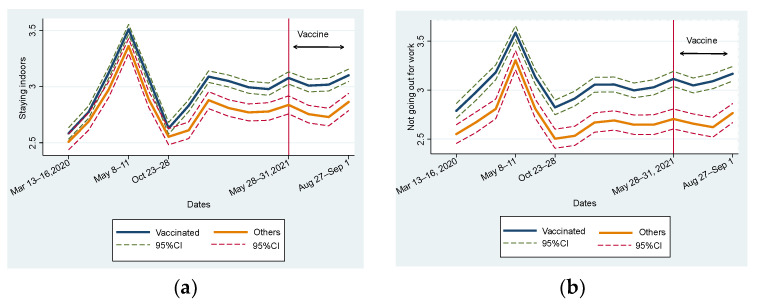
The coronavirus (COVID-19) vaccine is key to reducing the probability of contracting COVID-19. The vaccine is generally known to prevent severe illness, death, and hospitalization as a result of the disease and for considerably reduce COVID-19 infection risk. Accordingly, this might significantly change an individual's perceived risk of altering everyday behaviors. For instance, the proliferation of vaccination is anticipated to reduce preventive behaviors such as staying at home, handwashing, and wearing a mask. We corresponded with the same individuals monthly for 18 months from March 2020 (early stage of COVID-19) to September 2021 in Japan to independently construct large sample panel data (N = 54,007), with a participation rate of 54.7%. We used a fixed effects model, controlling for key confounders, to determine whether vaccination was associated with a change in preventive behaviors. The major findings are as follows. Contrary to the prediction, (1) based on the whole sample, being vaccinated against COVID-19 led people to stay at home; however, it did not change the habit of handwashing and wearing a mask. Especially after the second shot, respondents were likelier to stay at home by 0.107 (95% CIs: 0.059-0.154) points on a 5-point scale compared to before the vaccination. Dividing the entire sample into young and old, (2) those aged ≤ 40 years were more likely to go out after being vaccinated, and (3) people over 40 years of age were more likely to stay at home (similar to the first result). Preventive behaviors impact all individuals during the current pandemic. Informal social norms motivate people to increase or maintain preventive behaviors even after being vaccinated in societies where these behaviors are not enforced.
新冠病毒(COVID-19)疫苗是降低感染COVID-19几率的关键。众所周知,该疫苗可预防因该疾病导致的严重疾病、死亡和住院情况,并能大幅降低COVID-19感染风险。因此,这可能会显著改变个人对改变日常行为的感知风险。例如,预计疫苗接种的普及会减少诸如居家、洗手和戴口罩等预防行为。从2020年3月(COVID-19早期)到2021年9月,我们在日本与同一批人每月进行通信,为期18个月,以独立构建大样本面板数据(N = 54,007),参与率为54.7%。我们使用固定效应模型,控制关键混杂因素,以确定接种疫苗是否与预防行为的变化相关。主要研究结果如下。与预测相反,(1)基于整个样本,接种COVID-19疫苗会使人们更倾向于居家;然而,它并没有改变洗手和戴口罩的习惯。特别是在接种第二针后,与接种疫苗前相比,受访者在5分制量表上居家的可能性高出0.107(95%置信区间:0.059 - 0.154)分。将整个样本分为年轻人和老年人,(2)40岁及以下的人接种疫苗后更有可能外出,(3)40岁以上的人更有可能居家(与第一个结果类似)。在当前疫情期间,预防行为会影响所有个体。在这些行为未得到强制实施的社会中,非正式的社会规范会促使人们即使在接种疫苗后仍增加或保持预防行为。