Morrison Michael D, Thissen James B, Karouia Fathi, Mehta Satish, Urbaniak Camilla, Venkateswaran Kasthuri, Smith David J, Jaing Crystal
Physical and Life Sciences Directorate, Lawrence Livermore National Laboratory, Livermore, CA, United States.
KBRwyle, NASA Ames Research Center, Moffett Field, CA, United States.
Front Microbiol. 2021 Jun 2;12:659179. doi: 10.3389/fmicb.2021.659179. eCollection 2021.
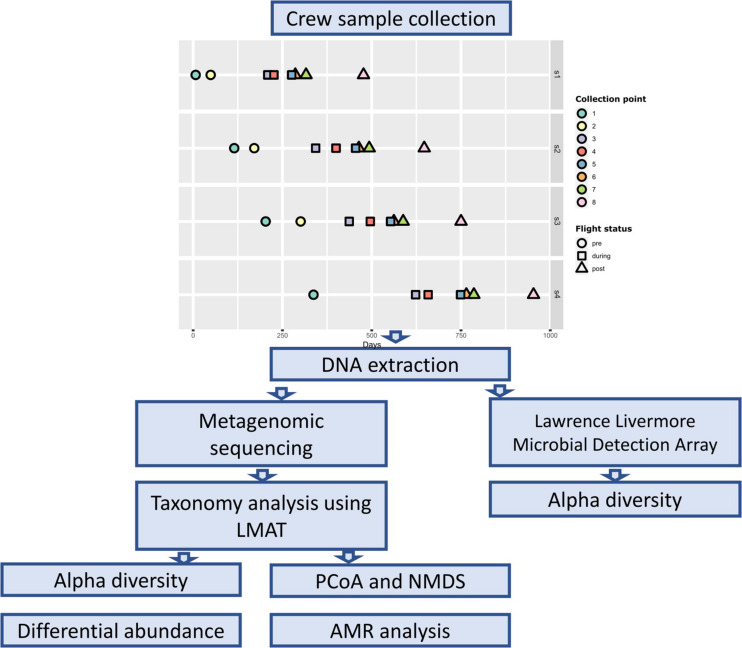
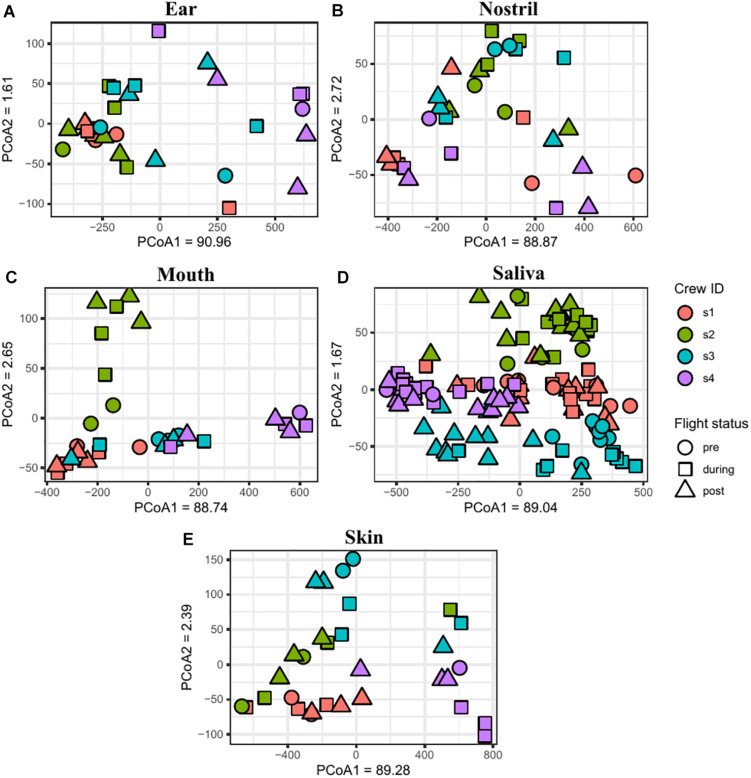
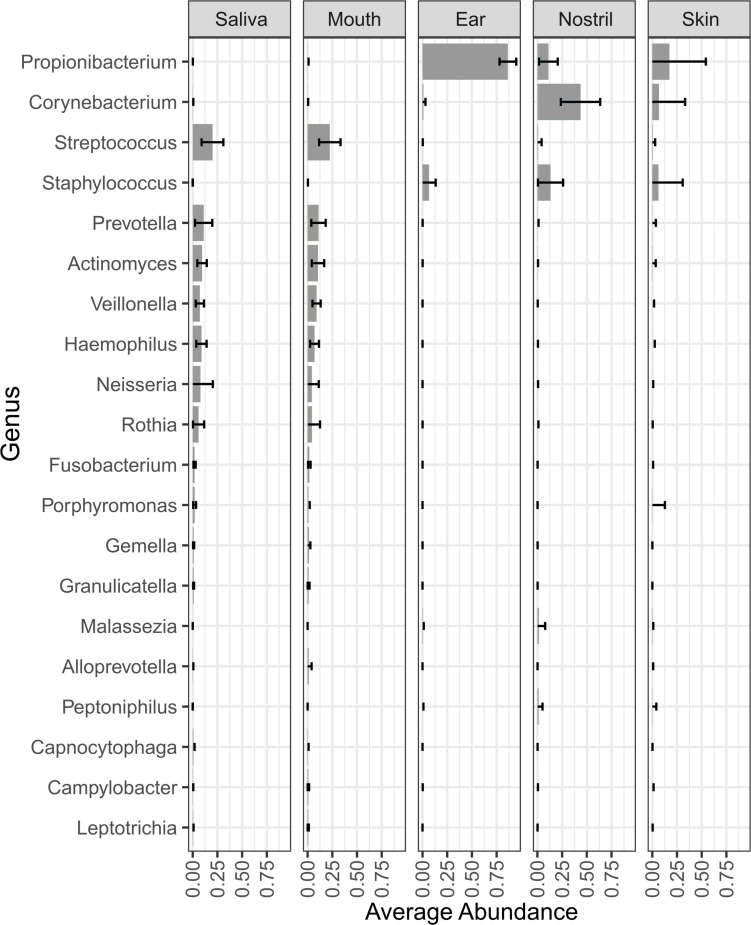
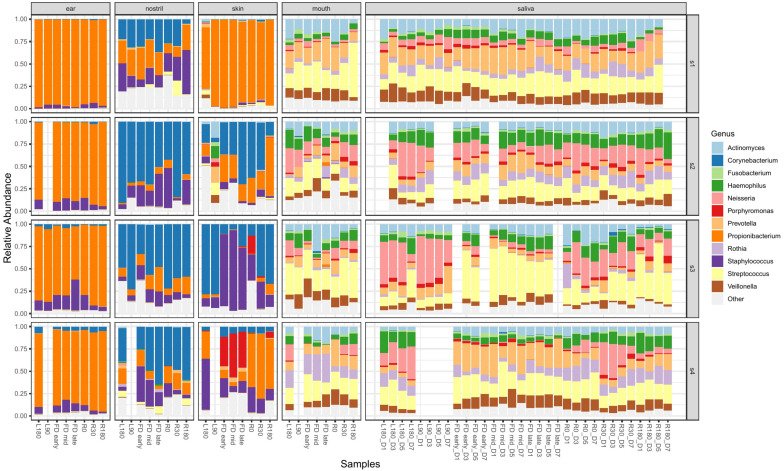
The International Space Station (ISS) is a uniquely enclosed environment that has been continuously occupied for the last two decades. Throughout its operation, protecting the health of the astronauts on-board has been a high priority. The human microbiome plays a significant role in maintaining human health, and disruptions in the microbiome have been linked to various diseases. To evaluate the effects of spaceflight on the human microbiome, body swabs and saliva samples were collected from four ISS astronauts on consecutive expeditions. Astronaut samples were analyzed using shotgun metagenomic sequencing and microarrays to characterize the microbial biodiversity before, during, and after the astronauts' time onboard the ISS. Samples were evaluated at an individual and population level to identify changes in microbial diversity and abundance. No significant changes in the number or relative abundance of taxa were observed between collection time points when samples from all four astronauts were analyzed together. When the astronauts' saliva samples were analyzed individually, the saliva samples of some astronauts showed significant changes in the relative abundance of taxa during and after spaceflight. The relative abundance of in saliva samples increased during two astronauts' time onboard the ISS while the relative abundance of other commensal taxa such as , , and decreased. The abundance of some antimicrobial resistance genes within the saliva samples also showed significant changes. Most notably, elfamycin resistance gene significantly increased in all four astronauts post-flight and a CfxA6 beta-lactam marker significantly increased during spaceflight but returned to normal levels post-flight. The combination of both shotgun metagenomic sequencing and microarrays showed the benefit of both technologies in monitoring microbes on board the ISS. There were some changes in each astronaut's microbiome during spaceflight, but these changes were not universal for all four astronauts. Two antimicrobial resistance gene markers did show a significant change in abundance in the saliva samples of all four astronauts across their collection times. These results provide insight for future ISS microbial monitoring studies and targets for antimicrobial resistance screenings.
国际空间站(ISS)是一个独特的封闭环境,在过去二十年里一直有人持续居住。在其整个运行过程中,保护空间站上宇航员的健康一直是高度优先事项。人类微生物组在维持人类健康方面发挥着重要作用,微生物组的破坏与各种疾病有关。为了评估太空飞行对人类微生物组的影响,在连续几次任务中从四名国际空间站宇航员身上采集了身体拭子和唾液样本。使用鸟枪法宏基因组测序和微阵列对宇航员样本进行分析,以表征宇航员在国际空间站上的前、中、后三个阶段的微生物多样性。在个体和群体层面评估样本,以确定微生物多样性和丰度的变化。当对所有四名宇航员的样本一起分析时,在采集时间点之间未观察到分类群数量或相对丰度的显著变化。当单独分析宇航员的唾液样本时,一些宇航员的唾液样本在太空飞行期间和之后显示出分类群相对丰度的显著变化。在两名宇航员在国际空间站上的期间,唾液样本中[具体细菌名称1]的相对丰度增加,而其他共生分类群如[具体细菌名称2]、[具体细菌名称3]和[具体细菌名称4]的相对丰度下降。唾液样本中一些抗微生物抗性基因的丰度也显示出显著变化。最值得注意的是,飞行后所有四名宇航员中埃弗米星抗性基因显著增加,一种CfxA6β-内酰胺标记物在太空飞行期间显著增加,但在飞行后恢复到正常水平。鸟枪法宏基因组测序和微阵列相结合显示了这两种技术在监测国际空间站上的微生物方面的益处。在太空飞行期间,每位宇航员的微生物组都有一些变化,但这些变化并非所有四名宇航员都有。两个抗微生物抗性基因标记物在所有四名宇航员的唾液样本采集时间内确实显示出丰度的显著变化。这些结果为未来国际空间站微生物监测研究提供了见解,并为抗微生物抗性筛查提供了目标。