Department of Infection and Immunity, Shanghai Public Health Clinical Center, Fudan University, Shanghai, China.
Medical Examination Center, Shanghai Public Health Clinical Center, Fudan University, Shanghai, China.
Front Immunol. 2021 Jun 3;12:568789. doi: 10.3389/fimmu.2021.568789. eCollection 2021.
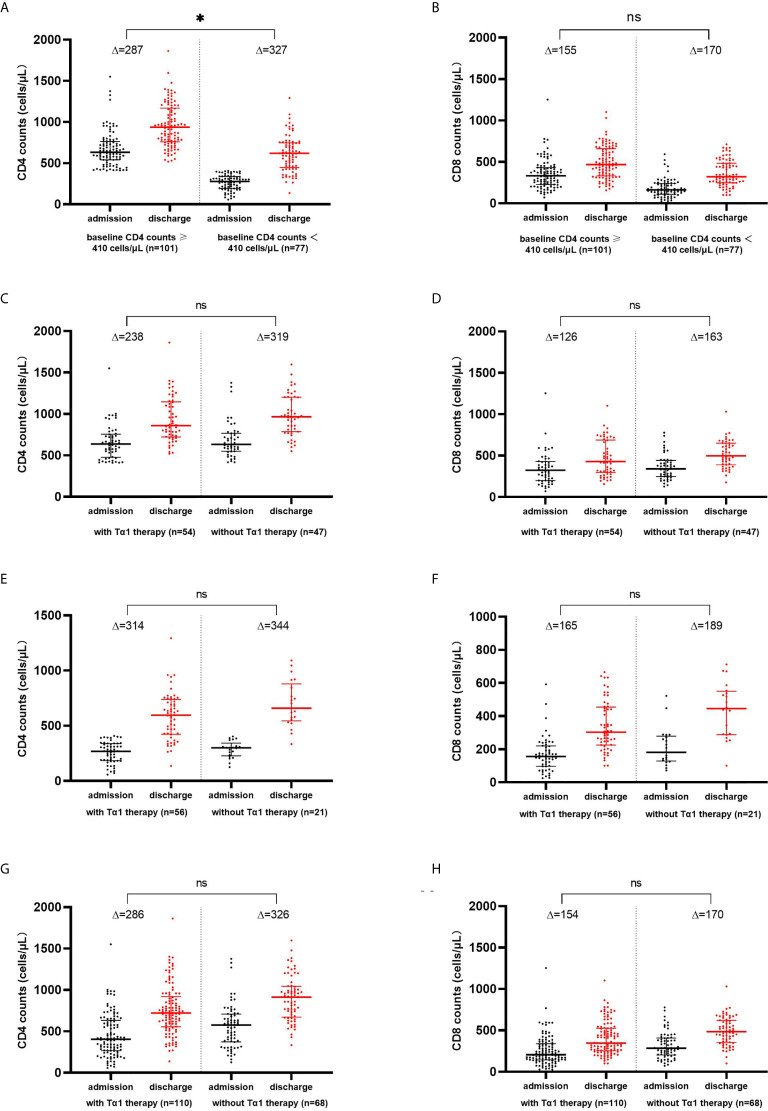
Dysregulation of immune response was observed in COVID-19 patients. Thymosin alpha 1 (Tα1) is used in the management of COVID-19, because it is known to restore the homeostasis of the immune system during infections and cancers. We aim to observe the longitudinal changes in T lymphocyte subsets and to evaluate the efficacy of Tα1 for COVID-19. A retrospective study was conducted in 275 COVID-19 patients admitted to Shanghai public health clinical center. The clinical and laboratory characteristics between patients with different T lymphocyte phenotypes and those who were and were not treated with Tα1 were compared. Among the 275 patients, 137 (49.8%) were males, and the median age was 51 years [interquartile range (IQR): 37-64]. A total of 126 patients received Tα1 therapy and 149 patients did not. There were 158 (57.5%) patients with normal baseline CD4 counts (median:631/μL, IQR: 501762) and 117 patients (42.5%) with decreased baseline CD4 counts (median:271/μL, IQR: 201335). In those with decreased baseline CD4 counts, more patients were older (p<0.001), presented as critically ill (p=0.032) and had hypertension (p=0.008) compared with those with normal CD4 counts. There was no statistical difference in the duration of virus shedding in the upper respiratory tract between the two groups (p=0.214). In both the normal (14 11, p=0.028) and the decreased baseline CD4 counts group (15 11, p=0.008), duration of virus clearance in the patients with Tα1 therapy was significantly longer than that in those without Tα1 therapy. There was no significant difference in the increase of CD4+ (286 326, p=0.851) and CD8+ T cell (154 170, p=0.842) counts in the recovery period between the two groups with or without Tα1 therapy. Multivariate linear regression analysis showed that severity of illness (p<0.001) and Tα1 therapy (p=0.001) were associated with virus clearance. In conclusion, reduction of CD4+ T and CD8+ T cell counts were observed in COVID-19 patients. Tα1 may have no benefit on restoring CD4+ and CD8+ T cell counts or on the virus clearance. The use of Tα1 for COVID-19 need to be more fully investigated.
在 COVID-19 患者中观察到免疫反应失调。胸腺肽 alpha1(Tα1)用于 COVID-19 的治疗,因为它已知在感染和癌症期间恢复免疫系统的稳态。我们旨在观察 T 淋巴细胞亚群的纵向变化,并评估 Tα1 对 COVID-19 的疗效。一项回顾性研究在上海公共卫生临床中心收治的 275 例 COVID-19 患者中进行。比较了不同 T 淋巴细胞表型患者之间以及接受和未接受 Tα1 治疗患者之间的临床和实验室特征。在 275 例患者中,137 例(49.8%)为男性,中位年龄为 51 岁[四分位距(IQR):37-64]。共有 126 例患者接受 Tα1 治疗,149 例患者未接受。基线 CD4 计数正常的患者共有 158 例(57.5%)(中位数:631/μL,IQR:501762),基线 CD4 计数降低的患者 117 例(42.5%)(中位数:271/μL,IQR:201335)。在基线 CD4 计数降低的患者中,与 CD4 计数正常的患者相比,更多的患者年龄更大(p<0.001),表现为危重症(p=0.032)和患有高血压(p=0.008)。两组患者在上呼吸道病毒脱落的持续时间上无统计学差异(p=0.214)。在 CD4 计数正常(14 11,p=0.028)和降低的患者组(15 11,p=0.008)中,接受 Tα1 治疗的患者病毒清除时间明显长于未接受 Tα1 治疗的患者。两组患者在恢复期间 CD4+(286 326,p=0.851)和 CD8+T 细胞(154 170,p=0.842)计数的增加均无统计学差异。多变量线性回归分析表明,疾病严重程度(p<0.001)和 Tα1 治疗(p=0.001)与病毒清除有关。结论:COVID-19 患者观察到 CD4+T 和 CD8+T 细胞计数减少。Tα1 可能对恢复 CD4+和 CD8+T 细胞计数或清除病毒没有益处。需要更全面地研究 Tα1 治疗 COVID-19 的效果。