Jansson Christer, Faiola Celia, Wingler Astrid, Zhu Xin-Guang, Kravchenko Alexandra, de Graaff Marie-Anne, Ogden Aaron J, Handakumbura Pubudu P, Werner Christiane, Beckles Diane M
Pacific Northwest National Laboratory, Richland, WA, United States.
Department of Ecology and Evolutionary Biology, University of California, Irvine, Irvine, CA, United States.
Front Plant Sci. 2021 Jun 4;12:636709. doi: 10.3389/fpls.2021.636709. eCollection 2021.
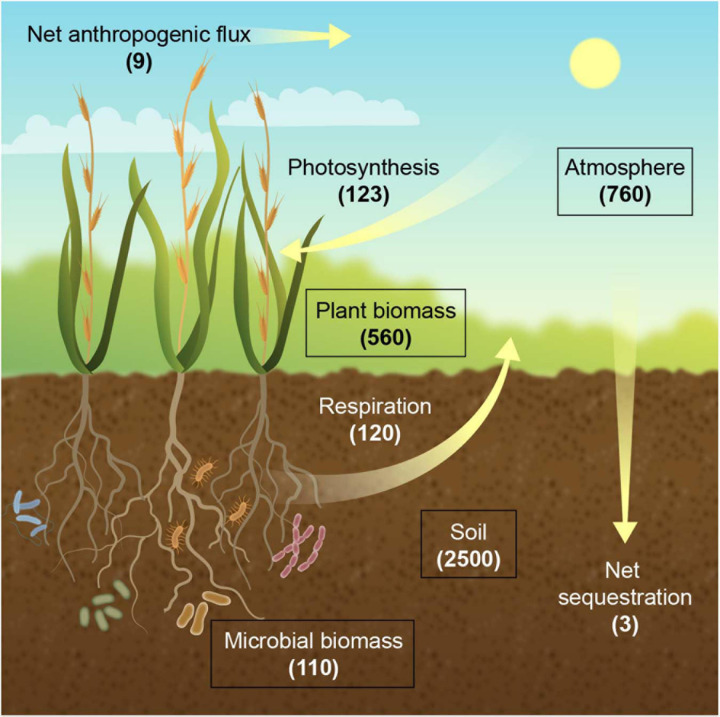
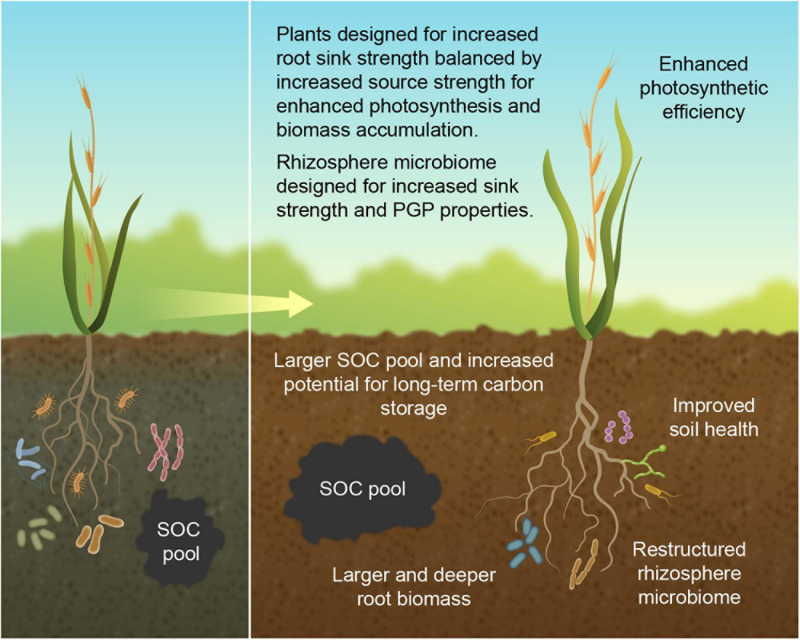
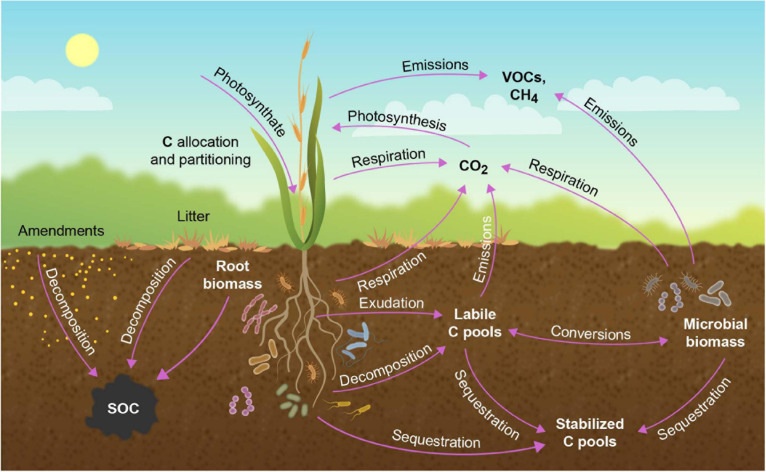
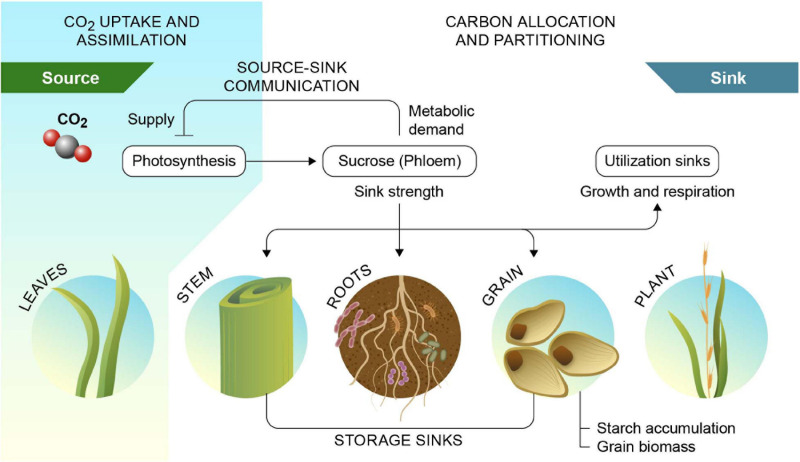
Agricultural cropping systems and pasture comprise one third of the world's arable land and have the potential to draw down a considerable amount of atmospheric CO for storage as soil organic carbon (SOC) and improving the soil carbon budget. An improved soil carbon budget serves the dual purpose of promoting soil health, which supports crop productivity, and constituting a pool from which carbon can be converted to recalcitrant forms for long-term storage as a mitigation measure for global warming. In this perspective, we propose the design of crop ideotypes with the dual functionality of being highly productive for the purposes of food, feed, and fuel, while at the same time being able to facilitate higher contribution to soil carbon and improve the below ground ecology. We advocate a holistic approach of the integrated plant-microbe-soil system and suggest that significant improvements in soil carbon storage can be achieved by a three-pronged approach: (1) design plants with an increased root strength to further allocation of carbon belowground; (2) balance the increase in belowground carbon allocation with increased source strength for enhanced photosynthesis and biomass accumulation; and (3) design soil microbial consortia for increased rhizosphere sink strength and plant growth-promoting (PGP) properties.
农业种植系统和牧场占世界可耕地的三分之一,有潜力吸收大量大气中的二氧化碳,以土壤有机碳(SOC)的形式储存起来,并改善土壤碳收支。改善土壤碳收支具有双重作用,既促进土壤健康(这有助于作物生产力),又构成一个碳库,碳可以从这个库中转化为难降解形式进行长期储存,作为缓解全球变暖的一项措施。从这个角度来看,我们提议设计具有双重功能的作物理想型,一方面为了粮食、饲料和燃料的目的实现高产,同时能够促进对土壤碳的更高贡献并改善地下生态。我们主张采用综合的植物 - 微生物 - 土壤系统的整体方法,并建议通过三管齐下的方法可以显著提高土壤碳储存:(1)设计根系更强壮的植物,以进一步将碳分配到地下;(2)在增加地下碳分配的同时,平衡增加源强度以增强光合作用和生物量积累;(3)设计土壤微生物群落,以增加根际汇强度和促进植物生长(PGP)特性。