Bjørnarå Helga Birgit, Westergren Thomas, Sejersted Ellen, Torstveit Monica Klungland, Hansen Bjørge Herman, Berntsen Sveinung, Bere Elling
Faculty of Health and Sport Sciences, University of Agder, Kristiansand, Norway.
University Library, University of Agder, Kristiansand, Norway.
Prev Med Rep. 2021 May 30;23:101425. doi: 10.1016/j.pmedr.2021.101425. eCollection 2021 Sep.
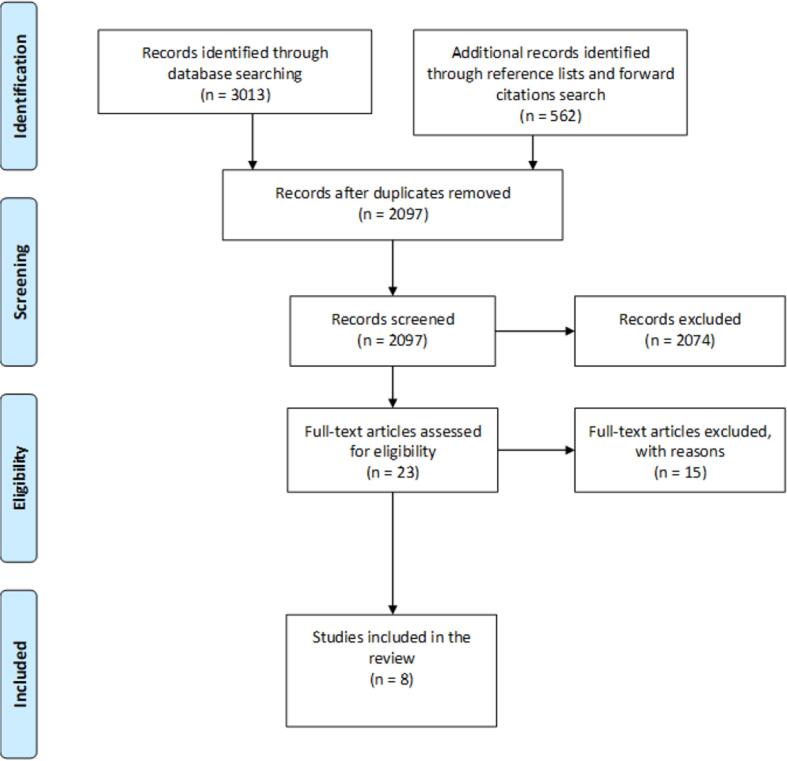
Sports participations have the potential for both positive and negative health outcomes. We hence aimed (i) to assess systematically reviewed associations between organized sports participation in children and adolescents and their health, and (ii) to assess qualitative syntheses of experiences among children and adolescents concerning organized sports participation and health. A search was undertaken in April 2020 across the databases MEDLINE, EMBASE, APA PsycInfo (Ovid), Scopus, SPORTDiscus (EBSCO), and specialized databases for reviews. The recommended Joanna Briggs Institute approach to critical appraisal, study selection, data extraction, and data synthesis was used. Systematic reviews were included that covered children and/or adolescents aged ≤ 18 years, and adult participants with retrospective exposure to-or experiences of-organized sports participation before the age of 19 and examining health outcomes and experiences (Prospero protocol CRD 42020206677). Five reviews based mainly on cross-sectional data, two mainly on longitudinal data, and one on experimental studies were included. A causal relationship of moderate-to-high level of evidence between organized sports participation and moderate crude weight reduction accentuated by diet control and team sports was identified. Evidence of causal relationships between sports participation and reduced anxiety, and depression and increased physical activity was at a moderate level. Evidence of causal relationships between sports participation and health was of low-to-moderate level concerning obesity status (inconclusive), bone health (positive), and psychological and social health (positive and negative). Causal relationships between organized child and adolescent sports participation and health remain uncertain. Experimental and well-conducted longitudinal primary studies are highly warranted.
参与体育运动对健康可能产生积极和消极的影响。因此,我们旨在:(i)系统评估关于儿童和青少年参与有组织体育运动与其健康之间的关联的综述;(ii)评估儿童和青少年关于有组织体育运动参与和健康的经历的定性综合分析。2020年4月,我们在MEDLINE、EMBASE、APA PsycInfo(Ovid)、Scopus、SPORTDiscus(EBSCO)等数据库以及专门的综述数据库中进行了检索。采用了推荐的乔安娜·布里格斯研究所关于批判性评价、研究选择、数据提取和数据综合的方法。纳入的系统综述涵盖年龄≤18岁的儿童和/或青少年,以及19岁之前有过参与有组织体育运动的回顾性暴露或经历的成年参与者,并考察健康结果和经历(国际前瞻性系统评价注册库协议编号CRD 42020206677)。纳入了五项主要基于横断面数据的综述、两项主要基于纵向数据的综述和一项基于实验研究的综述。确定了有组织体育运动参与与通过饮食控制和团队运动强化的适度体重减轻之间存在中等到高水平证据的因果关系。体育运动参与与焦虑减轻、抑郁减轻以及身体活动增加之间存在因果关系的证据处于中等水平。关于肥胖状况(尚无定论)、骨骼健康(积极)以及心理和社会健康(积极和消极),体育运动参与与健康之间存在因果关系的证据处于低到中等水平。儿童和青少年参与有组织体育运动与健康之间的因果关系仍然不确定。非常有必要开展实验性和高质量的纵向原发性研究。