Chen Chang-Hua, Wu Ming-Shiang, Yang Yu-Wen, Liu Yen-Tze, Chiu Yen-Feng, Hsu Chih-Cheng, Chuang Shu-Chun, Chung Tieh-Chi, Tsai Tsung-Lung, Huang Wen-Hao, Huang Wei-Lin, Juan Chung-Chou, Lien Li-Ming, Hsiung Chao A, Wu I-Chien
Department of Internal Medicine, Changhua Christian Hospital, Changhua City, Taiwan.
Center for Aging and Health, Changhua Christian Hospital, Changhua City, Taiwan.
Prev Med Rep. 2021 Jun 2;23:101432. doi: 10.1016/j.pmedr.2021.101432. eCollection 2021 Sep.
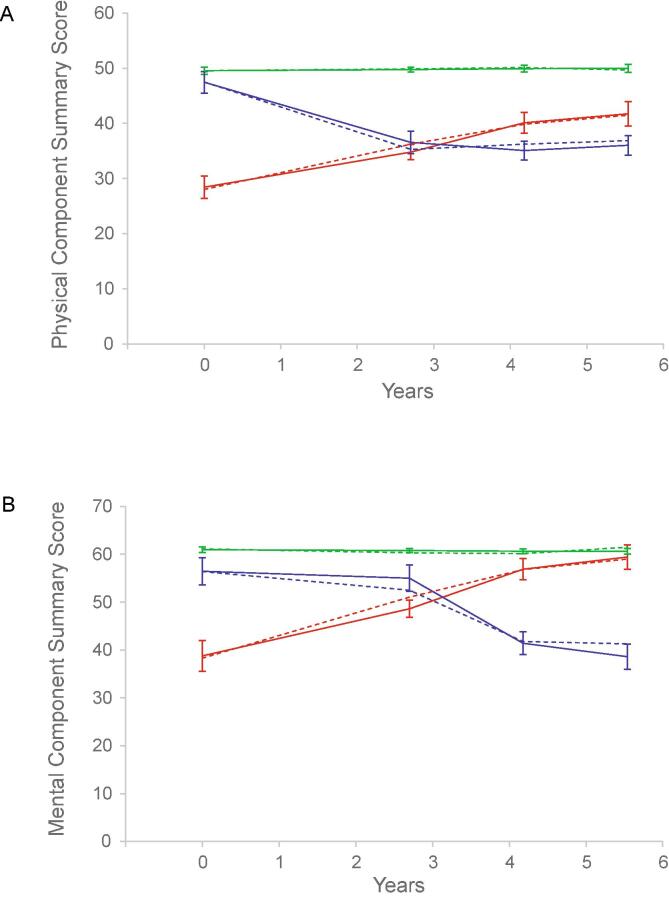
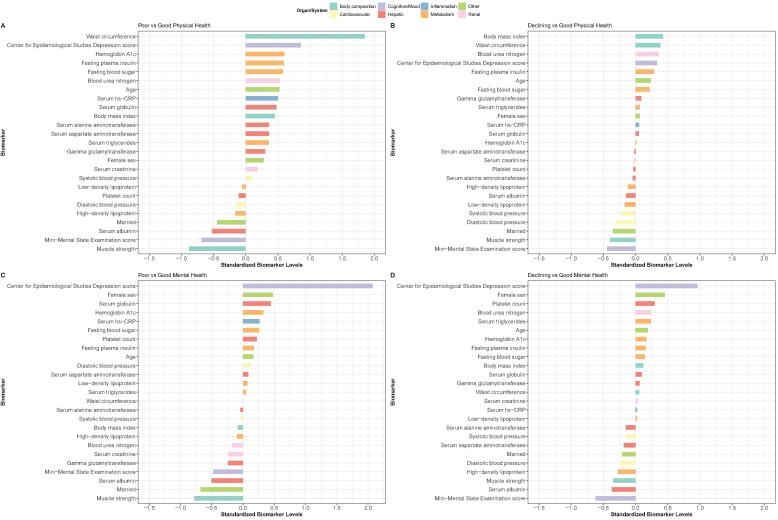
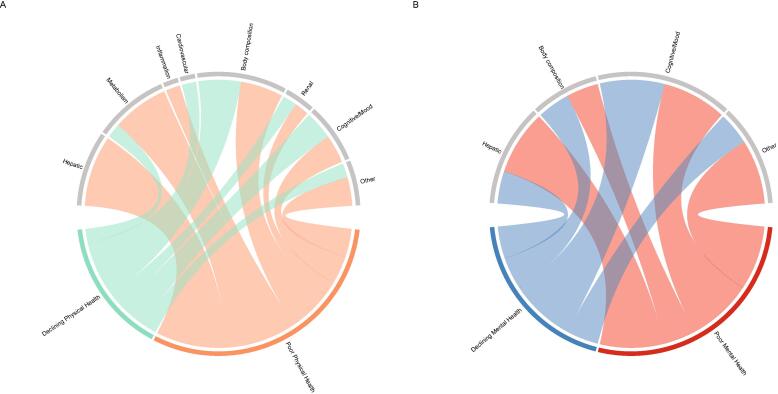
Despite the increasing health burden of chronic hepatitis B (CHB) in aging populations, little is known about the course of health-related quality of life (HRQoL) changes. We aimed to assess individual-level longitudinal HRQoL changes in elderly patients with CHB and to examine their correlates. A prospective 5.1 years-cohort study was conducted in community-dwelling adults aged 55 years with hepatitis B surface antigen-positive. Participants underwent serial measurement of HRQoL using the short-form (12) health survey version 2. Of 503 participants, 82.7% remained in good physical health throughout the study period, whereas 9.1% had declining physical health and 8.2% were in poor physical health. We likewise identified three trajectories of mental health changes ("good mental health" [86.9%], "declining mental health" [6.8%], and "poor mental health" [6.4%]). Three baseline characteristics were independently associated with a lower likelihood of remaining physically or mentally healthy: sarcopenic obesity (odds ratio [OR] with 95% confidence interval [95% CI] of 7.5 [2.8-20.5] for poor physical health, 3.1 [1.1-8.4] for declining physical health, 4.3 [1.4-13.0] for poor mental health), a higher number of metabolic abnormalities (OR [95% CI] of 3.6 [1.6-8.0] for poor physical health) and depressed mood (OR [95% CI] of 21.7 [5.8-81.0] for poor physical health, 5.3 [1.4-19.9] for declining physical health, 83.1 [19.7-350.2] for poor mental health, 13.6 [2.9-64.8] for declining mental health). In conclusion, in a cohort of elderly patients with CHB, we demonstrated the heterogeneity and nonlinearity of HRQoL changes and their associations with variations in specific extrahepatic organs/systems.
尽管慢性乙型肝炎(CHB)在老年人群中的健康负担日益加重,但对于健康相关生活质量(HRQoL)变化的过程却知之甚少。我们旨在评估老年CHB患者个体层面的HRQoL纵向变化,并探究其相关因素。对社区居住的55岁及以上乙肝表面抗原阳性成年人进行了一项为期5.1年的前瞻性队列研究。参与者使用简短健康调查问卷第2版对HRQoL进行了系列测量。在503名参与者中,82.7%在整个研究期间身体健康状况良好,而9.1%的人身体健康状况下降,8.2%的人身体健康状况较差。我们同样确定了心理健康变化的三种轨迹(“心理健康良好”[86.9%]、“心理健康下降”[6.8%]和“心理健康较差”[6.4%])。三个基线特征与身体或心理健康状况良好的可能性较低独立相关:肌少性肥胖(身体健康较差时的比值比[OR]及95%置信区间[95%CI]为7.5[2.8 - 20.5],身体健康下降时为3.1[1.1 - 8.4],心理健康较差时为4.3[1.4 - 13.0])、更多的代谢异常(身体健康较差时的OR[95%CI]为3.6[1.6 - 8.0])以及情绪低落(身体健康较差时的OR[95%CI]为21.7[5.8 - 81.0],身体健康下降时为5.3[1.4 - 19.9],心理健康较差时为83.1[19.7 - 350.2],心理健康下降时为13.6[2.9 - 64.8])。总之,在一组老年CHB患者中,我们证明了HRQoL变化的异质性和非线性及其与特定肝外器官/系统变化的关联。