Department of Neurology, Dongguk University Ilsan Hospital, Dongguk University College of Medicine, Goyang, Republic of Korea.
Department of Neurology, Samsung Medical Center, Sungkyunkwan University School of Medicine, 81 Irwon-ro, Gangnam-gu, Seoul, 06351, Republic of Korea.
Alzheimers Res Ther. 2021 Jun 21;13(1):117. doi: 10.1186/s13195-021-00854-z.
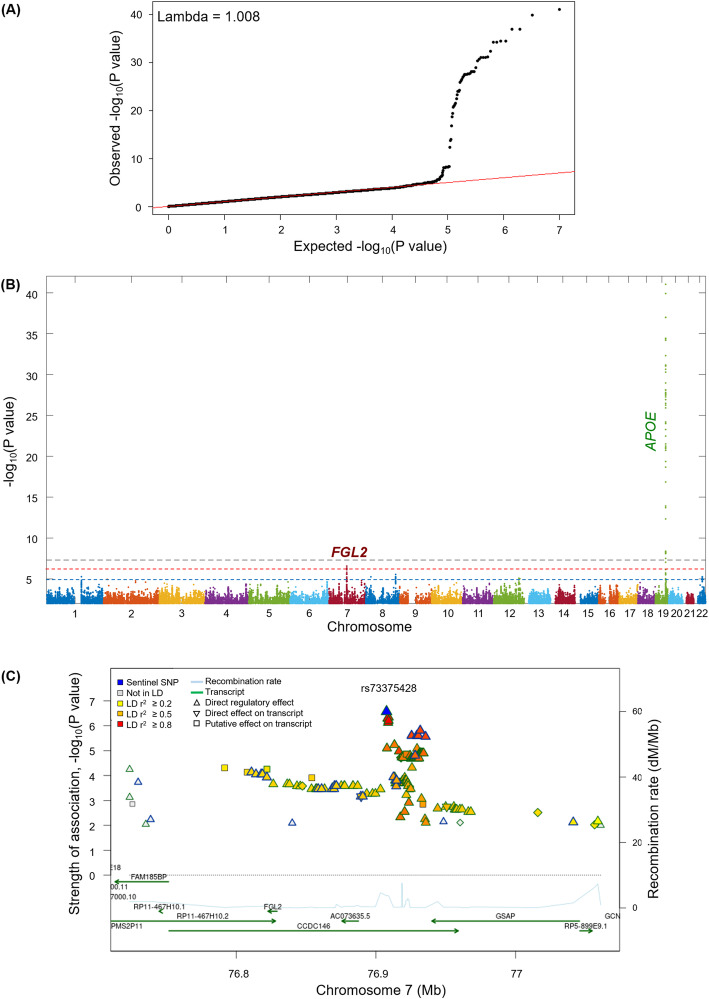
Genome-wide association studies (GWAS) have identified a number of genetic variants for Alzheimer's disease (AD). However, most GWAS were conducted in individuals of European ancestry, and non-European populations are still underrepresented in genetic discovery efforts. Here, we performed GWAS to identify single nucleotide polymorphisms (SNPs) associated with amyloid β (Aβ) positivity using a large sample of Korean population.
One thousand four hundred seventy-four participants of Korean ancestry were recruited from multicenters in South Korea. Discovery dataset consisted of 1190 participants (383 with cognitively unimpaired [CU], 330 with amnestic mild cognitive impairment [aMCI], and 477 with AD dementia [ADD]) and replication dataset consisted of 284 participants (46 with CU, 167 with aMCI, and 71 with ADD). GWAS was conducted to identify SNPs associated with Aβ positivity (measured by amyloid positron emission tomography). Aβ prediction models were developed using the identified SNPs. Furthermore, bioinformatics analysis was conducted for the identified SNPs.
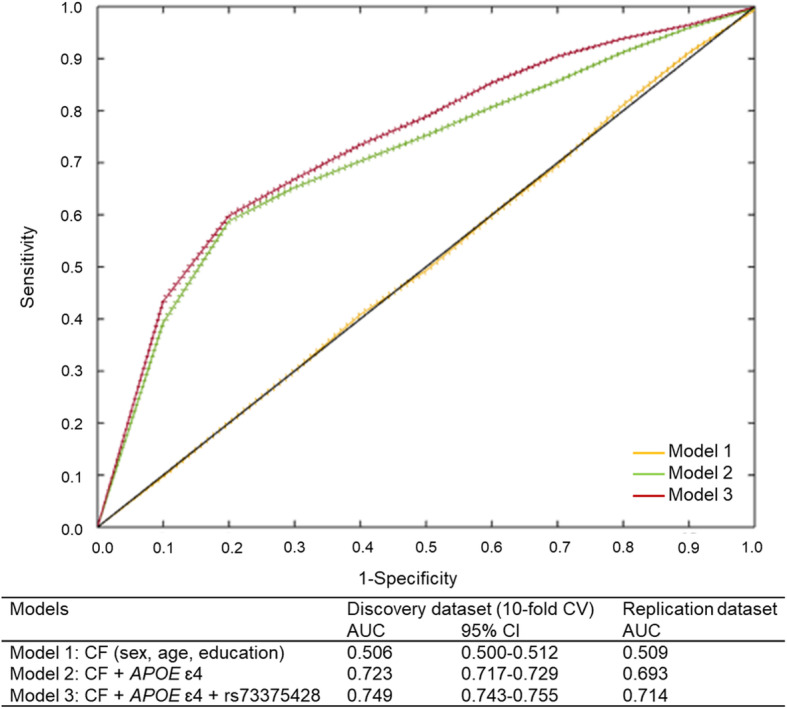
In addition to APOE, we identified nine SNPs on chromosome 7, which were associated with a decreased risk of Aβ positivity at a genome-wide suggestive level. Of these nine SNPs, four novel SNPs (rs73375428, rs2903923, rs3828947, and rs11983537) were associated with a decreased risk of Aβ positivity (p < 0.05) in the replication dataset. In a meta-analysis, two SNPs (rs7337542 and rs2903923) reached a genome-wide significant level (p < 5.0 × 10). Prediction performance for Aβ positivity increased when rs73375428 were incorporated (area under curve = 0.75; 95% CI = 0.74-0.76) in addition to clinical factors and APOE genotype. Cis-eQTL analysis demonstrated that the rs73375428 was associated with decreased expression levels of FGL2 in the brain.
The novel genetic variants associated with FGL2 decreased risk of Aβ positivity in the Korean population. This finding may provide a candidate therapeutic target for AD, highlighting the importance of genetic studies in diverse populations.
全基因组关联研究(GWAS)已经确定了许多与阿尔茨海默病(AD)相关的遗传变异。然而,大多数 GWAS 都是在欧洲血统的个体中进行的,而在遗传发现工作中,非欧洲人群的代表性仍然不足。在这里,我们使用大量韩国人群进行了 GWAS,以鉴定与淀粉样β(Aβ)阳性相关的单核苷酸多态性(SNP)。
我们从韩国的多个中心招募了 1474 名韩国血统的参与者。发现数据集包括 1190 名参与者(383 名认知正常[CU],330 名遗忘型轻度认知障碍[aMCI],477 名 AD 痴呆[ADD]),复制数据集包括 284 名参与者(46 名 CU,167 名 aMCI,71 名 ADD)。进行 GWAS 以鉴定与 Aβ阳性相关的 SNP(通过淀粉样蛋白正电子发射断层扫描测量)。使用鉴定出的 SNP 开发 Aβ预测模型。此外,还对鉴定出的 SNP 进行了生物信息学分析。
除了 APOE 之外,我们还在 7 号染色体上鉴定出了 9 个 SNP,这些 SNP 与全基因组提示水平的 Aβ阳性风险降低有关。在这 9 个 SNP 中,有 4 个新的 SNP(rs73375428、rs2903923、rs3828947 和 rs11983537)与复制数据集的 Aβ阳性风险降低相关(p < 0.05)。在荟萃分析中,有两个 SNP(rs7337542 和 rs2903923)达到了全基因组显著水平(p < 5.0×10)。当将 rs73375428 纳入临床因素和 APOE 基因型之外时,Aβ阳性的预测性能提高(曲线下面积=0.75;95%CI=0.74-0.76)。顺式-eQTL 分析表明,rs73375428 与大脑中 FGL2 表达水平降低有关。
与 FGL2 相关的新型遗传变异降低了韩国人群中 Aβ阳性的风险。这一发现可能为 AD 提供了一个候选治疗靶点,凸显了在不同人群中进行遗传研究的重要性。