TMS Clinical and Research Service, Neuromodulation Division, Semel Institute for Neuroscience and Human Behavior, and the Department of Psychiatry and Biobehavioral Sciences, David Geffen School of Medicine at UCLA, 760 Westwood Plaza, Los Angeles, CA 90024, USA.
Division of the Humanities and Social Sciences, California Institute of Technology, Pasadena, CA 91125, USA.
Psychol Med. 2023 Feb;53(3):823-832. doi: 10.1017/S0033291721002178. Epub 2021 Jun 22.
Major depressive disorder (MDD) and chronic pain are highly comorbid, and pain symptoms are associated with a poorer response to antidepressant medication treatment. It is unclear whether comorbid pain also is associated with a poorer response to treatment with repetitive transcranial magnetic stimulation (rTMS).
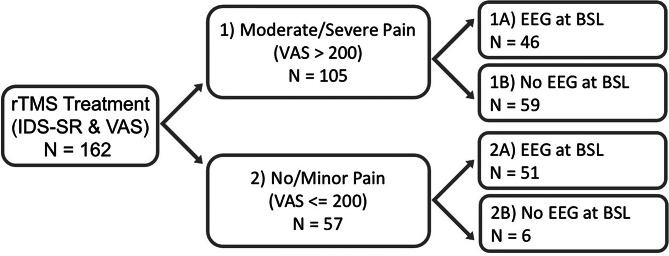
162 MDD subjects received 30 sessions of 10 Hz rTMS treatment administered to the left dorsolateral prefrontal cortex (DLPFC) with depression and pain symptoms measured before and after treatment. For a subset of 96 patients, a resting-state electroencephalogram (EEG) was recorded at baseline. Clinical outcome was compared between subjects with and without comorbid pain, and the relationships among outcome, pain severity, individual peak alpha frequency (PAF), and PAF phase-coherence in the EEG were examined.
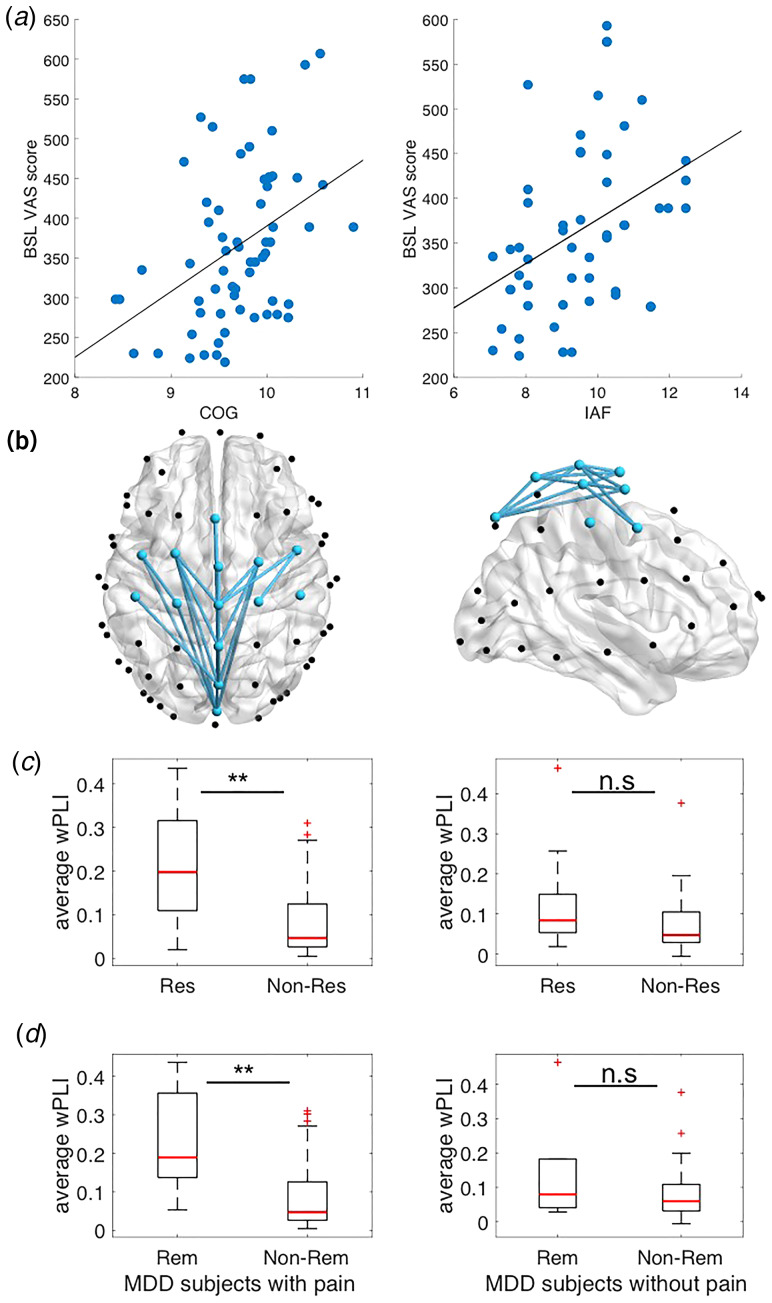
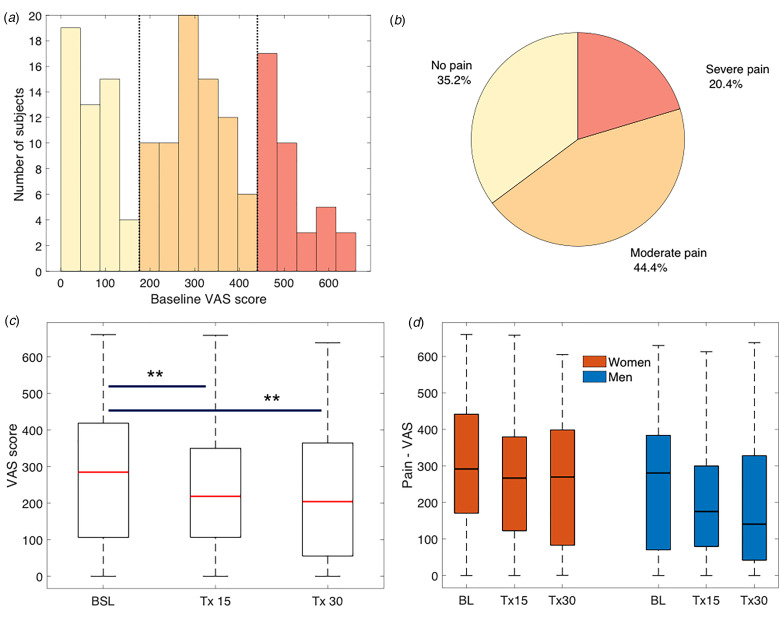
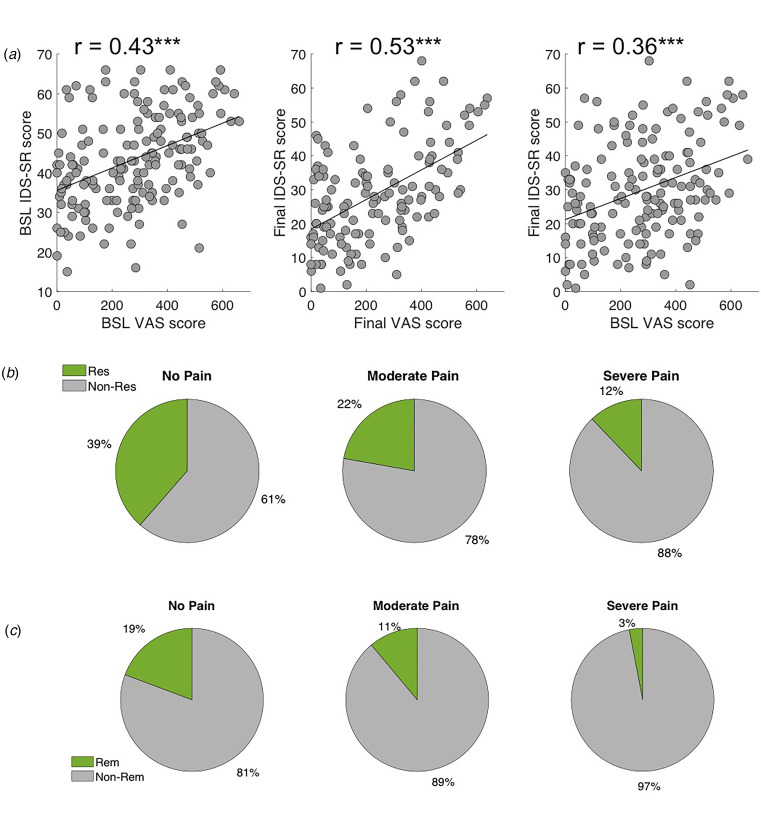
64.8% of all subjects reported pain, and both depressive and pain symptoms were significantly reduced after rTMS treatment, irrespective of age or gender. Patients with severe pain were 27% less likely to respond to MDD treatment than pain-free individuals. PAF was positively associated with pain severity. PAF phase-coherence in the somatosensory and default mode networks was significantly lower for MDD subjects with pain who failed to respond to MDD treatment.
Pain symptoms improved after rTMS to left DLPFC in MDD irrespective of age or gender, although the presence of chronic pain symptoms reduced the likelihood of treatment response. Individual PAF and baseline phase-coherence in the sensorimotor and midline regions may represent predictors of rTMS treatment outcome in comorbid pain and MDD.
重度抑郁症(MDD)和慢性疼痛高度共病,疼痛症状与抗抑郁药治疗反应较差相关。目前尚不清楚共病疼痛是否也与重复经颅磁刺激(rTMS)治疗反应较差相关。
162 名 MDD 患者接受了 30 次 10 Hz rTMS 治疗,刺激部位为左侧背外侧前额叶皮质(DLPFC),在治疗前后测量抑郁和疼痛症状。对于 96 名患者中的一部分,在基线时记录静息状态脑电图(EEG)。比较伴或不伴共病疼痛患者的临床疗效,并考察疗效与疼痛严重程度、个体峰 alpha 频率(PAF)以及 EEG 中 PAF 相位相干性之间的关系。
所有患者中有 64.8%报告有疼痛,rTMS 治疗后抑郁和疼痛症状均显著减轻,与年龄或性别无关。疼痛严重的患者对 MDD 治疗的反应可能性比无疼痛的个体低 27%。PAF 与疼痛严重程度呈正相关。对 MDD 治疗反应不佳的伴疼痛 MDD 患者,体感和默认模式网络的 PAF 相位相干性显著降低。
无论年龄或性别如何,rTMS 治疗左侧 DLPFC 均可改善 MDD 患者的疼痛症状,但慢性疼痛症状的存在降低了治疗反应的可能性。个体 PAF 和基线时体感和中线区域的相位相干性可能是伴疼痛 MDD 患者 rTMS 治疗疗效的预测指标。