Tunthanathip Thara, Oearsakul Thakul, Tanvejsilp Pimwara, Sae-Heng Sakchai, Kaewborisutsakul Anukoon, Madteng Suphavadee, Inkate Srirat
Division of Neurosurgery, Department of Surgery, Faculty of Medicine, Prince of Songkla University, HatYai, Songkhla, Thailand.
Department of Pharmacy Administration, Faculty of Pharmaceutical Sciences, Prince of Songkla University, HatYai, Songkhla, Thailand.
Surg J (N Y). 2021 Jun 17;7(2):e100-e110. doi: 10.1055/s-0041-1726426. eCollection 2021 Apr.
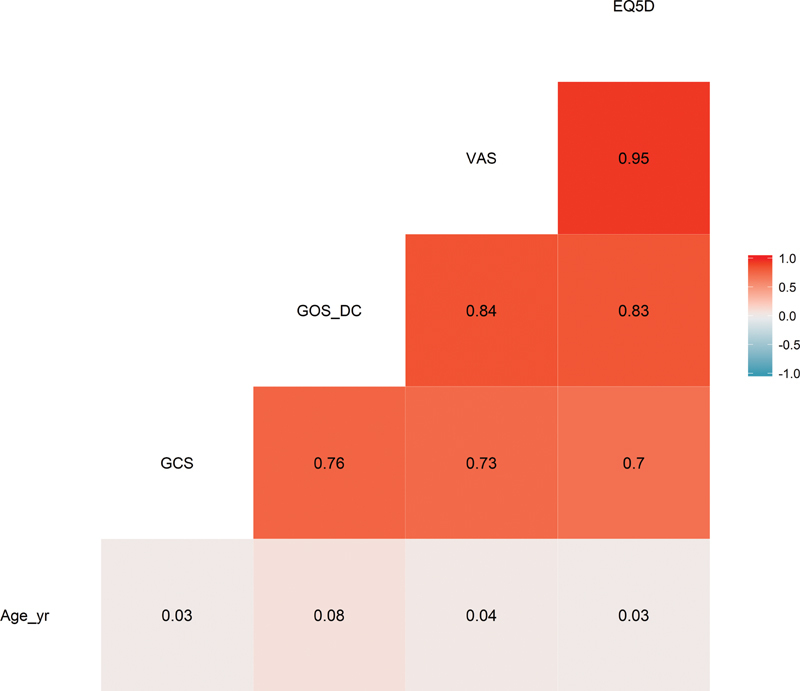
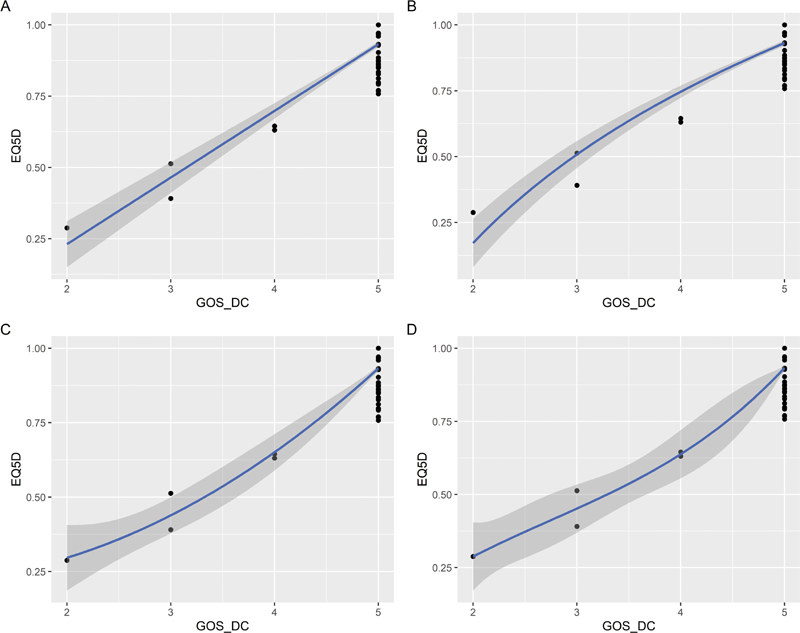
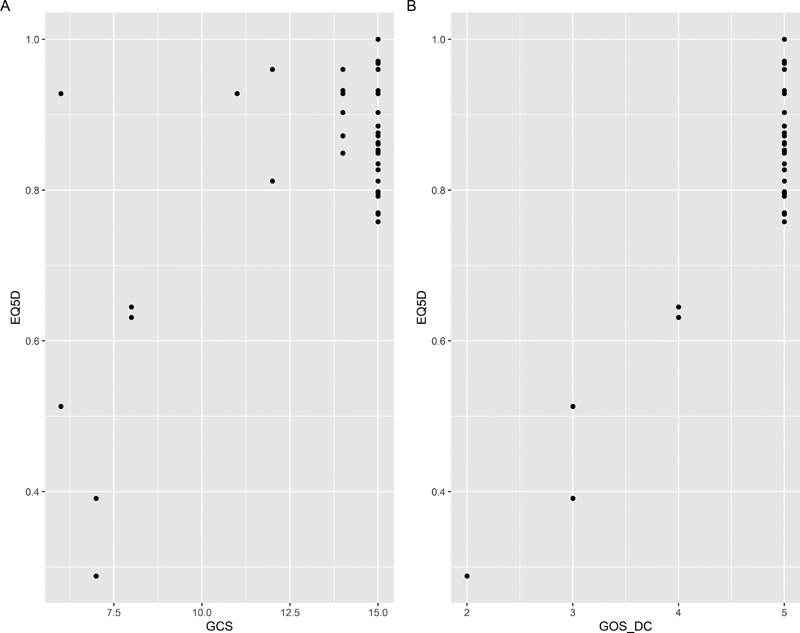
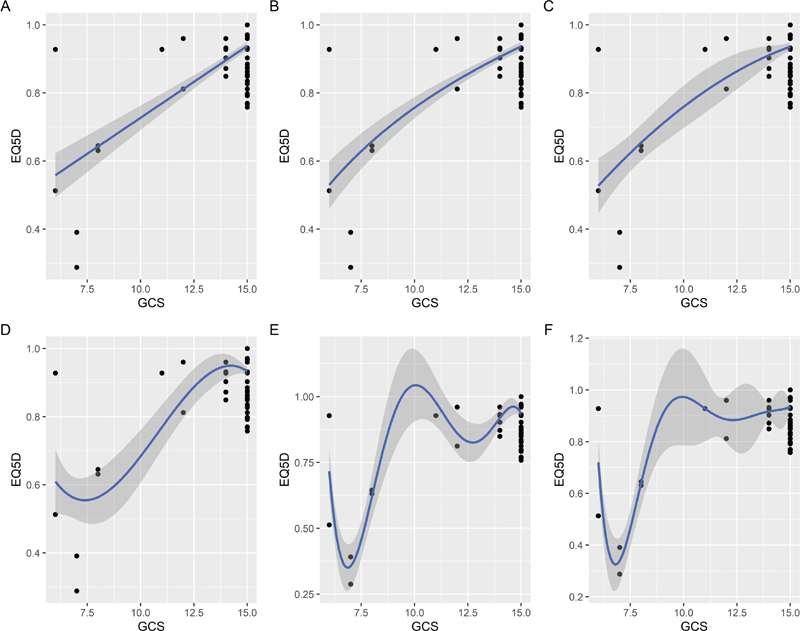
Traumatic brain injury (TBI) commonly causes death and disability that can result in productivity loss and economic burden. The health-related quality of life (HRQoL) has been measured in patients suffering from TBI, both in clinical and socioeconomic perspectives. The study aimed to assess the HRQoL in patients following TBI using the European quality of life measure-5 domain-5 level (EQ-5D-5L) questionnaire and develop models for predicting the EQ-5D-5L index score in patients with TBI. A cross-sectional study was performed with 193 TBI patients who had completed the EQ-5D-5L questionnaire. The clinical characteristics, Glasgow coma scale (GCS) score, treatment, and Glasgow outcome scale (GOS) were collected. The total data was divided into training data (80%) and testing data (20%); hence, the factors affecting the EQ-5D-5L index scores were used to develop the predictive model with linear and nonlinear regression. The performances of the predictive models were estimated with the adjusted coefficient of determination (R ) and the root mean square error (RMSE). A good recovery was found at 96.4%, while 2.1% displayed an unfavorable outcome. Moreover, the mean EQ-5D-5L index scores were 0.91558 (standard deviation [SD] 1.09639). GCS score, pupillary light reflex, surgery, and GOS score significantly correlated with the HRQoL scores. The multiple linear regression model had a high adjusted R of 0.6971 and a low RMSE of 0.06701, while the polynomial regression developed a nonlinear model that had the highest adjusted R of 0.6843 and the lowest RMSE of 0.06748. A strong positive correlation between the physician-based outcome as GOS and HRQoL was observed. Furthermore, both the linear and nonlinear regression models were acceptable approaches to predict the HRQoL of patients after TBI. There would be limitations for estimating the HRQoL in unconscious or intubated patients. The HRQoL obtained from the predictive models would be an alternative method to resolve this problem.
创伤性脑损伤(TBI)常导致死亡和残疾,进而造成生产力损失和经济负担。人们已从临床和社会经济角度对TBI患者的健康相关生活质量(HRQoL)进行了评估。本研究旨在使用欧洲生活质量量表5维度5水平(EQ - 5D - 5L)问卷评估TBI患者的HRQoL,并建立预测TBI患者EQ - 5D - 5L指数得分的模型。
对193名完成EQ - 5D - 5L问卷的TBI患者进行了横断面研究。收集了临床特征、格拉斯哥昏迷量表(GCS)评分、治疗情况和格拉斯哥预后量表(GOS)。将全部数据分为训练数据(80%)和测试数据(20%);因此,使用影响EQ - 5D - 5L指数得分的因素通过线性和非线性回归建立预测模型。用调整后的决定系数(R )和均方根误差(RMSE)评估预测模型的性能。
结果发现,96.4%的患者恢复良好,而2.1%的患者预后不佳。此外,EQ - 5D - 5L指数得分的平均值为0.91558(标准差[SD]为1.09639)。GCS评分、瞳孔对光反射、手术和GOS评分与HRQoL得分显著相关。多元线性回归模型的调整后R 为0.6971,RMSE为0.06701,而多项式回归建立的非线性模型调整后R 最高,为0.6843,RMSE最低,为0.06748。
观察到基于医生评估结果的GOS与HRQoL之间存在强正相关。此外,线性和非线性回归模型都是预测TBI后患者HRQoL的可接受方法。对于评估昏迷或插管患者的HRQoL存在局限性。从预测模型获得的HRQoL将是解决这一问题的替代方法。