Yumani Dana F J, Lafeber Harrie N, van Weissenbruch Mirjam M
Amsterdam UMC, VU University Medical Center, Department of Pediatrics, Amsterdam 1081 HV, the Netherlands.
J Endocr Soc. 2021 Jun 18;5(7):bvab089. doi: 10.1210/jendso/bvab089. eCollection 2021 Jul 1.
There are concerns that a higher fat mass in the early life of preterm infants is associated with adverse cardiometabolic outcomes in young adulthood.
To investigate the role of IGF-I and growth in determining body composition of preterm infants at term equivalent age.
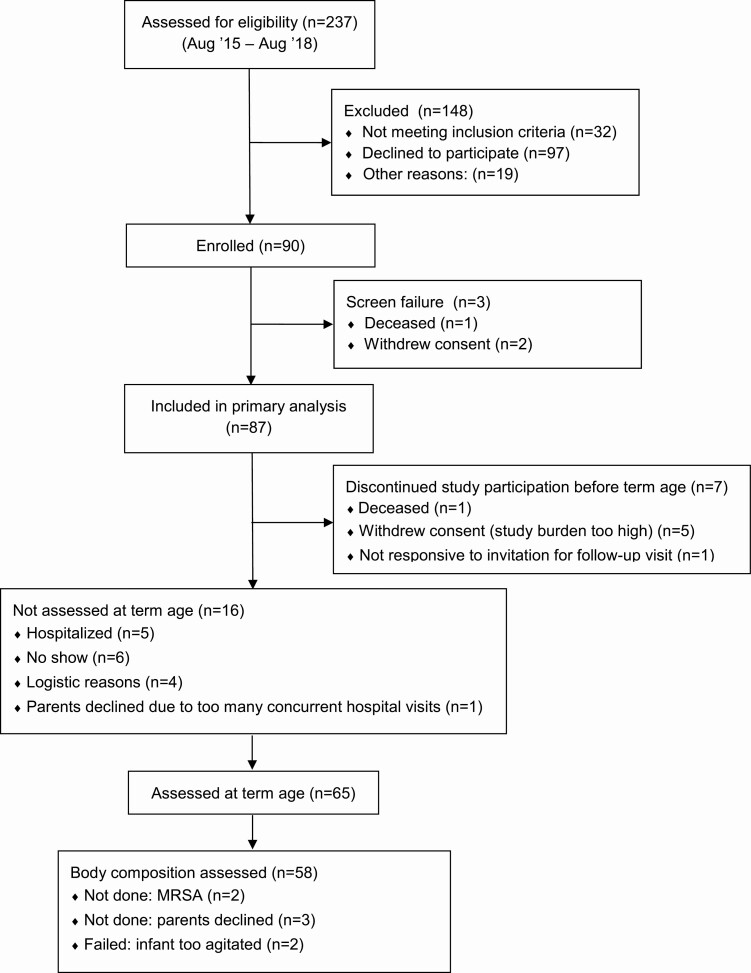
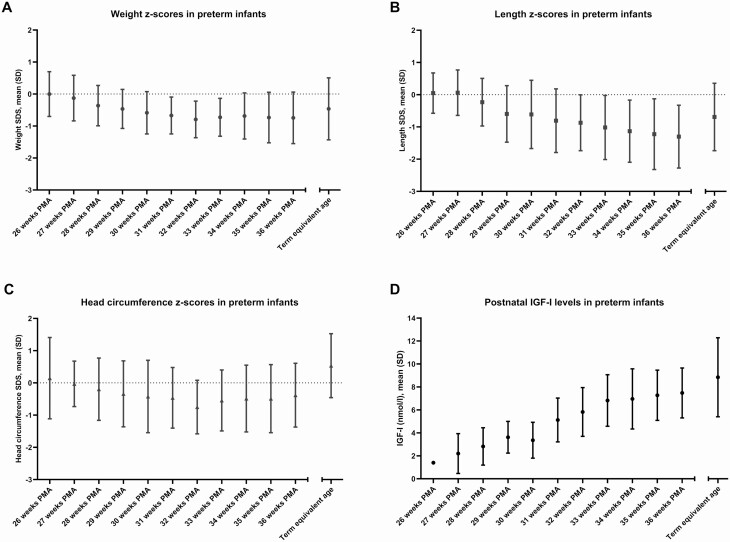
An observational study was conducted from August 2015 to August 2018. From birth to term equivalent age, IGF-I levels were measured bi-weekly and growth was assessed weekly. At term equivalent age, body composition was assessed through air displacement plethysmography; 65 infants with a gestational age of 24 to 32 weeks were assessed at term equivalent age, of whom 58 completed body composition measurement. The main outcome measures were fat (free) mass (g) and fat (free) mass percentage at term equivalent age.
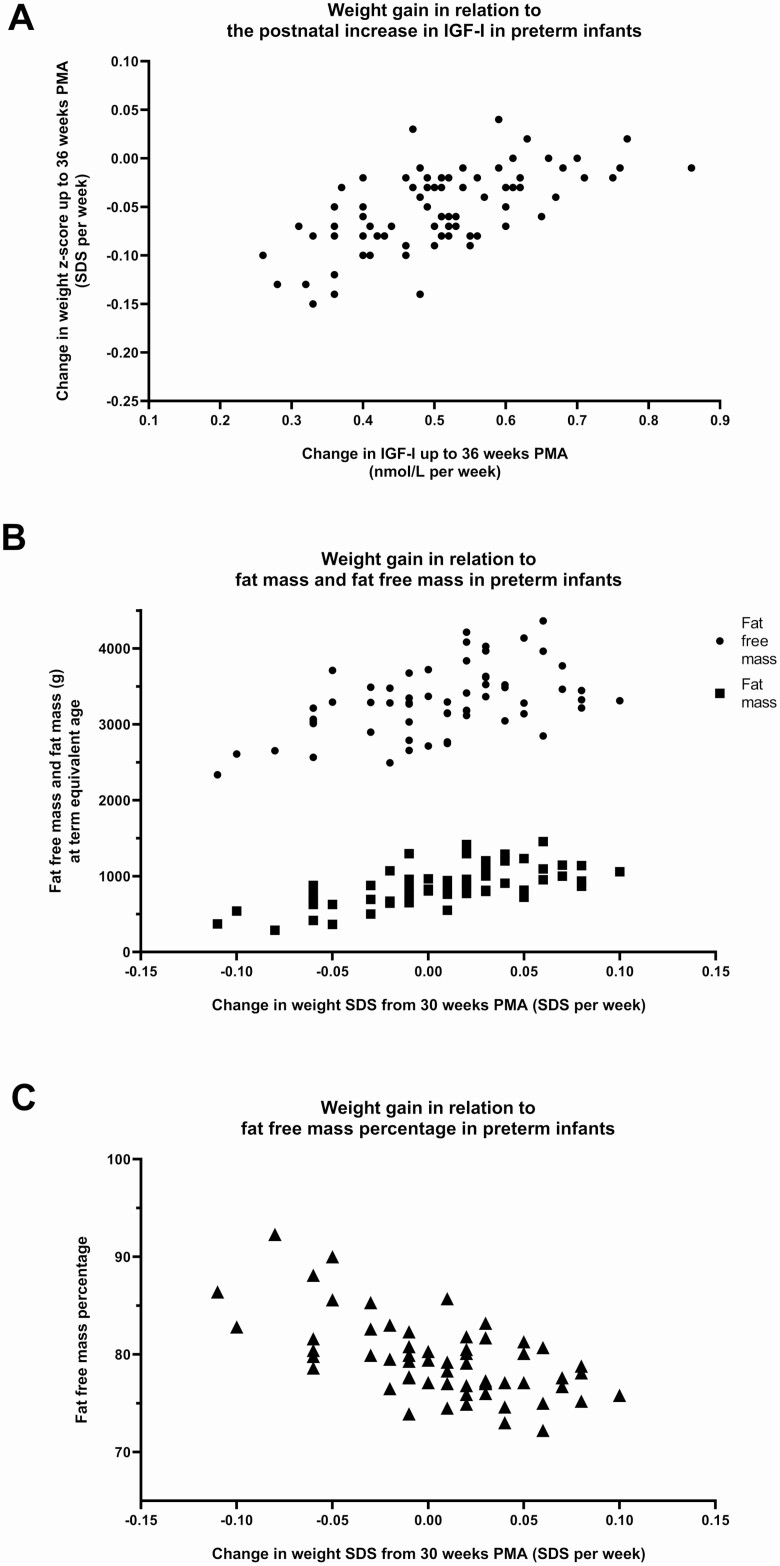
In the first month of life, each 0.1 nmol/L per week increase in IGF-I was associated with a 465 g (SE 125 g) increase in fat free mass. A greater increase in weight SDS in the first month of life was associated with a higher fat free mass percentage (B 200.9; 95% CI, 12.1-389.6). A higher head circumference SDS was associated with more fat free mass ( = 0.46; 95% CI, 0.21-0.65). However, a greater increase in weight SDS up to term equivalent age was associated with a lower fat free mass percentage (B -55.7, SE 9.4).
These findings suggest that impaired growth in the first month of life is associated with a less favorable body composition at term equivalent age.
有人担心早产婴儿早期较高的脂肪量与成年早期不良的心脏代谢结果有关。
研究胰岛素样生长因子-I(IGF-I)和生长在确定足月等效年龄早产婴儿身体成分中的作用。
于2015年8月至2018年8月进行了一项观察性研究。从出生到足月等效年龄,每两周测量一次IGF-I水平,每周评估一次生长情况。在足月等效年龄时,通过空气置换体积描记法评估身体成分;对65名胎龄为24至32周的婴儿在足月等效年龄时进行评估,其中58名完成了身体成分测量。主要结局指标为足月等效年龄时的脂肪(去脂)量(克)和脂肪(去脂)量百分比。
在生命的第一个月,IGF-I每周每增加0.1 nmol/L与去脂量增加465克(标准误125克)相关。生命第一个月体重标准差增加幅度越大,去脂量百分比越高(B 200.9;95%可信区间,12.1 - 389.6)。头围标准差越高,去脂量越多(β = 0.46;95%可信区间,0.21 - 0.65)。然而,直至足月等效年龄体重标准差增加幅度越大,去脂量百分比越低(B -55.7,标准误9.4)。
这些发现表明,生命第一个月生长受损与足月等效年龄时不太理想的身体成分有关。