Li Long-Jun, Gu Ya-Juan, Wang Lu-Qiao, Wan Wen, Wang Hua-Wei, Yang Xiao-Na, Ma Lin-Ling, Yang Li-Hong, Meng Zhao-Hui
Laboratory of Molecular Cardiology, Department of Cardiology, The First Affiliated Hospital of Kunming Medical University, Kunming, China.
J Thorac Dis. 2021 May;13(5):3105-3114. doi: 10.21037/jtd-21-609.
Circulating microRNAs (miRNAs) have emerged as potential biomarkers for cardiovascular diseases. However, few studies have focused on the role of exosomal miRNAs in acute coronary syndrome (ACS). The purpose of this study was to explore weather serum exosomal microRNA-146a (exo-miR-146a) could be used as a novel diagnostic biomarker for ACS and to investigate its relationship with inflammatory response.
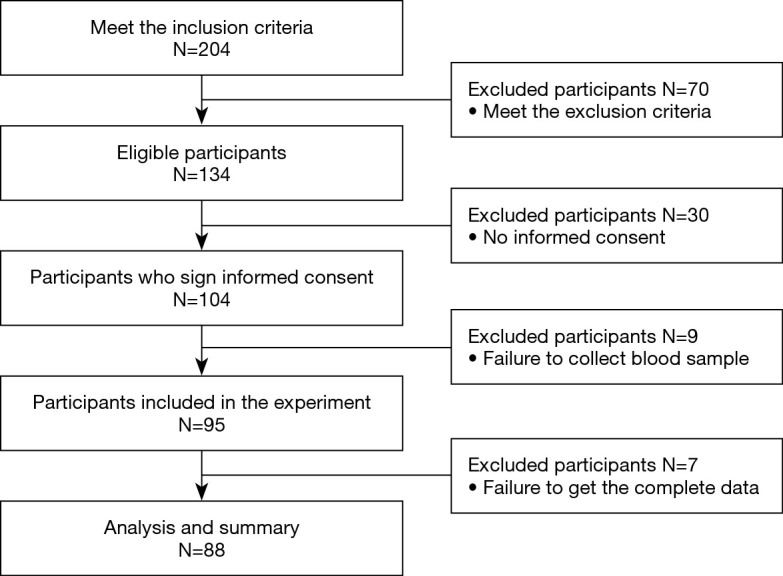
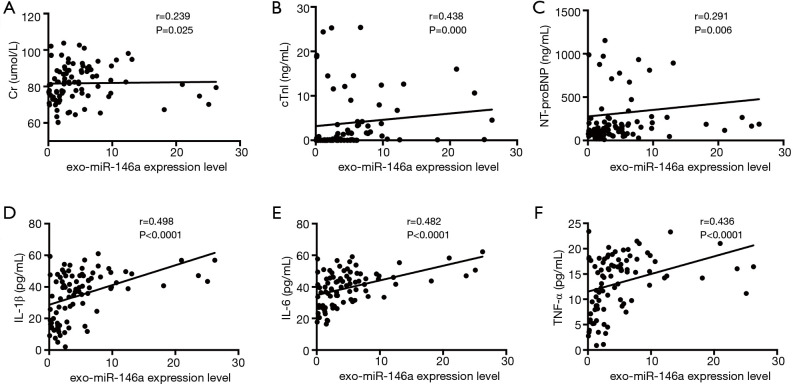
A total of 63 ACS patients and 25 patients with normal coronary arteries (Control) were enrolled respectively. The serum exosomes were isolated and then identified by transmission electron microscopy (TEM), western blot, and nanoparticle tracking analysis (NTA). The expression levels of exo-miR-146a in serum were detected by real-time quantitative polymerase chain reaction (RT-qPCR) and the expression levels of interleukin-1β (IL-1β), interleukin-6 (IL-6), and tumor necrosis factor-α (TNF-α) in serum were assessed by enzyme-linked immunosorbent assay (ELISA). Spearman's correlation analysis was used to appraise the potential factors related to serum exo-miR-146a and receiver operating characteristic (ROC) curve analysis was applied for predicting the accuracy of ACS via the area under curve (AUC).
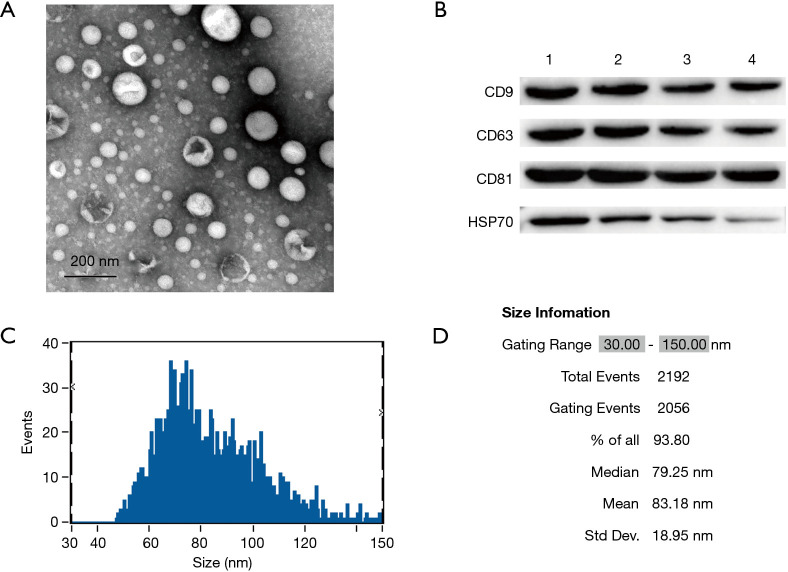
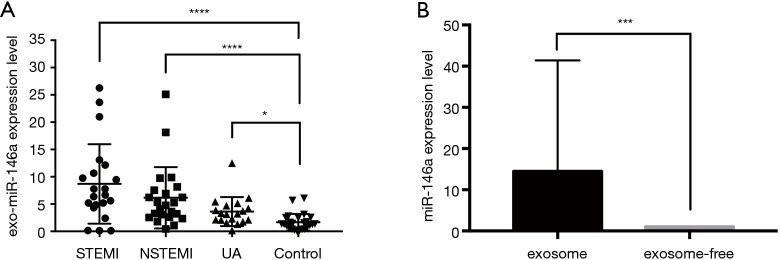
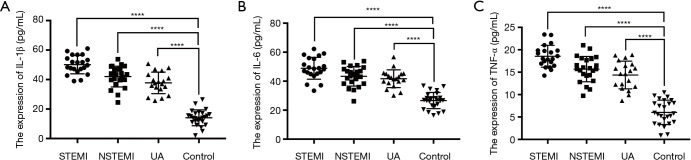
Exosomes isolated from serum were of typical cup-like shape, with 50-150 nm diameter, and expressed CD9, CD63, CD81, and HSP70. The expression levels of serum exo-miR-146a, IL-1β, IL-6, and TNF-α were significantly increased in ACS patients compared with the control group, Spearman's correlation analysis indicated that exo-miR-146a expression was markedly positively correlated with IL-1β, IL-6, and TNF-α. The ROC curve analyses revealed that exo-miR-146a could distinguish ACS patients from their normal controls.
The serum exo-miR-146a may be used as a novel diagnostic biomarker for ACS patients, and it is also associated with inflammatory response.
循环微小RNA(miRNA)已成为心血管疾病的潜在生物标志物。然而,很少有研究关注外泌体miRNA在急性冠状动脉综合征(ACS)中的作用。本研究的目的是探讨血清外泌体微小RNA-146a(exo-miR-146a)是否可作为ACS的新型诊断生物标志物,并研究其与炎症反应的关系。
分别纳入63例ACS患者和25例冠状动脉正常的患者(对照组)。分离血清外泌体,然后通过透射电子显微镜(TEM)、蛋白质印迹法和纳米颗粒跟踪分析(NTA)进行鉴定。通过实时定量聚合酶链反应(RT-qPCR)检测血清中exo-miR-146a的表达水平,并通过酶联免疫吸附测定(ELISA)评估血清中白细胞介素-1β(IL-1β)、白细胞介素-6(IL-6)和肿瘤坏死因子-α(TNF-α)的表达水平。采用Spearman相关性分析评估与血清exo-miR-146a相关的潜在因素,并应用受试者工作特征(ROC)曲线分析通过曲线下面积(AUC)预测ACS的准确性。
从血清中分离出的外泌体呈典型的杯状,直径为50-150nm,并表达CD9、CD63、CD81和HSP70。与对照组相比,ACS患者血清exo-miR-146a、IL-1β、IL-6和TNF-α的表达水平显著升高,Spearman相关性分析表明exo-miR-146a表达与IL-1β、IL-6和TNF-α显著正相关。ROC曲线分析显示,exo-miR-146a可区分ACS患者和正常对照。
血清exo-miR-146a可能作为ACS患者的新型诊断生物标志物,并且它还与炎症反应相关。