Bernáth-Nagy Dominika, Kalinyaprak Melek Sükran, Giannitsis Evangelos, Ábrahám Pál, Leuschner Florian, Frey Norbert, Krohn Jona Benjamin
Heart and Vascular Centre, Semmelweis University, Budapest, Hungary.
Department of Cardiology, Angiology and Pneumology, University Hospital Heidelberg, Heidelberg, Germany.
Front Cardiovasc Med. 2024 Sep 2;11:1425159. doi: 10.3389/fcvm.2024.1425159. eCollection 2024.
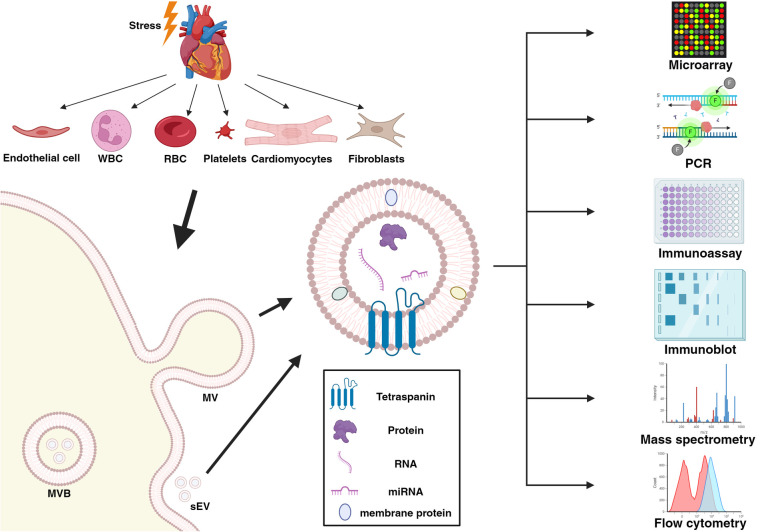
Cardiovascular disease (CVD) ranks among the primary contributors to worldwide mortality. Hence, the importance of constant research on new circulating biomarkers for the improvement of early diagnosis and prognostication of different CVDs and the development and refinement of therapeutic measures is critical. Extracellular vesicles (EV) have a great potential as diagnostic and prognostic markers, as they represent their parent cell by enclosing cell-specific molecules, which can differ in quality and quantity based on cell state. Assuming that all cell types of the cardiovascular system are capable of releasing EV into circulation, an emerging body of evidence has investigated the potential role of serum- or plasma-derived EV in CVD. Comprehensive research has unveiled alterations in EV quantity and EV-bound cargo in the form of RNA, proteins and lipids in the context of common CVDs such as coronary artery disease, atrial fibrillation, heart failure or inflammatory heart diseases, highlighting their diagnostic and prognostic relevance. In numerous and models, EV also showed promising therapeutic potential. However, translation of EV studies to a preclinical or clinical setting has proven to be challenging. This review is intended to provide an overview of the most relevant studies in the field of serum or plasma-derived EV.
心血管疾病(CVD)是全球死亡率的主要促成因素之一。因此,持续研究新的循环生物标志物对于改善不同心血管疾病的早期诊断和预后以及治疗措施的开发和完善至关重要。细胞外囊泡(EV)作为诊断和预后标志物具有巨大潜力,因为它们通过包裹细胞特异性分子来代表其母细胞,这些分子的质量和数量会因细胞状态而异。假设心血管系统的所有细胞类型都能够将EV释放到循环中,越来越多的证据研究了血清或血浆来源的EV在心血管疾病中的潜在作用。全面研究揭示了在常见心血管疾病(如冠状动脉疾病、心房颤动、心力衰竭或炎症性心脏病)的背景下,EV数量以及以RNA、蛋白质和脂质形式存在的与EV结合的货物的变化,突出了它们在诊断和预后方面的相关性。在众多体外和体内模型中,EV也显示出有前景的治疗潜力。然而,将EV研究转化为临床前或临床应用已被证明具有挑战性。本综述旨在概述血清或血浆来源的EV领域中最相关的研究。